
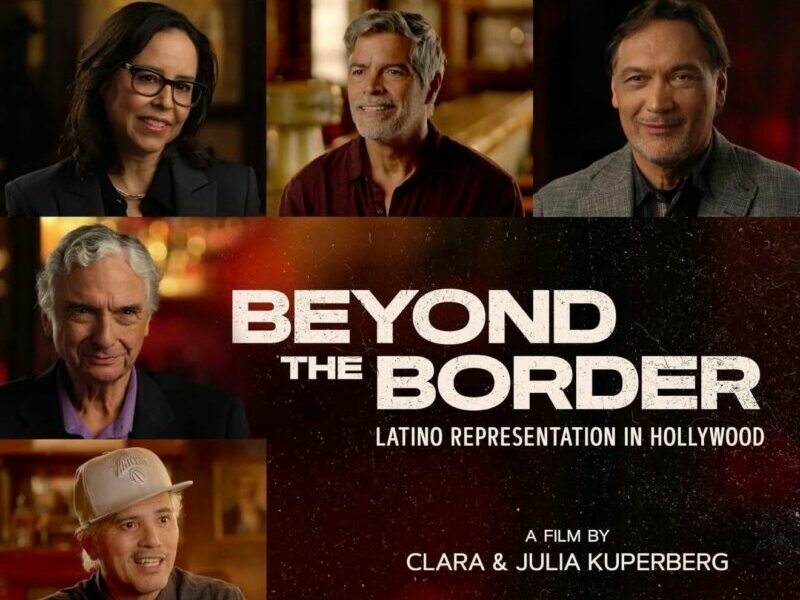
An Interview With ‘Beyond The Border: Latino Representation in Hollywood’ Co-Directors Clara And Julia Kuperberg
by Rachel Bellwoar
Latino representation has not always been great in Hollywood. Latino characters haven’t even always been played by Latino actors, and there’s still room for improvement. Julia Kuperberg and Clara Kuperberg‘s latest film Beyond the Border: Latino Representation in Hollywood gives Latinx creatives the chance to speak on it. For more on the documentary, check out this interview with the directing sisters below:

Rachel Bellwoar: Having directed multiple documentaries at this point, what keeps drawing you back to nonfiction filmmaking?
Julia and Clara Kuperberg: What keeps drawing us back is the opportunity to uncover stories that have been forgotten, overlooked or sometimes deliberately erased. Documentary filmmaking allows us to revisit history through the people who experienced it and to connect that history to the world we live in today. Even after making more than sixty documentaries, we still feel that sense of discovery every time we begin a new film. We learn with each project, and hopefully the audience makes that journey with us.
Bellwoar: Where did your interest in Hollywood history begin?
Kuperbergs: We grew up in France watching American movies, so Hollywood was part of our imagination long before we ever came to Los Angeles. But we were always as interested in what was happening behind the screen as in the films themselves: who was allowed to tell stories, who was excluded, and how Hollywood reflected, or distorted, American society. Over time, we realized that the history of Hollywood was also a way of telling the history of America.
Bellwoar: While some of your documentaries have been on specific people (like Ida Lupino and Gene Tierney), Beyond the Border covers a wider scope. Is one more challenging than the other?
Kuperbergs: They are challenging in very different ways. With a portrait of one person, the challenge is to go beyond the familiar image and reveal the complexity of that individual. With a subject as broad as Latino representation in Hollywood, the difficulty is deciding what story to tell within an enormous history that spans more than a century. It was also very important to us that the documentary give a voice exclusively to Latino filmmakers, actors and film historians, allowing them to tell this story from their own perspectives.
Bellwoar; Even in narrowing the focus to Hollywood movies, that’s still a lot of ground to cover. Was it difficult trying to edit it down to an hour and twenty minute runtime?
Kuperbergs: It was extremely difficult. There were so many films, performers, filmmakers and historical events we wanted to include. Every period could almost have become a documentary of its own.
The hardest part was removing material we loved without losing the historical progression of the film. We wanted to show how the same stereotypes kept reappearing in different forms, but also how Latino artists gradually challenged those images and created space for themselves. The editing process was really about finding the balance between history, film analysis and personal testimony.
Bellwoar: When did you first start working on this documentary, and has it been a long process?
Kuperbergs: The idea had been developing in our minds for quite some time before production officially began. Once we started researching, we realized how vast and largely untold this history was. The process involved extensive archival research, identifying the films and historical events that would shape the narrative, and finding the right people to tell that story.
It has been a long and very intensive process, particularly because the subject continues to evolve. Representation in Hollywood is not a closed chapter; it is still being debated and fought for today.
Bellwoar: Going into this project, were there certain people you knew wanted to reach out to from the start and what was it like getting to interview legends like Edward James Olmos?
Kuperbergs: There were definitely people we dreamed of including from the beginning, and people like Edward James Olmos, Jimmy Smits, Jose Zuniga, John Leguizamo, Esai Morales were among them. They are not only major figures in American cinema; their careers embody many of the struggles and changes explored in the documentary.
What made those conversations so powerful was their combination of personal experience and historical perspective. They could speak about the roles they were offered, the stereotypes they confronted and the ways they tried to change the industry from within. Interviewing people whose careers have helped transform what is possible for Latino performers was both moving and a tremendous privilege.
Bellwoar: As co-directors and sisters, is there a way you usually split the workload, or do you try and make all creative decisions as a team?
Kuperbergs: We make all the major creative decisions together. After working together for more than twenty years and making over sixty films, we know which of us is better at certain things, whether it’s writing, archival research or editing. So we divide the workload according to our individual strengths, while continuing to shape the film as a team.
Bellwoar: TCM is airing two films after Beyond the Border but are there any films you discovered over the course of working on this feature that you wish more people knew about?
Kuperbergs: We particularly discovered, or rediscovered, the films of Gregory Nava and Patricia Riggen. Gregory Nava’s films, such as El Norte, My Family and Selena, tell deeply personal stories while exploring immigration, identity and the Mexican American experience. Patricia Riggen’s Under the Same Moon also moved us tremendously. Both filmmakers tell Latino stories with great humanity and from within the community. Their films deserve to be seen and discussed much more widely. And thanks to TCM, audiences will have the opportunity to discover all these remarkable films.
Bellwoar: Thanks for agreeing to this interview, Clara and Julia!
Beyond the Border: Latino Representation in Hollywood makes its TV premiere 18th September at 8 PM EST on TCM, followed by airings of Mi Familia and Giant.

