
You Keep Going Because You Love It — Discussing New Publisher Brain Poison’s Upcoming Slate Of Comics
by Tom Smithyman
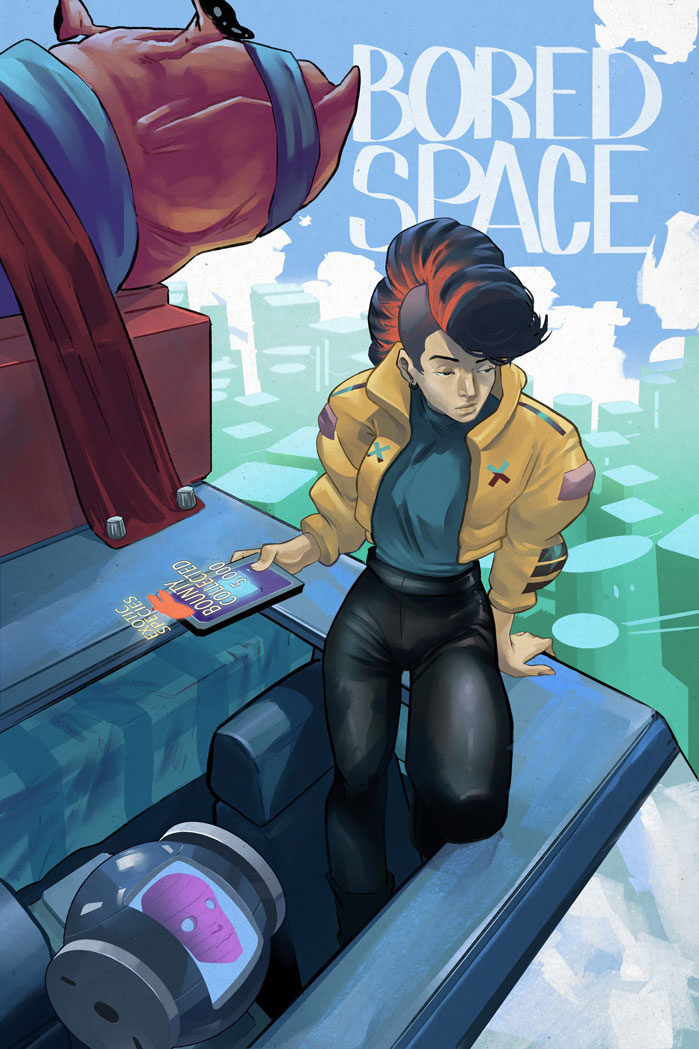
If you thought creating one comic book series was difficult, imagine launching three at the same time. That’s the task in front of writer P.A. Lopez, who founded new publisher Brain Poison with illustrator Samuel Bermudez. Brain Poison is publishing sci-fi mystery Vox Wormhall: Robot Detective, sci-fi thriller BoredSpace, and the coming-of-age adventure 10 Million AD. Comicon.com caught up with Lopez to discuss the fledgling publisher as well as their ambitious plans which include a fourth series.
Tom Smithyman: It’s ambitious to launch three series at the same time. Why did you choose to take that approach instead of staggering them out a bit?
P.A. Lopez: Actually, there are now four, haha, because I decided to add RNWY Galaxies at the last moment.
I launched all four because it’s just a drop in the bucket of what I want to release. I have stories going back decades. I wake up around 8 every morning. I work until around 11 p.m., and it feels like I can’t move fast enough to get the stories out there.
I was about to say “I’ve wanted to be a creator my whole life,” but then I saw a video of Tom Cruise the other day, and he said, “Stop saying ‘I want to be an actor.’ Stop saying ‘I want to be a director.’ Say ‘I am an actor.’ Say ‘I am a director.'” So, I’m a creative. Maybe no one knows who I am, and maybe no one will ever know who I am, but that is completely beside the point. I’ve really come to realize that.
Andy Warhol used to get up and paint, screen print, create, film, and work on his magazine for 15 hours a day. John Coltrane practiced 15 hours a day. Pablo Picasso was creating some of the best stuff at the very end of his life. It doesn’t matter whether anyone likes it or anyone sees it. If you’re a creator, you create. That’s what you do because you love it. That’s who you are.
Technically, I’m a writer. But I’ve always seen everything I’m writing in full color. I saw a documentary a few years ago about the making of Star Wars. There was a part about how George Lucas hired these incredible artists like Ralph McQuarrie to bring his visions to life. He used those illustrations to show backers exactly what he was seeing in his head, because a picture is always more immediately engaging than a page of 12-point Courier font.
A few years ago, I hired Sam to start bringing the ideas in my writing to life in a way that people could actually see. In the beginning, it was simply concept artwork to go along with my movie scripts. It was only a couple of years ago that it occurred to me I should hire him to start creating graphic novels for the projects.
For years, my creative life was confined to Word documents, Scrivener documents, Final Draft Pro documents. Now, for the first time, I found ways for people to see the stories. I don’t have to wait for anyone to green-light it. I don’t have to wait for a publisher to publish it. I don’t have to wait for a literary agent to believe in it. I don’t have to wait for a movie studio to finance it. I can just do it.

Smithyman: These are different stories but parts of the same universe. What are the commonalities among the stories?
Lopez: Cyberpink and Vox Wormhall share a universe. Vox Wormhall is Stacyÿ of Cyberpink’s favorite TV show, haha.
I think what they all have in common is that they are ordinary people doing extraordinary things. None of them are chosen ones. They’re multi-dimensional people who find themselves in impossible situations and have to use their wit and heart to get themselves out of it.
Smithyman: This universe is female-led. Why was that important for you?
Lopez: I have no idea why I only write women. Vox Wormhall, who reads male, I guess, is currently the exception. I know that I’ve known some really extraordinary, tough, fun, and wonderful women in my life, and they just seem to come through as my protagonists, but it’s not a conscious choice.
Maybe one day I’ll write a male as a protagonist. It just seems like every time I sit down, I start writing, and it’s another female protagonist. Actually, the original protagonist of 10 Million AD was a guy, but somehow during a rewrite it changed.

You call these “adult stories.” What makes them appealing to adults, and do you see a future where you might publish something for a younger audience?
Lopez: BoredSpace is more of an “adult story” than the others.
I consider Cyberpink, 10 Million AD, RNWY Galaxies, Vox Wormhall, to be all-ages. Originally, I wanted to do everything all ages. So BoredSpace is the outlier, more grimdark-adjacent.
Stories are always really fascinating and gripping when the creators are willing to break conventional rules of narrative. There are certain unwritten rules that we all know when we come to see a story: the protagonist is not going to die (unless it’s Vincent Vega), a pregnant woman would never be stabbed in the stomach (unless it’s Talisa Stark), comic relief doesn’t die horribly and suddenly (unless it’s Marvin).
When those rules are broken, we find ourselves in unfamiliar territory, and the story becomes more urgent and more terrifying. BoredSpace was and is my attempt to explore that type of narrative structure.
Smithyman: All of your stories are science fiction. What makes for a compelling sci-fi story?
Lopez: In The Hero With a Thousand Faces, Joseph Campbell explains that all heroes are the same hero. The story is never really about the location or the setting. The story is always about the characters and the things the characters go through. And interestingly, no matter what Nabokov might say, that character in one way or another is always us.
In Randy Ingermanson’s book The Snow Flake Method, he says something really interesting and compelling: that stories are told to strengthen the tribe. No one wants a cheap morality story, but at the same time, narrative creates a safe space for us to experience something dangerous and learn something about survival, whether that’s physical or emotional.
Personally, I love science fiction because I love the future. I love futurism. I love the fact that science fiction is limitless in terms of what it can create, but it’s still bound by the laws of physics. I also love physics, so it’s an intoxicating combination.
I think a compelling sci-fi story is compelling not because of the science fiction elements, but because of the same elements that make any other story successful. If you only care about the characters in a limited way, you’re only going to enjoy the story in a limited way, no matter how fantastical the premise or how gorgeous the setting (see Valerian). If you care about the characters, you can put them in an empty room, or at a dinner table, like in My Dinner with Andre, and it will be fascinating to watch them interact.

Smithyman: How did you come up with a name like Brain Poison?
Lopez: Ha, my mother already hates it.
I liked the idea of an old punk rock record label. Something funny and ridiculous and a little cheeky. Something that doesn’t take itself too seriously and is also a little self-deprecating. Something that can go anywhere, and then you can’t complain because you were warned in advance.
Smithyman: How’s this for an unfair question: Which of the series is your favorite?
Lopez: None of them.
Right now I’m working on something called The Meat Girls, or possibly The Trash Girls. Or possibly some completely different name. It’s about a band in this post-apocalyptic world. There are cannibals, a monastery, an orphan, the lead singer has a twin sister, and that’s all I can say about it right now.
Tomorrow I’ll have another favorite. That’s how I keep going. When I was a kid, I loved making up fantastical stories, sometimes to annoy my teachers, sometimes to keep people off guard. I still do that. When you’re a creator, you create. You keep going because you love it, not because anybody else is watching.


