
The Weekly 2000 AD Prog #2500: All-New Strips For The Milestone
by Richard Bruton
Taking a look inside the UK’s greatest sci-fi comic, the Galaxy’s Greatest, fast approaching 50 years of brilliance — it’s the Weekly 2000 AD.

It’s all-new here, a complete blank slate of new strips, five continuing, plus another of those creepy and spooky Thistlebone prose tales from TC Eglington and Simon Davis, putting a delicious chill down your spine. There’s also a one-off Silent Hill short by lead writer and game director Jon McKellan and artist David Roach, a direct prequel to the new game in the series. As for the five new strips, well, it’s all rather exciting. It all kicks off with the latest bit of Judge Dredd brilliance from Rob Williams, Arthur Wyatt and Henry Flint, bringing us the follow-up to their quite brilliant A Better World, and the fallout from Judge Maitland’s experiment to transform Mega-City One. Then there’s new weirdness in Azimuth, as Dan Abnett and Tazio Bettin take the world of Sinister Dexter into some strange places. We have Alec Worley and Ben Willsher returning to Durham Red, giving us a blood-stained Hungry City, and Guy Adams and Megan Huang open Book 2 of Ghosted, with all its perfectly challenging ways. Finally, David Barnett and Lee Milmore check in with Herne & Shuck for their latest bit of occult strangeness.
Yes, a perfect jumping-on point for any of you reading this and wondering just how you get into 2000 AD, absolutely the greatest sci-fi anthology around. Five new ongoing strips to draw you in, never a better time to experience the magic of this one.
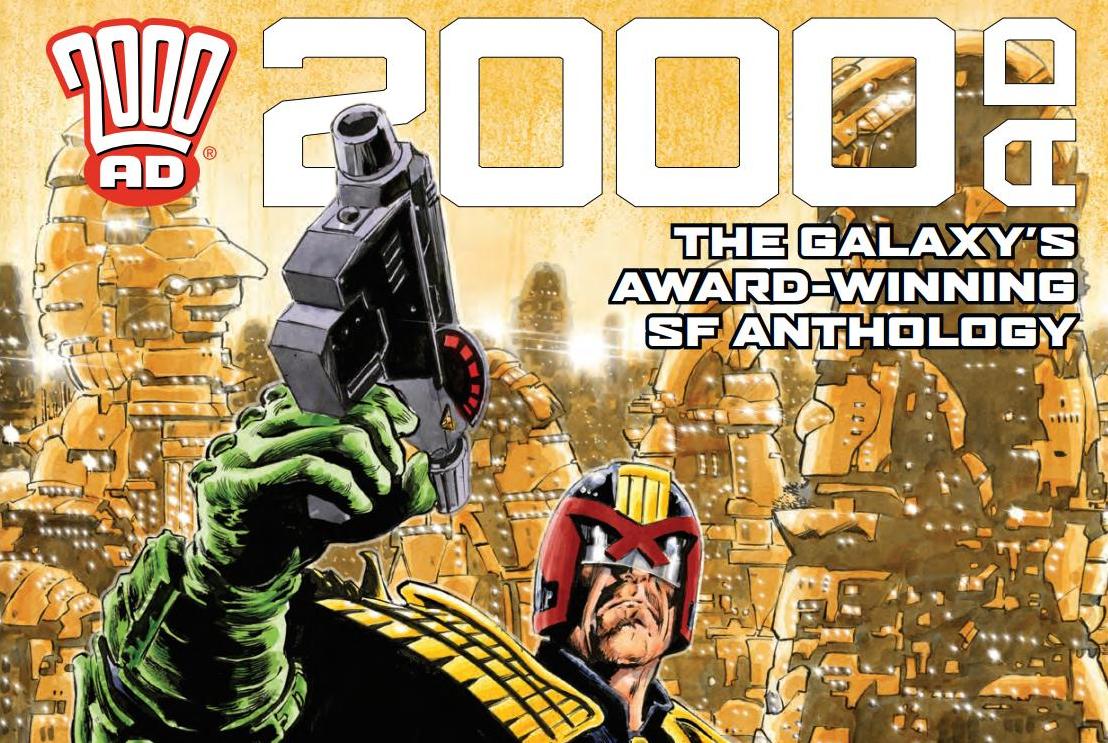
All of it begins under a Mike Perkins Dredd cover …

2000 AD Prog 2500 is out in the UK on 16th September, and out in the USA on 30th September. If you are in the USA, get yourself down to your local comic shop and ask them to order it in for you.

Judge Dredd: The New Future (Prologue) – By Rob Williams, Arthur Wyatt, Henry Flint, letters by Annie Parkhouse
Well, here we go, the follow-up to ‘A Better World’, where Judge Maitland worked out a radical new way to solve all of Mega-City One’s problems, raising the accounts Judge from bit-part player to major character, watching as her experiment in social engineering first worked perfectly and then, subject to outside forces, the media, the establishment, the powers that be, all with an interest in seeing it fail, led to her downfall and her death. If you haven’t read A Better World, you really are missing out on one of those pivotal moments in Dredd history, something that only happens every once in a while, a truly landscape-changing moment. Seriously, go ‘read the book now.
So, assuming you’ve done all that, we’re back here now with Williams, Wyatt and Flint’s follow-up to that bit of brilliance, two years on from the events of ‘A Better World’, where we see the fall-out from Maitland’s failed experiment, where those involved don’t yet realise just why it failed, and where, in this prologue to ‘The New Future’, the major players find themsleves under investigation by the SJS, the Special Judicial Squad, those Judges who judge the Judges, and whose powers are being flexed here as they round up the members of the Council of Five in the wake of Maitland’s perceived failures.

As an opener, revisiting the events of ‘A Better World’, it’s simply perfection. Absolute perfection. A way to look back, but with the addition of the SJS Judges sticking their noses in, one with added threat and menace and political overtones. It both reminds us of past events and pushes us into what’s to come. And what’s to come really, really looks like it will be a damn fine new series by Williams, Wyatt and Flint.
And so much of what makes this so damn good comes from the art of Flint. For many years now, he’s been the very best of a good crop of Dredd artists, with every series seemingly having something new and exciting about the way he’s developing his style.
Here, for the prologue, he sticks to a tight 3×3 grid throughout for the story panels. All emphasising the order and rigidity of the SJS and the whole sense of cramped confines for the interrogations. His line is beautiful, his colour choice exquisite, creating brutal beauty in this world. Each interrogation is highlighted in one colour, stark, uncomfortable, with backgrounds stripped back to pull in tight on the perfect figure work and body language at play. Perfect.
But then comes the stylistic masterstroke this time round, as there’s a single vertical panel to the right of each page – the Eagle of the Justice Department in profile. First page, it’s clean, set against a clear grey sky. But as the six pages roll on, the weather gets darker, and blood red appears on the eagle. First a trickle, then more and more and more, until we end like this — just so impressive, summing so much of the themes we’re about to explore in ‘The New Future’.

Oh, and things to note: Chief Judge Logan, Judge Beeny and Dredd get pulled in for interrogation by the SJS at the same time, yet Judge Hernandez gets to do it all first? The mention of the clone production reports? Beeny being recognised as one of Chief Judge Logan’s replacements?
All of them magnificent little moments in the tense moments where the SJS Judges haul everyone in. Like I said, quite brilliant and just sets it all up for the start of ‘The New Future’ proper next episode, where Dredd’s search for proof of who engineered Maitland’s assassination starts and where we’ll revisit journalist Oswald Roth, who received a mystery package at the end of A Better World, courtesy of Maitland.
Oh yes, the next 12 weeks are going to be something a bit special, I think.

Azimuth: How To Train Your Dagon — Part 1 — By Dan Abnett and Tazio Bettin, colours by Matt Soffe, letters by Rob Steen
Oh, the title. Abnett does love his puns, and Azimuth, like the long-running Sinister Dexter before it, is full of them.
In case you didn’t know, Azimuth and Sinister Dexter are inextricably linked. What started off as a bizarre adventure in the data-driven world of Azimuth, where the New Flesh aristocracy ruled all, creating their techno kingdoms populated by the wild and the wonderful, turned into something else with the arrival of Ramone Dexter in town. Over the events of Azimuth, it’s been uncovered that Azimuth is actually Downlode, the city Dexter and his partner Finnigan Sinister once called home. Except Downlode’s been taken over by a rogue Artificial Intelligence (oh, how preposterous, that could never happen! — checks news — oh.)
Finn’s been taken over by the AI, Ramones on the run from him, seeking whatever sanctuary he can. In Azimuth he’s joined by Suzi Nine-Millimetre, one of the cadavatar warriors native to Azimuth, and, intriguingly, Cassandra ‘Andi’ Anderson — ‘Ex-Judge, Ex-Psi, Exile.’ So yes, it would appear that this is THE Judge Anderson from Dreddworld. Like I say, fascinating. No clue from Abnett as to the why or the how she’s actually here, but it’s definitely her — we got that in the final part of Cornered, the last Azimuth series in Prog 2466. But then again, so much of Azimuth is still a mystery.

Here, it’s intro time, Dexter, Cass and Suzi picking up from where we left them in Cornered…

On their way to Funderland to locate Krugerrand. Unmasked and visible to the AI. Things aren’t exactly looking good for them.
Anyway, they’ve hitched a lift on a phishing boat, crossing the hypotheseas, the ocean medium of raw, unfiltered data out of which Azimuth was rendered. A little bit of repelling hostile boarders follows, giving us a moment for Abnett and Bettinn to reintroduce us to the cast…

Azimuth has taken the long-running story of Sinister Dexter and rejuvenated it, breathing fresh life into the whole thing. And a big part of that is having one artist responsible for the whole thing. Sinister Dexter suffered too often from switching artistic styles, lessening the overall story playing out. But here, Bettin’s really showing us one cohesive, if completely insane world. It helps as well that Bettin’s art just looks lovely, with the artist clearly having a blast giving flesh to the ideas.

Silent Hill: Townfall: The Dock House — By Jon McKellan and David Roach. Colours by Emily Roach, letters by Rob Steen
Well, I’m not a video gamer. Haven’t been for some time. Motion sickness every time I played. But even I know about Silent Hill, Konami’s survival horror video game series, full of the supernatural and the deadly. And there’s a new episode in the Silent Hill series, Townfall, releasing on 24 September, set in Scotland in 1996, where one man awakens in St. Amelia with seemingly no connection to this place. The Dock House, written by McKellan, lead writer and game director of Silent Hill: Townfall, joins 2000 AD here for a special one-off prequel, directly leading into the events of the new game, all exquisitely drawn and coloured by David and Emily Roach.
What you get here isn’t anything huge, but that’s rather the point. It’s merely 10 pages of setting up the moment on the last page when Simon Ordell pulls himself out of the sea and onto the jetty. But the previous nine pages are just this great little mood piece, all about sending a distinct shiver down the spine and making you want to explore more of what’s been introduced here.
From the very first, McKellan’s giving us all the mean and moody isolated dock house shrouded in fog, the voiceover announcing that “Every day is the same. No boats come in. No boats leave. No radio signals, and no contact … just fog.” The old guy in the dock house wears the 45 years of his time here in every perfectly realised line on his old face – oh yes, David Roach draws the hell out of this one. And from there, it’s a creeping horror thing, as the old man wanders the dock house, only to find something new, something going deep into a very Lovecraftian nightmare …

Like I say, it’s a prelude, just setting the scene, but even though there’s very little happens, it all happens really well — the journey through the dock house and down to ancient horrors is paced really well, the mood set just right.
But the real stars here are the Roachs and their art. Honestly, there’s few who could capture the whole spooky, mists rolling in, unveiling the horrors tone of Silent Hill as they’ve done here. David’s art and Emily’s colours are just so evocative and nightmarish, capturing, emphasising, and amplifying the tone of the script, elevating it all to absolute heights.

Durham Red: Hungry City — Part 1 — By Alec Worley and Ben Willsher, letters by Simon Bowland
The return of the vampiric mutant Search/Destroy agent, feared throughout the galaxy like no other of her fellow Strontium Dogs. Worley and Willsher have done a fair few of these now, and they’re just these glorious bits of action-packed things, the story playing out against a backdrop of violence and blood.
As for where we’re at, well, there’s something rather brilliant about Worley opening it up with Durham Red, mouth and face a vivid, deadly mask of blood, coming to and finding the bloody head of a giant rabbit thing in her bloodstained lap.
Trouble is, that’s merely the start of it. As she casts her eye around the room … well, you know how you go out (or nowadays at our age, used to go out), get very worse for wear, and decide that the best thing you can possibly do to end the night is to have a massive takeaway of your choice? Well, that’s just what Red did. It’s just that when she has a bit of a bender, it’s not curry left over in the morning; it’s blood … lots of blood …

Oh yes, that must have been some night. She doesn’t know where she is, doesn’t know why she’s here, wondering if she’s there on a hit, noticing all the bodies look like private security, not civvies. Trouble is, she doesn’t have all that much time before another group of not-nice folks with weaponry are after her.
A great start to this one, Worley dropping us right in it and hitting the ground running. And as for Willsher, well, there’s this…

Oh, I do love a bit of well-drawn rain in comics. And that’s an excellent bit of rain.
Frankly, Willsher’s really doing quite wonderful things on these Durham Red tales. His art’s just sharp of line, stylish, flowing real well, stylish as all hell. But it’s the colours that stand out to me, just popping off the page. Everything’s super bright, colours dialled up and so vivid. It all looks so damn good, whether it’s the muted purples on those first few pages, all the better to make the blood red just pop, or the sickly, vibrant green of the assault team’s gas attack, and then the glorious blues of the rain-soaked ending. Oh, I do love me some great comic rain.

Thistlebone: The Witchfinder’s Apprentice — By TC Eglington and Simon Davis
Another of these Thistlebone prose pieces from TC Eglington and Simon Davis, revisiting the folk horror world they created around the village of Harrowdale, surrounded by mysterious woods, home to the cult of Thistlebone, and site of many murderous events over the centuries.
Do go and pick up the Thistlebone collections for something that really will put the chills down your spine. After finishing the third book, all we’ve been treated to since then has been those prose pieces, designed and written by Eglinton, whose shadow art surrounds and illustrates the text, but always with a little bit of Davis artwork for the ending. They’re just these perfect little vignettes of a story, each one giving you those familiar Thistlebone vibes, giving you that chill that Thistlebone always does.
Here, it’s all about a too-proud, too boastful Witchfinder and his young apprentice arriving in Harrowvale, entertaining the tavern locals with the Witchfinder’s tales of his exploits and the women who suffered, until the Witchfinder and the men of Harrowvale all retired, drunk, to their beds.

But the apprentice can’t sleep, a pious and abstinent youth, full of resentful thoughts. Seems he’s the one doing the work, whilst his Witchfinder master took all the credit. But when he spots the ladylady of the tavern going door to door in the village, gathering all the women of Harrowvale and then heading off to the woods, he really shouldn’t have followed them.
A short but effective bit of period horror, keeping the spirit of Thistlebone alive and kicking.

Ghosted Book Two — Part 1 — By Guy Adams and Megan Huang, letters by Simon Bowland
For the second series of Ghosted, we’re back in Kinshasa, the capital of the Democratic Republic of Congo, somewhere in the far future for Ghosted. It’s a walled city metropolis, divorced from the rest of the planet.
The first series followed young, rich Kinshasa citizen Benu discovering many secrets of the place she calls home, not least that she’s neurally connected to a soldier fighting an alien war. Or so she thought. But on escaping the city, she discovered that the war was taking place outside the walls protecting Kinshasa, leading to this, the ending of Book One …

Through Book One, we followed Benu, saw her visions of the warriors unwillingly forced into fighting the alien war, until one of those warriors reached back to her, opening her eyes and mind to all manner of wrong about her comfortable little isolated world. We met the tiny resistance, fighting to reveal the truth to Kinshasa’s populace, and we met The Trust, the secretive rulers of the city, who sent out their psychopathic killer to stop that truth from getting out. By the end of Book One, the truth had been told, but the citizens, too cosseted in their comfortable world, seemingly ignored it.
That first series was, as I continually told you, this wonderfully confusing and somewhat frustrating thing, yet the frustration wasn’t a bad thing, not at all; it was something that made what you read perplexing yet impressive, Guy Adams going out of his way to make it something that kept me reading, wanting to uncover the secrets behind it all.
Now, in Book Two, there’s absolutely no continuation of how Book One ended — Adams keeping that intriguing/frustrating thing going from the off, it seems.
Instead, we’re sent back 14 months earlier, to Kinshasa, where The Trust watches over the people, keeping them safe and secure, hiding the nastier bits of the city from the rich and insulated.
Then there’s Chant, one of The Trust, always watching, observing events beyond this walled-in city-state, watching as the world receives a signal, audio resonating around the globe, from something mysterious, possibly alien, off-world (but with Adams writing, who knows?) We watch as the future world’s states get the audio, and where Amerika responds first, making first contact. And then a thin blue alien finger presses a button. And suddenly, brutally, Amerika doesn’t exist anymore.

As Chant tells the others of The Trust … ‘Cat purrs at mousehole. Idiot mouse squeaks. Cat pounce. Mouse dead.’
Kinshasa is locked down, the wall keeping them safe, ‘let the others die while we learn.’

And so we’re thrown into the second series of Ghosted. It’s just wonderful in its mystery. One of those things where the author deliberately confounds you at every turn doesn’t annoy; it just keeps you hooked, wanting the next episode to garner anything you can to make sense of the great story you’re reading. And that keeps on keeping on here, all the mystery still there, going back in time to fill in those blanks, answer some of those questions from the first series. Maybe.
But still, it’s a series that I look forward to the next episode every time, one that reads and looks so good. Something very different, very stylish, confounding in all the best ways.

Herne & Shuck: Storming The Stone — Part 1 — By David Barnett and Lee Milmore, colours by Quinton Winter, letters by Annie Parkhouse
Herne is a magical troubleshooter; Shuck is his black dog, a demon in dog form — and yes, that black dog. They’re hired help for different magical factions around the UK. Herne is also the embodiment of Herne the Hunter, ancient British magical stuff. Although those particular god-like powers have been stripped from him while the magical council decides what to do about him.
He was tasked with saving young Caris from ritual sacrifice, which he did, only to make an enemy of the powerful organisation known as St Michael. Now, St Michael has Caris once more, taken by the Crawly Man, and it’s down to Herne to mount a rescue op, off to the secure St Michael’s facility under Stonehenge.
Barnett and Milmore’s Herne & Shuck is a fun thing. Part magical journey, part quest tale, part ageing hippy or raggletaggle magician just doing what he can to get by. Or, as described by Barnett on the opening page, ‘he looks like a pagan binman or something.’ It’s lightweight in the best of ways, plenty of comedy amongst the bigger stories, Barnett continually finding ways to take the piss out of the hero of the piece, and it’s all the better for that.
In ‘Storming the Stone’, we’re back with Herne and the gang, working out what to do now that Caris is back in the hands of St Michael. (And as a UK kid of a certain age, all I think when I read St Michael is that Marks & Spencer’s brand has gone very, very bad.)
So, time to open a portal to St Michael, Shuck’s job …

Which, as you’d expect, doesn’t go exactly the way Herne figured it would. Because it never does, does it?
Herne & Shuck continues to be a hell of a lot of fun, a mystical journey through ancient British magics, given a modern twist, where the hero is this screw-up magician who attracts weirdos and losers to his particular gang, and Barnett obviously enjoys making Herne the butt of the joke throughout. Alongside this, of course, the storyline that runs through it all gives Herne the chance to actually do something good, despite himself and his failings. All of this, drawn with love by Milmore, who obviously enjoys everything about Herne & Shuck, shows in everything he’s doing here.


