
Talking ‘The Bride Of Frankenstein Lives’ With Kelly Thompson And Mattia De Iulis
by Rachel Bellwoar
If the title The Bride of Frankenstein Lives sounds a little contrary to how the 1935 movie ends, that’s because it’s supposed to. In the latest collaboration between writer Kelly Thompson and artist Mattia De Iulis, the Bride is alive, but what does that mean — practically speaking — and can she have a future without first learning more about her past? With letters by Becca Carey, here’s what Thompson and De Iulis could reveal about their take on the classic Universal monster:

Rachel Bellwoar: To anyone who’s never seen The Bride of Frankenstein it always comes as a surprise how little screentime the Bride actually has. What made you want to tackle the challenge of expanding her story and imagining a scenario where she survived the explosion that ended the original movie?
Kelly Thompson: I mean, I think you’ve answered your own question there. [laughs] The Bride of Frankenstein isn’t actually about the Bride; it’s very much about The Creature and his search for meaning and understanding in the world. The Bride has no agency, which is by design; it’s simply not her story. But I think those final few minutes where she shows up in the film are so visceral, so powerful. It demands its own story. So that’s the place I wanted to dig in — as I think most writers do — it’s the untapped story within The Bride of Frankenstein.
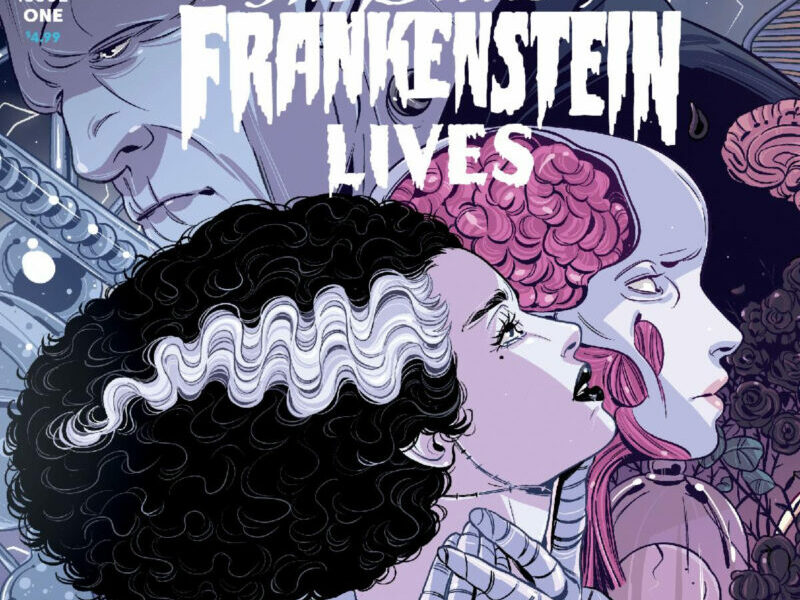
Bellwoar: For your cover, Mattia, we have the Bride being grabbed at by unseen figures, but at least one has very identifiable hands. How did you come to that image for the first issue?
Mattia De Iulis: I studied the cover to capture both the Bride’s inner feelings and the reality of how she was brought into the world within a single image. She has a look of complete awareness about the reason for her creation, contrasted with the hands of men gripping her as if she were their property, an object rather than a person.
Bellwoar: Despite how loquacious Frankenstein’s monster is in Mary Shelley’s novel, in films Frankenstein’s monster and the Bride tend to not be very verbal characters. Do you feel narration was a way of giving the Bride a voice again?
Thompson: Absolutely. When we first started talking about the book, and even my original pitch, had her speaking much more freely, much sooner — but as we started getting into it — that felt wrong. But what really worked on the page was her slowly learning about the world, as contrasted with her narration from the future — a more refined and knowledgeable perspective. It ended up being one of my favorite things about the book. And gave us room to do and say the things the story needed us to do and say, without straining readers’ suspension of disbelief so much.
De Iulis: This was the biggest challenge for me, but also the most intriguing one. Every time I set out to draw a character, I gradually get to know them, understand them, and step into their world, learning who they are through their emotions, their silences, their feelings, and their vulnerabilities. My goal is to capture all of that in the visuals, bringing out the raw power and strength of who she truly is.

Bellwoar: She may not be the Creature’s Bride but we do meet a different husband in the first issue. Can you tell us anything about him and why you wanted to delve into the Bride’s past before she became the Bride?
Thompson: I think Bride of Frankenstein is a shockingly good movie. But again, it’s not concerned with the actual Bride; it’s just concerned with her creation. Those are different things. The film is all about The Creature; it’s his story. His search. His threats and demands and ultimately, disappointment. But this story — is her story. And her story to have any weight behind it, any sense of scope for what her creation means — has to be about both what she becomes — and where she came from — the women that were destroyed to make her.
Bellwoar: The film ends before the Bride has the chance to make any decisions of her own about her personal appearance. Did you enjoy the opportunity to give the Bride more agency in how she dresses and pivot away from the iconic hair and silhouette?
Thompson: It was all I wanted really — to explore the agency of The Bride. The iconic hair is a bit of a plot point in the book — perhaps a minor one, but thematically powerful — don’t expect it to entirely disappear!
De Iulis: I have to admit, drawing the Bride with a hairstyle other than her iconic one felt a bit strange at first, haha! But at the same time, exploring different options, while respecting the historical period (my algorithm is basically set exclusively to fashion from those years now, haha) and pulling inspiration from the Gothic aesthetic I love, was genuinely one of the best parts of the whole process.
Bellwoar: Where does the Bride fall on your personal pantheon of Universal monsters?
Thompson: Well, as a woman, she’s rare among the monsters, which makes her feel interesting to me right off the bat. I think that would be true even if I wasn’t as drawn to female characters as I am. And Frankenstein has always been my favorite monster. Thematically, it’s all such powerful stuff, and of course, written by a young Mary Shelley who essentially invented science fiction here … can you even imagine? How could I choose anyone else? So Bride has always been one of my favorites and her themes are arguably even more powerful than The Creature’s — she just didn’t get that attention until later adaptations and inventions came along. After writing this mini-series, I think I have to admit she is my favorite. I’m sorry, Frank, you’re still second in my heart!
De Iulis: Frankenstein has always been at the top of my list for Universal monsters, but the Bride holds a truly unique and compelling place for me. What makes her so fascinating isn’t just her design, but her massive, untapped potential. She’s a character literally created to fulfil another’s desire, conceived as a companion, an object to satisfy someone else, yet her entire essence screams a refusal to just be a satellite. Taking a figure who was born as a tool for a man and exploring her path toward true autonomy and independence makes her incredibly powerful. For me, that sheer narrative potential puts her right at the very top alongside Frankenstein himself.
Bellwoar: Thanks for agreeing to this interview, Kelly and Mattia!
Universal Monsters: The Bride of Frankenstein Lives #1 goes on sale 28th October from Skybound.


