
Trains Don’t Always Stick To Tracks: An Interview With ‘Nocturnal Whispers’ Creator Bong Redila
by Rachel Bellwoar
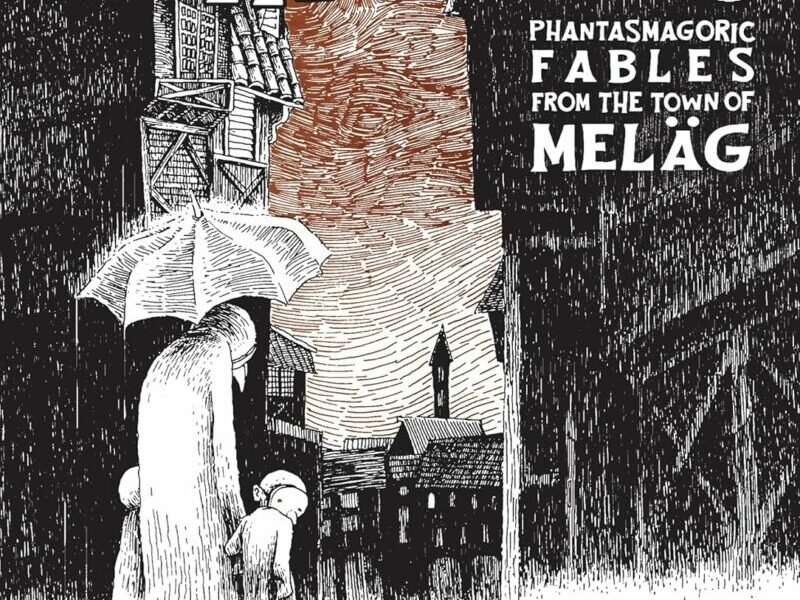
A place where paper planes can be found in the sky, and trains don’t always stick to tracks. This is Meläg, the fictional setting of BongRedila‘s stories in Nocturnal Whispers: Phantasmagoric Fables from the Town of Meläg. Newly collected by Fantagraphics, here’s what Redila had to say about the process of putting this collection together:

Rachel Bellwoar: How did you decide on the title, Nocturnal Murmurs, and what was the selection process like for choosing which stories to include in this collection?
Bong Redila: There wasn’t really a selection process for the stories, because most of them were written with the idea that they would eventually become part of one book. I was already thinking about Meläg as a collection while I was writing them. The exception is “Hope (Arapaap),” which was written by my father long before I was even born, so that story has a very different and personal history.
For the title, Gary Groth and I went back and forth brainstorming different possibilities. I suggested a few, including Windvane Lullabies and some others that I honestly can’t remember anymore. At some point, Nocturnal Whispers came to me. I remember walking one night with my headphones on and listening to Echo and the Bunnymen sing “Nocturnal Me,” and somehow the phrase Nocturnal Whispers just popped into my head.
It felt right for Meläg. Meläg has always felt like a place that comes alive after dark — a bit mysterious, slightly unsettling, and a little strange. “Nocturnal” suggests nighttime, shadows, secrets, and things that might not happen in the ordinary world. It doesn’t necessarily mean that every story takes place at night. It’s more like a nighttime state of mind.
And “whispers” feels right because the stories don’t really shout their meaning at the reader. They give you an unusual image, a strange situation, a fragment of a story, or a peculiar character, and then leave room for your imagination to take over.
So I think Nocturnal Whispers captures both the atmosphere of Meläg and the way I like to tell its stories.
It’s almost like saying: “Come closer. There’s something strange I want to tell you — but I’ll have to whisper it.”
Bellwoar: At the end of the book you include a map of Meläg. Is that something you created early on to provide yourself with a visual reference of the town or is it something you’ve built over time and as you’ve created more stories set there?
Redila: When I started writing the earlier Meläg stories, I had no idea I was slowly building what would become a fairly large place. In the beginning, it was easy. I could just imagine a street, a house, or a particular location and write the story around it. The idea of a visual guide never occurred to me.
But as I wrote more stories, Meläg kept growing, and I started getting confused about where things actually happened. I would sometimes think, “Wait, where is this place again?” Things were becoming inconsistent, and I realized I was getting a little lost in that “little town”.
It wasn’t until I was in the middle of writing “Before the Raindrops” that I finally sketched the first map of Meläg in my sketchbook. So the map came fairly late in the process, after I had already written several stories and the town had begun to take on a life of its own. It was never something I planned from the beginning—it was something I created because I needed it.
The sketchbook map helped me tremendously. Once I could actually see the streets, buildings, and different places, it became much easier to keep everything connected and consistent.
Later, I took that working map and finalized it on a much larger sheet of paper to hang in my studio. So the map evolved along with Meläg. It started as a practical reference because I was getting lost in my own fictional town, and eventually became something I’m actually quite proud to have on my studio wall.
Bellwoar: Some artists prefer not to explain or share their inspirations, but I really appreciated the insights you offered in this collection into where you get your ideas from. Is that something you’ve always been comfortable with sharing or did you specifically want to add those for this book?
Redila: That was actually something I had in mind from the very beginning. When I started writing the first Meläg stories, I was already thinking about sharing how each story came about — the history behind it, where the idea came from, and basically the “story behind the story.”
I’ve always been fascinated by how things are made. I love watching behind-the-scenes features on movies and hearing about how a particular scene, character, or visual idea came together. That’s actually one of the reasons I still buy physical media like Blu-rays, especially the Criterion Collection editions. I love all the beautiful and informative extras and behind-the-scenes material they include.
So I thought, why not do something similar with my own stories? I wanted to share not just the finished story, but also some of the things that were going through my mind when I was creating it — what inspired it, where the idea came from, or sometimes the personal experience behind it.
I’ve always enjoyed that kind of peek behind the curtain, and I wanted to share that same feeling with the readers of Meläg.
Bellwoar: At least in this collection, while there are recurring locations, we don’t really see the same characters pop up across multiple stories. Would you ever be interested in doing that?
Redila: You know, I’ve thought about that too. It’s always a possibility that one of the characters might return in a new story. I actually like the idea of characters quietly crossing paths within Meläg, even if the reader doesn’t immediately notice it.
In fact, there are already a few little Easter eggs hidden throughout the book where a character from one story appears somewhere in another. One example is the floating girl riding her bicycle, who also appears in “Mirasol Dolores.”
There are a few others, too, but I’ll let the readers hunt for them. I like the idea that Meläg feels like a real little town where these characters exist beyond the particular story we’re reading about them. You might see someone in the background of one story and not even realize that you’ve encountered them before.
So, yes, I would definitely be open to bringing a character back in a more significant way. But for now, some of them are just quietly wandering around Meläg, waiting to be noticed.
But I always consider the town itself is the main character.
Bellwoar: One of the stories that stuck with me the most was “Wish” and how, unlike similar fairy tales like “The Ridiculous Wishes” where a couple wastes their wishes on a sausage nose, it has a much more optimistic view of what people would do in that situation of being granted three wishes. Do you feel fables can sometimes be too harsh or unkind in their estimations of humanity?
Redila: Absolutely. I think fables can sometimes be a little harsh about human nature. A lot of traditional fables focus on our weaknesses—greed, foolishness, vanity, and all the ways people can get themselves into trouble. And I enjoy those stories too. But I don’t think we’re always that predictable.
I suppose that’s why “Wish” has a more hopeful view of humanity. I don’t think we’re always driven by greed or selfishness. Sometimes what we wish for is very simple: something to eat, something to share, or something that might make another person’s life a little better. For me, “Wish” was really about that—and about how something as small as a wish can reveal a lot about who we are.
That’s one of the things I like about fables. They give you a way to talk about human nature, but you don’t always have to end up with a cynical view of humanity. Sometimes I like to leave a little room for hope.
It’s sort of like this: As much as I love listening to Dead Kennedys, Minor Threat, Black Flag, and such, I also never stopped listening to Satchmo and Joe Raposo.
Bellwoar: Starting with “Before the Raindrops” you really start to experiment with creating a hybrid form between comics and picture book art. Do you feel you’ve landed on your style or is there still more experimentation to come? Is there a world where color gets introduced to Meläg?
Redila: I don’t know if I’ve completely landed on a style yet, and I think that’s probably a good thing. I’m still curious and still experimenting. With “Before the Raindrops,” I was interested in moving between comics and picture-book illustration—telling a story through the images themselves but also giving each page enough space to breathe.
I think that’s something I’ve been doing with Meläg for a while now. Sometimes a story needs panels and sequential storytelling, and sometimes one image can carry the whole story. I don’t really want to put too many rules around it.
As for color, that’s an interesting question, especially because I’m colorblind. I’ve always worked very naturally in black and white, particularly with pen and ink, so in a way, that’s become part of how I see and tell stories. I love what black and white does for Meläg. There’s something about the limitations of it that lets the imagination do some of the work and gives the stories that slightly mysterious feeling.
But I wouldn’t completely rule out color. If I ever introduce it into Meläg, it would probably be a very different experience for me, and I’d want to approach it thoughtfully. I wouldn’t want to add color just because I could. I’d want it to have a reason—to serve the story or create a particular feeling.
So, yes, I think there’s still plenty of experimentation to come. I don’t want Meläg to stay exactly the same forever. I like the idea that it can continue to surprise me, too.
Bellwoar: Thanks for agreeing to this interview, Bong!
Nocturnal Whispers: Phantasmagoric Fables from Meläg goes on sale November 17th from Fantagraphics.

