
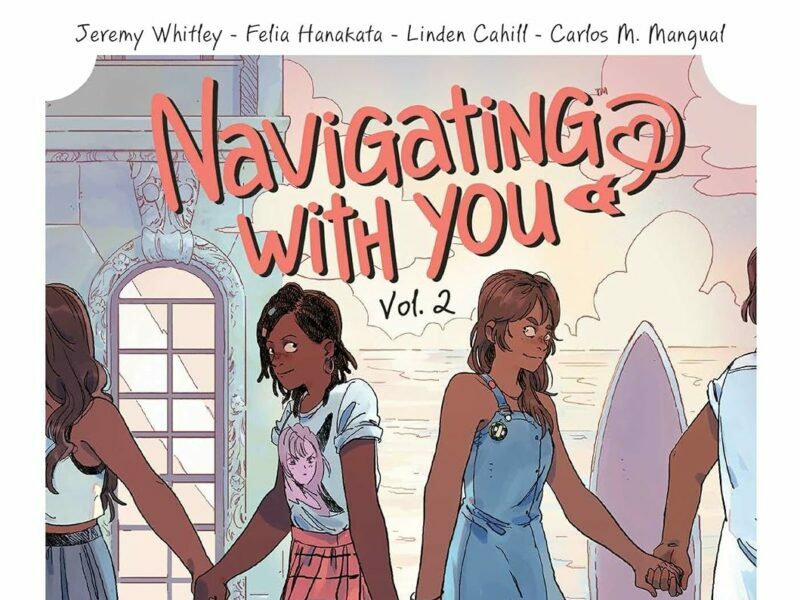
Talking ‘Navigating With You’ Vol. 2 With Jeremy Whitley And Felia Hanakata
by Rachel Bellwoar
Every relationship gets tested at some point or another but to say Gabby and Neesha weren’t expecting to be challenged quite so soon into their fledgling romance is an understatement. Volume 1 of Navigating with You ended with Gabby’s family moving back to Florida due to her dad’s job. Will Gabby and Neesha’s love story be able to withstand long distance? With Felia Hanakata replacing Cassio Ribeiro as artist, here’s what Hanakata and writer Jeremy Whitley had to say about the challenges ahead for Gabby and Neesha:

Rachel Bellwoar: While book one ended with Gabby and Neesha agreeing to continue their relationship long distance, you could’ve tried and manipulate events so they’d be in the same town for the sequel. Did you consider painting yourself out of that corner or were you happy to get to explore this new territory for the couple?
Jeremy Whitley: Oh, it didn’t feel at all like painting myself into a corner. It actually felt like I was opening up a lot of possibilities for what stories we could tell and introducing new characters to fill out both of their lives. As soon as I knew we were going ahead with doing a sequel, I got to work making things more complicated and more dramatic. They both have things that matter a lot to them in the first book that don’t get as much attention as their relationship and book club. Doing a sequel gave me so much room to open up these gifts I’d left to myself there and get to play with them. I didn’t know whether I would get to do a sequel when I wrote that first book, but as soon as I did, I was so excited that I’d left so many paths open to myself.
Felia Hanakata: When I first read the premise of this book I was instantly interested because of the long distance relationship. Not many books explore this. LDR is a huge and difficult commitment! I can relate to Gabby and Nesha because I had been in LDR for such a long time myself. I can understand their frustration, hopefulness, helplessness, and yearning. I thought about all the possibilities and emotions I could explore between the girls, and that was pretty exciting.
Bellwoar: To that end, whereas volume 1 mostly took place in North Carolina, volume two has to move back and forth between North Carolina and Florida. Was it difficult switching between such different locations or did that variety keep things interesting?
Hanakata: I had my worries at first but Jeremy and the editorial team were quite helpful with providing references. Between POV switching, anime-watching, and Gabby/Nesha virtual dates, the book was quite fast-paced and dense, so I had to be careful and smart about changing scenes and establishing shots so they felt seamless. It was quite fun. I think the pacing was great and the switching was fluid, and readers shouldn’t have trouble following the story.
Whitley: It is a little more difficult, just because I don’t live in Miami. I’ve spent time in Florida, so I had some ideas of the sorts of areas, communities, and politics I wanted to explore, however I couldn’t just jump in my car and go take reference photos of a building I saw every day. That was a really nice feature of creating a story in Durham with which I had to get more inventive when it came to Miami.
From a storytelling perspective though, I really like switching back and forth. One of the things that I love about writing stories of queer characters in the south is that you get to push back against the ignorant people that think everything below Virginia is all racism and rednecks, when much of the south is actually more culturally diverse than other parts of the country. There are queer people and black people and Latine people and disabled people and trans people down here trying to live their lives and it all gets wallpapered behind headlines about gerrymandered governments passing unpopular laws.
It was also really nice, because we hear bits about what Gabby’s life was like before moving to North Carolina and who was important to her back in Florida. Now we actually get to meet those people and they’re pretty awesome.

Bellwoar: This also means a lot of Neesha and Gabby’s dates are virtual or over text. Did that create any challenges visually, in terms of making computer screens romantic?
Whitley: You know, it could have been, but I think Felia actually did an amazing job giving them that feeling of being connected over all of this space. Their dates are some of the most interesting parts, where we get to see how they’re connecting over all this space and, in some cases, how those connections fail them.
The big change from my first draft is that there was initially a lot of cross talk between the girls during the anime. That ended up really mucking up the pace of the anime itself and making it feel less important. I had a lot of good jokes in there that I was sad to lose, but the overall book is better without them.
Hanakata: I think drawing the virtual dates “literally” could definitely get stale and fail to convey emotions. I made sure I drew Neesha and Gabby as if they were in the “same space”, together, feeling and reacting to things. I even removed the restriction of panels in some pages, because to Neesha and Gabby, their love could break down these walls and close the distance between them.
Bellwoar: I’ve always appreciated how much these books treat Neesha and Gabby’s relationship seriously and don’t hold their age against them. With that maturity, one of the things we see them struggle with in book two is expressing their different needs when it comes to sex (partly because they’re just discovering those needs themselves). How was it tackling those difficult or sometimes awkward conversations?
Hanakata: One of the things I appreciate and enjoy exploring in the book is the girls’ relationships. How they express love and needs. How everyone is different. How it can be heart-breaking when you find out that the love of your life is not compatible with you. How to still love, despite all that.
Whitley: You know, this reminds me of something I said in an interview recently about the fact that I read a lot of comics, book, and graphic novels written by women. I think one of the greatest surprises about getting older is discovering, despite what I’d been taught all through my teen years, that teenage girls were actually just as horny as I was as a teen, they were just taught to handle it differently. I think that knowing that would have changed a lot about my perspective and my feelings of guilt as a teenage boy and I’m sure girls are feeling some variation of that shame as well.
Not everybody experiences the desire for sex or even just physical contact in the same ways and I think that’s not something we tell teenagers enough. Some people don’t like to be touched, period. Some people thrive of[f] physical touch. Some people like to keep it siloed into certain parts of their lives. Teens don’t gain anything from being taught that there is just one way that they’re supposed to want or enjoy things and I think we do them a great disservice when we pretend like that’s how it is. It’s not always an easy or comfortable topic to discuss, but it’s so much easier than spending half of your life just not knowing.
And I think something a lot of us have in common is, beyond desiring other people, there is a want to be desired. I think a lot of us, especially people who aren’t petite, straight, and white might go a pretty good portion of our lives before we hear somebody express that they find us sexy and that is a strange sort of magic in its own right.

Bellwoar: Previously, Neesha tended to wear outfits, like long skirts, that covered up her braces. How was it getting to explore other options for her this time around?
Whitley: Well, in the first book I tried to make the point with Neesha that she was covering up her braces not because she personally had any shame about them, but because being new to this school, she hated the way they made people treat her. I think we as a society have a pretty poor grasp on disability, but especially how various physical disabilities interact with a person’s mental acuity. I think disorders like cerebral palsy are especially vulnerable to people assuming that because you need braces or are in a wheelchair that you also have some sort of learning disability. Neesha isn’t shy about asking for the accommodations she needs, but she despises being treated like she doesn’t know or understand things. She’s incredibly intelligent, just like a lot of people with CP, and constantly having to assure and remind people of that is something she really hates.
But especially thanks to the controversy in this story around dress code, there are lots of reason for her to show a different side. And now that she has this group of friends around her that know who she is and how she lives her life, she is comfortable showing this different side. The fact that one of those friends tells her that she looks sexy in a skirt is an added bonus.
Bellwoar: We also get to meet some new characters in book two, including one of Gabby’s exes who we’ve heard about but never seen before. What was it like bringing these characters to life and expanding Neesha and Gabby’s worlds?
Whitley: That was my favorite part. As much as I love these two, getting to add some more characters to the cast and fill in pieces of the world that were necessarily kept to a minimum in the first book. When I knew we were headed back to Miami for Gabby’s part, I started digging through what I’d written about Miami in the first book and who she knew there. I wanted to make sure our Miami in volume 2 had some continuity with what Gabby had told us in volume 1. I particularly liked the idea of bringing back Caridad, Gabby’s first girlfriend, about whom the only things we really knew is that she was cool and that she dumped Gabby via text. I had the idea that Caridad had been through equally difficult and transformative years as Gabby and I liked the idea of them remeeting on the other side of that and ending up being just the person the other one needed to have in their life at the time.
I think Neesha’s new friend group may actually be my favorite though. Especially Noli, who has this kind of effortless cool that’s hard to write on purpose. My feeling with her was always just that she never quite fit in anywhere, so she decided to be herself and like what she liked and not care what others thought. I think those are always the kinds of people who end up being really cool and that we all wind up wanting to be friends with. Due to an accident, Noli is now dealing with some self-doubt about herself and her body that she’s never really had before. She sees how confident Neesha is regarding her own disability and she can’t help but want some of what Neesha has.
Hanakata: I love Neesha’s and Gabby’s friends! Like Jeremy, Noli is my fav. For me she always steals the spotlight whenever she appears in scenes. Caridad is tricky because book 1 seemed to paint her in a bad light, what with the sudden breakup and everything. So I tried to convey guilt, withdrawal, and hesitance through Caridad, and Gabby’s anger, skepticism, and kindness throughout the book. As we get to see the true story in Book 2, Gabby and Caridad were able to mend their broken relationship and relearn to trust each other again. It was a lovely arc.
Bellwoar: Stories about teens sometimes love to treat parents as antagonists or absent figures, but that’s never been Navigating With You‘s policy. Why did you want to highlight that bond instead of dismissing it or surrendering to cliches?
Hanakata: I appreciate that the parents in this book are very supportive. Obviously there’s tragedy with Gabby’s mom, or Neesha’s divorced parents, but I like the positivity and resilience those events brought to the girls.
Whitley: I think I’ve been pretty lucky myself in that regard. My parents haven’t always had the answers, but they were always willing to try and willing to help me figure things out. My in-laws are the same. The relationship between Neesha and her mom is based very much on the relationship between my wife and her own mom.
There are always going to be parents out there that think they know best and turn their back on their kids – like Caridad’s father – or parents who are a net negative influence on their kids – like Dallas’s mom in The Dog Knight. However, I think it’s also important to show parents who are also just doing their best. Most parents are trying to be good parents, even if they have no idea how to do it and none of the support they ought to have from their own family or government. Both Gabby’s dad and Neesha’s mom are trying to be single parents to them while navigating their own loss and confusion and frustration. They have neither the inclination nor the financial freedom to be helicopter parents, but they are parents with their ears to the ground who talk to their kids like real people.
As much as any of the stuff involving teens is modeling behavior for things in this book, I think the parents stuff is really doing that. I mean, hopefully any adults who read this can see just how easy it is to be in your kid’s corner.
Bellwoar: Thanks for agreeing to this interview, Jeremy and Felia!
With colors by Linden Cahill with Juancho! and letters by Carlos M. Mangual, Navigating With You Vol. 2 goes on sale November 24th from Maverick.


