
Interviewing Nick Maandag About His New Graphic Novel ‘Betas’
by Koom Kankesan
Summary
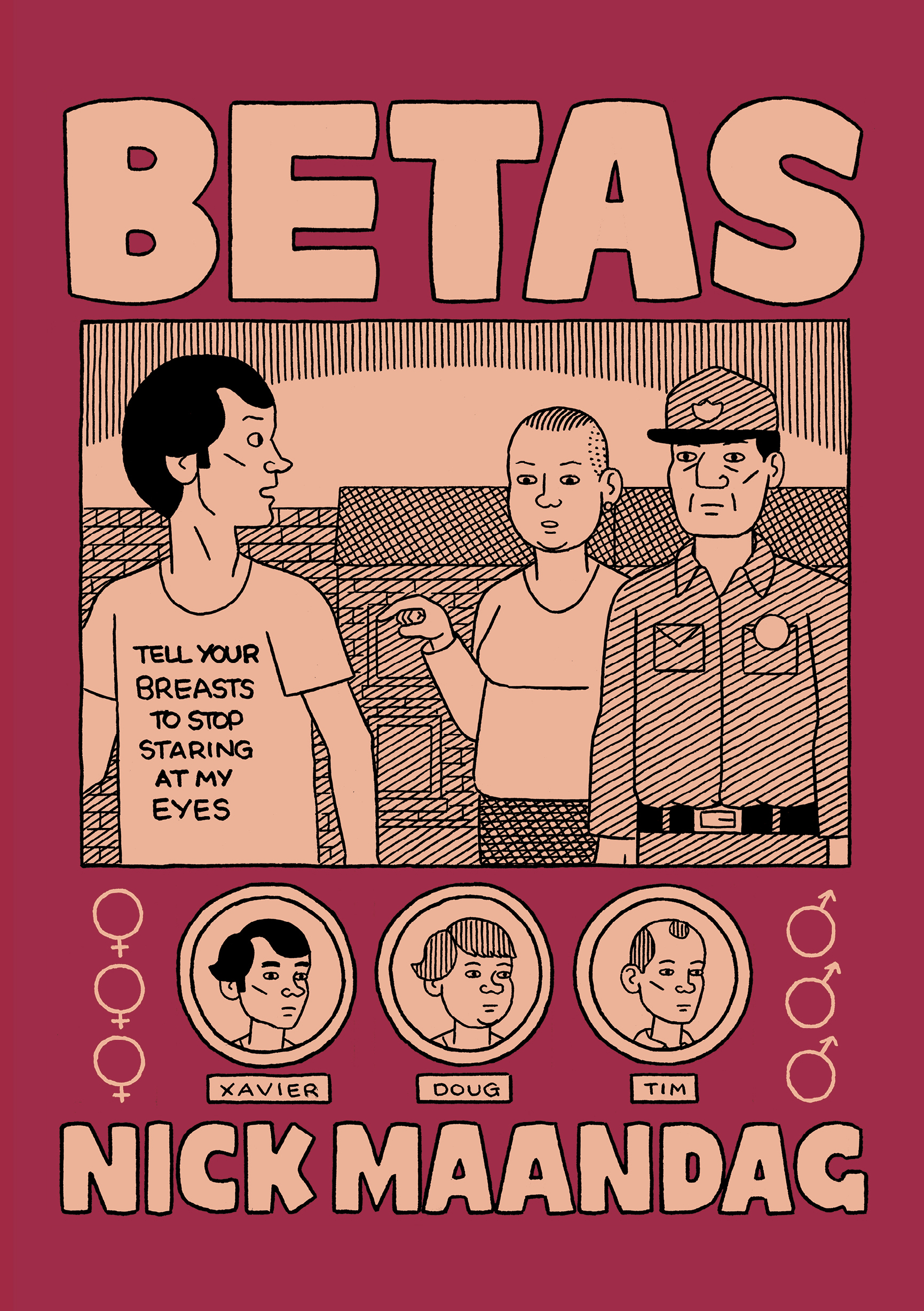
Nick Maandag is a cartoonist living and working in Toronto, Canada. His work is often funny. His latest book, Betas, is a full length graphic novel and wades into the turbulent waters of the current culture wars.
After reviewing Nick Maandag‘s recent graphic novel, Betas (published by Drawn & Quarterly), I interviewed him over email. You can read the review here and the interview below.

Koom Kankesan: Glad you liked the review — why don’t we begin the interview with you responding to my criticism in the review, and we’ll try to discuss the issues?
Nick Maandag: Regarding your criticisms, many other readers have pointed out the shift in tone toward the end of the book. Some think it’s a flaw; others don’t seem to think so. The book, in part, is about male-female relations, and I thought the book would be incomplete without incorporating the darker side of that relationship. The book also discusses the validity of current social ideas, and I thought it was necessary for the Lauren character to have to confront reality and update her worldview accordingly. I think it’s a mistake to say that the Lauren character is dating Doug at the end to express her gratitude. She’s dating him because she wants to. His coming to her rescue is what sparks her desire. But I take the criticism seriously from an aesthetics point of view. Is it such a sharp shift in tone that it feels like two separate things jammed together rather than a single cohesive story? Right now I don’t think so (I generally like art that takes the types of unexpected turns we’re talking about), but maybe I’ll change my mind in five years or so when I’m re-reading the story with fresh and objective eyes.
Kankesan: If we can leave aesthetics aside for a moment, let me ask you more about the relationships and characters. You mention the darker side of male-female relationships — can you elaborate? You also mention that Lauren needs to confront reality and update her worldview accordingly. Can you elaborate on that? The situation leading to the ending of your book isn’t grounded in reality: Xavier would not be brought in front of the Ontario Human Rights Tribunal simply because a mistake had been made over his ‘broad noodles’ comment (this is presuming that a genuine mistake was made and he didn’t say that as an underhanded dig towards Lauren). Also, the way the case proceeds is not representative of how a hearing before the tribunal would proceed — i.e. with Xavier given no counsel, judgments being made against him that are predetermined and biased, etc., so that everything is a foregone conclusion. You’re obviously working in the realm of satire here, even if it’s no longer comedic.
Maandag: When I mention the darker side of male-female relations, I’m talking about sexual violence.
The Lauren character, in the earlier part of the book, is operating under the delusion that there are no natural psychological differences between men and women. We are born as ‘blank slates’, and the culture fully determines how we turn out. At the end of the book, she has an experience that conjures up primitive emotions. She recognizes that these emotions run much deeper than culture.
The situation leading to the end of the book is grounded in reality. He wasn’t brought to the tribunal only because of the noodle comment. It was also because of his flirtatious comments, his ‘offensive’ jokes, and the ‘offensive’ debate they had about gender roles. If you don’t think it’s believable that a case like this would make it to a tribunal, just look up some recent examples. In Ontario, the Human Rights Legal Support Centre is a government-funded organization that provides free legal advice and representation to claimants of human rights complaints, and not to respondents. Respondents are on their own.

Kankesan: This gives me a chance to ask you to expand on what you intended to do with this book, specifically. What makes this work different from your previous efforts? What did you intend to say with it? What’s your opinion of satire and how are you using it?
Maandag: In terms of what I intended to say with the book, I’m hesitant to reduce this to a sentence or even a series of sentences. We tell stories because they can communicate things that other forms of communication can’t. Also, I think artists and storytellers have to have some humility in light of the fact that ideas come from a place deep in the subconscious. We might think we know what we’re up to with a story or work of art, but we can’t know for sure. For this reason I was even slightly hesitant in giving the above answers about the Lauren character and the final events of the book. But I can tell you what I was consciously up to when I conceived of the book. First and foremost, I wanted to entertain. I’m a humourist and entertainer above all else. I also wanted to do a real graphic novel as opposed to another short story collection. I was looking for an idea substantial enough to justify a graphic novel-length story. I realized I could find the humour in my experiences with girls and dating, find the humour in the current culture war, and throw it all together into a single story. I wanted to write about the culture war because I’m against political correctness and censorship. I wanted to make a small contribution, in my own small way, to the backlash. I’ve touched on politics in previous books, but this is the first time I’m taking a side. So, this book differs from previous books in terms of length and political/social content.
I’m somewhat cantankerous and pessimistic by nature, and I have the ability to make people laugh (at least at times), so satire has always come naturally to me. Even as a kid I was doing Mad Magazine-style parodies of sitcoms. One of them was called Bull House. Unlike myself, satirists who have a lot of influence have a chance to help cure ailments in the culture. Good satire is candy-coated medicine. If you’re hearing an uncomfortable truth it will be easier to swallow if it’s presented as entertainment. I suppose I’m using satire in this book for the same purpose, but with the knowledge that my reach is so small, it won’t have any real impact.
Kankesan: In response to your first paragraph: can you talk a little bit more specifically about your “experiences with girls and dating” as well as what you’re contributing to the backlash against political correctness and censorship? Could you expand more specifically on the political/social content in terms of your views in Betas? I understand that this simply broaches the conscious approach of what you’re doing — we can try and tackle the more subconscious aesthetic forces or influences afterwards.
My question about the second paragraph of your answer might be related to the first: you describe satire as “candy-coated medicine” — if the candy is the entertainment, what is the medicine? I think of satirists as being incensed about ills or flaws in human nature and society – that deep down, they really wish to correct or remedy these ills. This means that though the exterior quality of their work and texture may be scathing, deep down it is coming out of a well of concern for humanity. Do you agree or disagree with this, and how so? You say you are cantankerous and pessimistic by nature so I accept that you may not agree with me. Do you believe heartfelt empathy is necessary for satire to work?
Maandag: The events of the book are entirely fictional, but I draw from personal experience. I draw from my lack of success with the opposite sex, as well as the many faux pas I’ve committed on first dates which have disqualified me (along with other factors, I’m sure) from a second date. Many women won’t date you if you don’t share their political ideology.
I hope that what I’m contributing to the backlash against political correctness and censorship is to point out some of the flaws and absurdities. For instance, this tendency to view privilege mostly through the lens of race and gender, rather than class, which is a much more accurate (and much less divisive) proxy for privilege. Or the wrong-headedness of censoring others, even from a selfish point of view. Power’s always changing hands, so when you open the door to censorship, you’ll find yourself on the receiving end of it sooner or later.
The medicine part is truth. We need to know the truth before we can solve problems. I connect satire with pessimism just because of the focus on the negative. I agree that satirists are motivated by a concern for humanity. I believe I’m motivated by a concern for humanity. I believe the case for free speech is rock solid, and I want to contribute to its defense for the good of society as a whole. But motivation is never entirely pure. I think I also have the motivation of an animal who feels threatened. As an artist, I’m one of the people who makes use of my right to free speech. Those who want to take it away are a threat to me and what I value. So, I attack back in self-defense. I think some heartfelt empathy is probably necessary for satire to work. If it wasn’t there it would probably be apparent, and the work would fall flat as a result.

Kankesan: Two questions this time:
A) I want to ask you more about your dating experiences that have contributed to the background of Betas without getting too personal or too specific. Even though the book isn’t an autobiography, do you take your own specific personal experiences and distill or change them somehow? How do you creatively process them? When it comes to creating female characters (and Betas has many), do you have a process in terms of understanding or constructing them? How do you go about deciding their personality or motivations or how they operate? Do you talk to female cartoonists or friends to get their opinions of what you’re doing?
B) In terms of politics, I think I’d agree with you that economic or class concerns are probably the most pressing across the board. As you say, this can also change … racial and gendered identities are often inexorably tied up with economic status. However, I’d have a hard time seeing you as a Marxist, as you tend to critique Marxists and leftists in your satire. Are you committed to a political outlook? Reading your work, I thought you might be a libertarian, but I’m not sure. Is there a particular social or political outlook you’ve tried to infuse into Betas?
Maandag: The experiences are distilled and then adapted to the story. Here’s a tidbit from my dating experience relevant to the book: Because I live in an urban centre and because I’m involved with the arts, I usually end up on dates with girls who identify as leftist and feminist (it’s never worked out with any of these girls). Also, in my milieu, the topic of favourite filmmakers and comedians inevitably comes up on a first date. Around the time that the #metoo movement and cancel culture started taking shape, I was faced with a conundrum. Would I admit, in the initial stages of a relationship, that I was a fan of any guys who’d been cancelled? The answer I always gave to myself was ‘yes.’ As a result, I’ve had countless opportunities to study the reactions of girls as you tell them you’re a fan of Woody Allen or Louis C.K. The reaction is similar to what you’d expect if you were to tell them you’re a necrophiliac.
I don’t really have a thought process when it comes to creating characters. I have a sense of what I want, and the general essence of a character just presents itself to me. From there, I decide what they’d say and how they’d behave. It helped that I listened to hours’ worth of feminists speaking in podcasts to prepare me for the book, and I read a few feminist books too. I’ve also read a lot of popular science books on human sexuality. I feel that I have a good theoretical understanding of female sexuality, though I’ll never understand it subjectively of course. I have no female friends and am not in contact with any female cartoonists. Read into that what you will, but keep in mind I only have a handful of male friends.
I tried my best to keep non-cultural political issues out of Betas, because I didn’t want to alienate non-woke leftists. But I’m definitely not Marxist. I’m a moderate libertarian, so I don’t think we should be too focused on privilege in the way that leftists are. But if you were to worry about privilege and economic equality, class would be the best lens to look at it from. It’s probably easier to say what the book is against than to say what it’s for. It’s against the P.C./woke left (the main focus of the book), and it’s also against an extreme form of social conservatism, represented by the Rug Torrent character and the Xavier character toward the end of the book. The reason I focus more on the left is just because the left is far more censorious right now in Canada.

Kankesan: We’ve been focusing more on theme and content, so I want to give you a chance to talk about aesthetics and artistic choices. Have you chosen the six-panel grid as the dominant structure in Betas deliberately — why so?
Is there a particular visual way you approach your cartooning before drawing, either in terms of panel layout or rendering?
What are some of your influences in terms of what you aspire towards (content as well as aesthetics)? Cartooning specifically, and then beyond (films, animation, books, paintings, etc.) as well?
Maandag: There isn’t too much thought behind my 6 panel grid — it’s just a format I feel works well for comics. Of course I sometimes deviate from that grid, and will sometimes have 5 to 8 panels in a page. I will often use a wide panel for the opening panel of a scene so that you get a feel for the surroundings, and I’ll often use narrow panels when it’s just talking heads, or when one character is pondering something to themselves. This is the same format I’ve used for a good 15 years now, so not unique to Betas.
I don’t focus too much on the visuals compared to other cartoonists. The art work serves the writing, and of course my art is fairly basic. The prep work I do before the final artwork is to serve the storytelling and pacing. I start with a script, which is broken up into scenes, and which have no visuals (like a screenplay). For each scene I then do a rough panel layout with the full text and only very basic, quick sketches. This is to make sure the scene reads well as comics, that the timing is right, that it flows well. Then comes the final artwork. I may continue to make small modifications to the text and layout as I go. In terms of comics visuals, I think cleanliness is key. Was it Joe Matt who came up with the 3 Cs? Comics should be clean, cartoony, and clear.
Because comedy and comedy writing is what I love best, my biggest influences in terms of what I aspire towards are comedians of various stripes. In comics they’re Peter Bagge, Charles Schultz, Doug Allen, and John Stanley. In film they’re Charlie Chaplin, Buster Keaton, The Marx Brothers, W.C Fields, Woody Allen, Jacques Tati, and Albert Brooks. There are plenty of funny prose writers too, but comedy just works better for me as a visual medium.
Kankesan: Great! My last question is — Can you tell readers a bit about what you’re working on now and/or what your next book release will be? Will it deviate from your previous works? What prompted the new project(s)? How do you see yourself approaching them?
Maandag: Next book is being drawn, but far from complete, so I won’t give too many details except to say that it will be a short story collection of at least six stories and will feature some familiar characters as well as new ones. Topics will include AI, workplace politics, bizarre science experiments, and sexually perverted Counts.
Betas is out now from Drawn & Quarterly
