
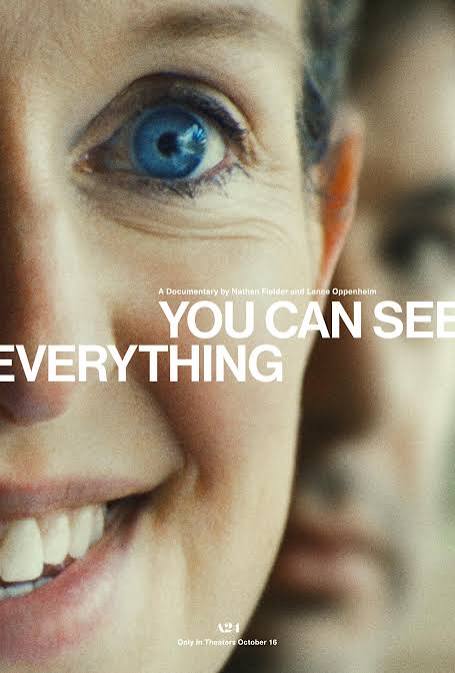
Trying To Parse ‘You Can See Everything’
by Koom Kankesan
Nathan Fielder and Lance Oppenheim‘s documentary You Can See Everything has taken the internet by storm, reigniting interest in Elizabeth Holmes and her massive fraud, Theranos. Although it sounds like “Thanos”, the name of Holmes’ biotech company was supposed to evoke futurism and healthy living (‘therapy’ + ‘diagnosis’). A little over ten years ago, Holmes’ business and technological promise — which purported to diagnose scores of medical tests easily and quickly based on a few droplets of the patient’s blood — were worth $9 billion. Holmes was Silicon Valley’s only female self-made tech billionaire, making her a media darling. While very young (Holmes had left Stanford University after her freshman year to become a tech entrepreneur), she was engaged in a romantic relationship with her business partner, the much older Indian tech industrialist Sunny Balwani. Once the truth about Theranos was revealed (it was a complete fraud), both Balwani and Holmes were convicted and given jail sentences.

A24’s new documentary covers the weeks leading up to the moment Holmes reported for her eleven-year prison sentence. This time is spent at a wealthy beach house in Del Mar, California. Holmes is there with her two young children and her husband, Billy Evans. Actually, it’s unclear whether they’re simply engaged or actually married. As the almost three-hour documentary unfolds, very little remains clear. The truth, and both its subjectiveness and blurriness, becomes the central subject, not Holmes herself. Watching the film, you might think that this is a Nathan Fielder project, in line with one of his other awkward comedic social engineering projects, but we know that he is only the co-director. Nevertheless, it feels like a Fielder when we constantly asking ourselves, “Is this real?”, the culmination of a trajectory which has taken him from his roots in Canada through Nathan For You and HBO’s The Rehearsal. Holmes and Evans seem to have simply requested A24 make a documentary about their lives (supposedly to rehabilitate Holmes’ image), with Fielder and Oppenheim just happening to be the directors who take the assignment. Holmes and Evans seem to have no idea who Fielder is. Similarly, if the viewer has no exposure to his prior projects, they might mistake this for cinema verite, thinking it an objective document about its subjects. Instead, it’s more of a high-concept wrestling match, one master liar going up against another, with Evans thrown into the melee. After witnessing Fielder’s prior work, it’s difficult to believe power is ever wrested from the filmmaker who, with his arch sense of humour and dry irony, retains ultimate control.

As Fielder continues to interrogate Holmes and Evans using his patented wry, stone-faced, awkward-blurted-truth delivery, Holmes insists that she’s done nothing wrong. If anything, she’s been used and maligned. She stares at Fielder wide-eyed, protesting her innocence, claiming that she’s never told a lie that she can remember. And that, to her understanding, simply saying that Theranos could perform the tests was true because it has the potential to fulfill that function in the future when more testing is done and the tech developed. Evans makes the comparison to Tesla’s self-driving technology, which is sold to consumers on the assumption that it will be readily available in the future for their cars. Holmes is unrelenting in her position: her opinion that she is innocent and that people have sold a biased story of her, with the public unaware of what she really is like. In the film, she is shown as sensitive, sometimes crying, frail and vulnerable, doting on her kids. She seems to have an absolutely loving relationship with her partner, and he seems to be very solicitous and caring of her. Fielder and Oppenheim shoot using extreme close-ups for much of the documentary, allowing prolonged intimate explorations of people’s faces, including Fielder’s. It’s mesmerizing.
Things progress towards the date when Holmes must check in to prison, and this is where things get really strange. The couple reveal they’re working on “Theranos 2.0”, and that they will not stop developing the project. Before Holmes leaves for her sentence, Evans has her videographed and recorded so that he can use her likeness to promote their (or is it only his?) tech business. We start to get the feeling that Holmes is once again falling into old patterns, that she is being manipulated by the mendacious Evans … or is it all a ruse orchestrated by Holmes herself? It’s difficult not to think of the documentary Tiger King, which used its twists and turns to take audiences by storm, but this is a much more subtle exploration than that. When you add Fielder’s persona and techniques into the mix, it’s really hard to separate truth from reality.

It’s pretty common knowledge that the second half of the film features reenactments by Amanda Seyfried (who played Holmes in a biopic series called The Dropout), now standing in as Fielder tries to portray encounters with Holmes he couldn’t film. These include an early meeting with Evans and Holmes in which shw excuses herself, and Evans demands a percentage of the profits for their participation (this is very unusual and unethical for a documentary subject). We’re never sure whether Holmes’ disappearance is premeditated so she can wash her hands of the extortionary stink, just like we’re never sure whether Holmes is completely aware of everything Evans is doing on the outside, using her name. As Fielder says to Seyfried, either she’s a victim or the most accomplished liar the world has ever seen. Seyfried starts off wanting to help break Holmes and Evans up, but by the end of the film, she’s as lost and confused as we are.
For viewers who have seen The Rehearsal, this aspect won’t feel new. Documentaries routinely use reenactments to convey information, but Fielder uses them differently. His dramatizations function like an eerie echo chamber that leaves the viewer disoriented, haunted, and unsure. It’s not uncommon to come away feeling like his work has wormed inside you in an unsettling way. In the hyperactive age of social media and reality TV, reality feels undermined, and Fielder exacerbates that uncertainty.
The film’s strength is its knack for focusing so closely on its subjects that something abstruse, almost psychologically mystical, emerges. It’s like a microscope focusing on emotions and revealing the lack of cohesive truth underpinning our consciousness. We know truth is slippery and subjective, that people are complex and contradictory, but this film engages a sublime level beyond that. It doesn’t help that Fielder himself is a fairly inscrutable and deadpan performer practising his own brand of comedy and discomfort, like Sacha Baron Cohen in terms of the intensity with which he commits to the bit. Like Cohen, he could argue that he conducts his social engineering for altruistic or satiric purposes (Cohen claims that his own portrayals aren’t prejudiced, but instead reveal his interviewees’ prejudice), but it’s obvious that both have employed their craft for many years purely for laughs. Sometimes very cruel laughs. There’s almost a sociopathy to the way both have engineered their own brand of interaction and humour, disregarding the feelings of their subjects or the repercussions they might face. However, Fielder’s technique is more subtle and absurd than Cohen’s — he might have more of an affinity with fellow Canadian Matt Johnson, but once again, whatever Fielder is doing is much more sublime than the various comedic variations produced by Johnson.
When you cross that intense, unwavering commitment to a dry, withering persona (and it must be a persona, right? Even this might be in doubt given how long Fielder’s done his thing) with Holmes’ starry-eyed, soft-spoken, doe-in-headlights commitment to how she wishes to be perceived, you have something really odd and metafictional. Add in Evans’ anger, ambition, and alt-right disregard for others, and you have a potent cocktail of fascination and uncertainty. The only person who comes off as even remotely “normal” in this is Seyfried, but she’s a star and actor, paid to play personas that are not herself, including Holmes in this very film. But is Seyfried also playing herself?
The actor was coy about her involvement in the film with interviewers before it was released, and I couldn’t help wondering whether some of the second half was scripted. If everything is earnest and above board, why hide it? In fact, Fielder’s application of his techniques during the second half, enlisting Seyfried to portray Holmes, makes him possibly yet another man trading on Holmes (like Bulwani and Evans) and her notoriety. And yet, Fielder seems genuinely uncertain (as are we) as to who Holmes truly is. Towards the end of the film, Seyfried points out Fielder might ultimately be skewing the documentary in Holmes’ favour because he’s fallen under her spell and developed feelings for her, the same thing which drew many high-powered investors and influential figures to Holmes in the first place.
It’s powerful and reframes and reshapes the long experience of watching the film, but is it real? It feels very similar to the ending of The Rehearsal‘s first season, where Nathan (playing himself) has a similar psychological conundrum about a different topic. Though documentary reenactments are common practice, Fielder’s involve himself in crucial moments, reminding us memory can be both extremely subjective and faulty. As can filmmaking. His editing and arrangement of footage involving Holmes and Evans could also be extremely unreliable. Or it could be extremely insightful and searing. It’s impossible to tell. Fielder revels in this territory, getting off on it, the ultimate payoff being the social engineering he applies to the audience.

The last aspect is probably the greatest strength of the documentary — its focus on truth, subjectivity, and lack of clarity or self-understanding. If Fielder is simply playing that at the end, it’s a master stroke because it’s utterly compelling and believable. He’s a much better actor than he often lets on. We can no more put a finger on his feelings than we can on Holmes. We simply project our own conjectures and suspicions onto his intense expression, his stone-faced mien that’s more mask than messenger. Many people are weighing in on the documentary, but there are few answers or takeaways to be had. People who reported on Holmes years ago are reminding the public that she is a liar and that we shouldn’t be taken in by her deceit in the new film. Certainly, if we step back and look at footage of her from years ago, we see the change in voice, the (perhaps faux) vulnerability she’s projecting, the impossibility of her not knowing what she was doing to investors back then. But watching the film makes us feel very differently. This kind of social project could only result from the interaction of the special entities involved. If Fielder is purposely making us question fundamental and obvious truths about Holmes on purpose, then there are subatomic waves of control and dread at work here I can’t even begin to get at.
The film comes to us at a very interesting time in the world’s development. This is the era of tech giants, of financial juggernauts and titans who reshape not just our outer, but inner, lives. Ways of living that have been established over centuries, if not millennia, are quickly falling away without anyone knowing what the future will hold. These tech giants, more often on the spectrum than not, are unlike the extreme capitalists that drove society to penurious disbalance a generation ago. The insane quest for power, disregard for empathy, and absolute pervasiveness of their tech in people’s lives have brought a state of being into fruition that we little understand.
And yet, it’s as if people and society don’t know how to react to these social juggernauts — we’re both in awe and fear of them, in thrall and paralyzed by their power and tech. There’s the whiff of fraud to what they’re promising. We’ve been stung and will never catch up to the present moment. Holmes’ ambition, outlook, and mystique are a reflection of all this and a confounding one. She’s a woman, not a man, and still relatively young. She’s been found guilty but is unrepentant, determined to continue doing more or less what she’s done all along. Did she have children, knowing she’d be separated from them, simply to garner sympathy? She’s both a victim and a predator; she defies classification and labels. Like quantum physics, she confounds understanding and contains opposing realities at once.
This is also a time of extreme subjectivity. The internet has divided us into factions that seem incapable of hearing or reaching one another. We live in a post-postmodern age. The film speaks to all of these things and is probably the finest thing Fielder has executed, though its methods may leave you queasy. A24 is mounting a campaign to have this film nominated for Best Director, Best Picture, and even Best Supporting Actress (Seyfried) at the Oscars. If they are successful and these nominations happen, this will only complicate the already untenable fog this documentary traverses. If Seyfried is nominated for Best Supporting Actress (for playing the older version of somone she played in a biopic, but also being herself), should Holmes be nominated for Best Actress? Some seem to believe Holmes is capable of award-wining acting levels.
The film is definitely an important one and should be watched. It’s difficult to editorialize or even spoil the film because so much depends on the subjective viewing of it, its effect upon the audience, their reactions and speculations. Its subject is obfuscation, and that’s very difficult to write about in a clear manner. Perhaps F for Fake by Orson Welles could be mentioned as an analogue but that tricky bird, that hybrid form, used its structure as a metaphor for fakery. For Welles, an avid magician, his strange documentary was intended as a mirrored cabinet, a magic trick that showed you it was a magic trick. You Can See Everything, deserving of the ironic falsehood its title suggests, is very much the opposite of that.
