
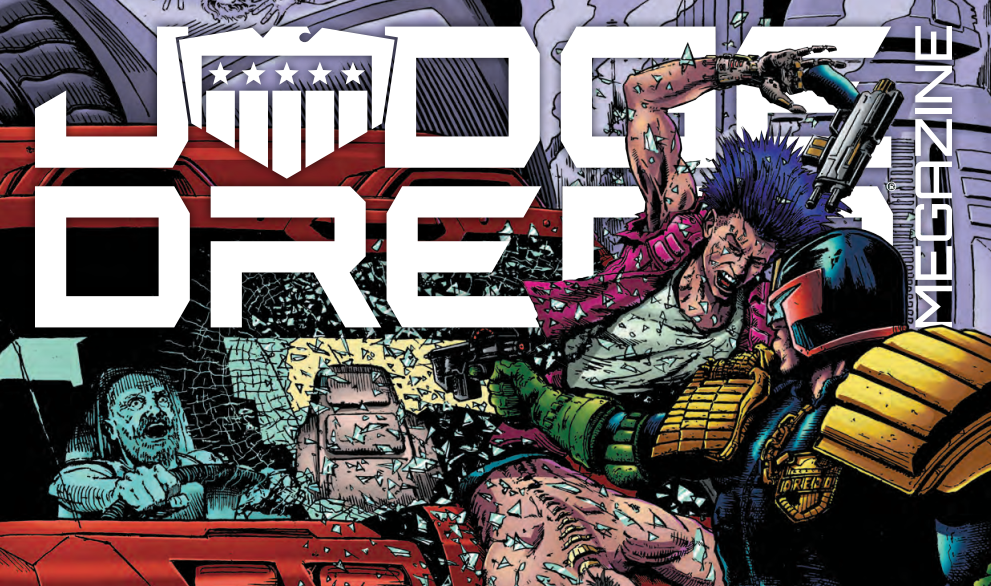
The Monthly Megazine Issue #497: When Dredd Says Stop, You Stop
by Richard Bruton
Welcome once more to the Monthly Megazine — doing just what it says, taking you through the latest goings-on in the sister monthly to 2000 AD.

Here we go, another month, another Judge Dredd Megazine, 100 pages of monthly goodness. This month, same as last month, five strips keeping on doing what they’re doing. Plus a new Treasury of British Comics reprint, Timequake, published back in Starlord.
So, that means part 2, the final part, of Judge Dredd: Rojimbo, where a Hondo City yakuza is in MC-1 looking for a very particular action figure; more from Lilian Storm in Storm Warning, as the investigation into Slaughter House gets deeper and deeper; more from Judge Dredd of the past in Mega-City 2099; more Rogue Trooper in action in the wilds of Nu Earth in An Iteration of Allies, and last, but by no means least, more of the always incredible Lawless by Dan Abnett and Phil Winslade.
Everything starts under another great Dredd cover by Steven Austin.

Judge Dredd Megazine #497 was out on 21st October in the UK. It’s also going to be out in the USA, through your local comic shop, on 18th November — be sure to head into your friendly neighbourhood comic shop to ask them to order it in for you.
Okay, enough with the intro already, time to get into this month’s Megazine. It’s been all lurgy and fever here in Bruton Mansions this past week or so, meaning I’m way, way behind on doing this. So you’ll forgive me if I take this at speed …

Judge Dredd: Rojimbo — Part 2 — FINAL PART — By Geoffrey D Wessel and Nick Roche, letters by Simon Bowland
Toshiro Mikami’s in MC-1 on a mission to track down a particular toy (well, action figure if you insist). As for why he’s in MC-1 for that, well, Wessel and Roche give us a quick interrogation recap in the first two pages. Turns out there’s a data chip in one of the figures, a data chip that could exonerate his cousin, accused of murder.

So, it’s out on the streets for Dredd, tracking down all the Cits who’ve bought that particular figure, before getting caught up in other Hondo City crims looking for exactly the same thing. Nice to see Roche really getting into the bloodshed here …

All in all, a neat little two-parter, just your everyday tale of Judges on the streets, and a little lesson for all of us not to get so wrapped up in the whole collecting thing to boot.

Storm Warning: Slaughterhouse — Part 3 — By John Reppion and Lee Carter, letters by Rob Steen
Oh, I do love Lilian Storm, a grumpy Psi-Judge in Brit-Cit, perhaps matching Amitage for that level of bad-tempered sarcastic greatness. And John Reppion, this time going it alone without partner Leah Moore, has penned several of these, all of them character studies with a nice line in supernatural horrors. This time round, he’s joined on the art by Lee Carter, an artist whose work’s been a pleasure to see getting better and better over the years, with this as his best yet, his style more organic and tempered now, all for the better.
Anyway, Storm’s here in Slaughter House on a Department favour called in by the Slaughter family. She’s investigating the murder of Lord Slaughter, although it’s open and shut that the modified Botler Droid did it. The question’s become more about the why, not to mention Psi-Div taking the opportunity to investigate Slaughter House, somewhere that’s always been officially off-limits to them in the past. So, what is it that the Slaughters and the higher-ups in Brit-Cit don’t want coming out?
It’s a murder mystery, Brit-Cit style, where Storm starts interrogating the plentiful supply of ghosts about the place. The rebellious biker Slaughter tells a tale of his death, then one of the Lady Slaughter tells her own tale, and it’s all shaping up to be about ownership, family, and what people will do when there’s a name and a title up for grabs.
Meanwhile, Storm’s getting pressure to get this job done, and information they want getting…

Yes, plenty to enjoy in Storm Warning for me. Reppion’s doing the supernatural murder mystery in the closed room thing — well, closed stately home, but you get the idea. And it’s all developing nicely. It does help that he (and Leah) have put in the hard work already of developing Storm’s character to the point where you enjoy seeing her in action. And with Carter on the art, it looks quite wonderful, all moody colours and interesting character work all the way through.

Mega-City 2099 — Father’s Day — Part 1 –By Ken Niemand and Conor Boyle, letters by Annie Parkhouse
This one’s a series of stand-alone adventures of past Dredd in Mega-City 2099, but carrying a thread of something through them all. And it’s all rather good.
If you don’t know, Mega-City 2099 refers to the year 2099, way back in the earliest days of Dredd on the streets of the city. When first published in 1977, Dredd was set in 2099, and the timeline has kept pace over the years, with every year for us readers being one year passing in Mega-City One. (We’re now up to 2048).
So Niemand’s idea to go all the way back to the beginning is a nostalgia-fest of a thing. But it’s one that’s done so well. The whole tone of it is different to what you’ll read in the main Dredd strip, harking back to simpler times, writing-wise — why, it’s even got the thought bubbles that were ditched quite early on. Joining him in Mega-City 2099 is Conor Boyle, who was there with the first of these strips, and who does it better than any of the other artists who’ve taken a bash at Mega-City 2099. His black and white tones evoke the best of early Dredd, paying subtle homage to the greats of the past, whilst putting his own, very talented, spin on things.
Here in Father’s Day, we’re getting more into the mystery Dredd’s been gnawing at over the past few episodes, something to do with his origins — known to us all now, but completely a mystery back then, and something the Chief Judge really doesn’t want Dredd to be getting himself involved in. But even back in the early days, Dredd was always one to tug obsessively on the threads of a thing, meaning he’s even going so far as to consult an illegal fortune teller he’s just busted about events of the past few episodes …

But the revelations will have to wait, as the Judge Executioners are on him, and it’s a frantic race to escape for Dredd, thinking all the way as he runs. Only to find himself going, as the saying goes, from out of the frying pan into the fire.
Yes, it’s nostalgia, pure and simple, but it’s great nostalgia, done really well, and it’s a pleasure to have Boyle back on the art here, making every page a retro treat.

Rogue Trooper: An Iteration Of Allies — Part 5 –By Andi Ewington and Sinu Senan, colours by Jim Boswell, letters by Simon Bowland
As with any half decent Rogue Trooper tale, the best way to do them is to set them in the midst of Rogue’s quest to uncover the Traitor General. And that’s exactly what Ewington does here. I’ve banged on about how Rogue Trooper is one of those perfectly realised things, with a perfectly simple driving motivation for the character — find and kill the Traitor General who betrayed him and his fellow Genetic Infantrymen. But the perfect nature of that initial story led to a big problem for anything Rogue Trooper after that initial big story had reached its conclusion — the drive had gone, the reason for the character was over, and anything post-Traitor General suffers greatly because of it. Sometimes, you just have to say enough; the story’s done, let it go.
The answer to that, as I say, is to revisit Rogue when he was vital, where the stories mattered, meaning that these modern Rogue tales are mostly set as interludes happening to Rogue during his quest to find the Traitor General.
Here in ‘An Iteration of Allies’, that means Rogue taking a pit stop at Fortress Itter, a place where Norts and Southers have left the never-ending war on Nu Earth behind, working together. But the war is never too far away, and a whole Nort battalion is now threatening this most unusual of places in the Nort-Souther war.
Ewington and Senan play this out as one big battle sequence here in this episode, Rogue and the Fortress’s soldiers doing all they can to repel the Norts, and fighting to keep their unusual truce alive. It’s page after page of Rogue action brought to life really well by Senan, all the best bits of Rogue on the pages here…

Everything is very simple and straightforward, and there’s no criticism of that from me; it’s a fun little war tale, with no real peril, such is the nature of these interludes. But it’s well done, and it’s an enjoyable piece of Rogue to be read as nothing more, and nothing less, than another little sci-fi war tale for us to enjoy.

Lawless: The New Brutalists — By Dan Abnett and Phil Winslade, letters by Simon Bowland
You know, Lawless just gets better and better as it rolls through the series. Every time Abnett and Winslade pull one out of the bag, it’s something different, always hugely enjoyable, but there’s just the sense that Abnett has so much fun doing these adventures of Colonial Marshall Metta Lawson, the Justice Department’s representative out here on the frontier township of Badrock. Over the many volumes, all of them absolutely essential reading, she’s got through the mill so many times, each time Abnett and Winslade finding new ways to impress.
Here we have something different again, as this series is a set of self-contained little vignettes in the world of Lawless, each of them giving us moments in the lives of various characters, teasing us, tempting us, enthralling us with how everything fits into the ongoing saga, and seeding future plot threads along the way. Oh, it’s oh so good, it really is.
And here we have something that’s not just good, not just great, but something that allows Abnett to indulge in a little sentiment, giving us 10 pages that are just beautiful.
It all starts with the latest in a series of guerrilla art raids on the streets of Badrock, something Lawson isn’t exactly impressed with …

Oh yes, the wonderfully grumpy Lawson — the Megazine does seem to have its fair share of gloriously grumpy characters, with Lawson being the finest of them all.
Anyhow, through various twists and turns, Uplift Deputy Kill-A-Man Jaroo ends up investigating just how the hell is doing all this street art, only to find out that the artist is rather close to home… other Uplifts, the genetically enhanced apes used by the Justice Department as workhorses. Sure, Jaroo’s respected and loved in Lawson’s camp, but the history of Uplift exploitation runs deep in those not so respected …

They’ve been making their art as a protest, and Jarroo knows only too well how that desire to make art, to express your innermost feelings. And then we get a moment where one of the strange little mysteries running all the way through the last series of Lawless is revealed. It’s all about the book that everyone’s been engrossed with, ‘Lift and Liftability,’ written under the pen name Jenette Plaidly. Oh yes, it’s a little bit of a surprise to all involved.
I’ll say no more than that; you connect the dots. Even better, go read the damn thing; it’s absolutely the greatest thing that’s been in the Megazine for many, many years.
Suffice it to say that Abnett is doing this magnificent thing, crafting this huge saga of Badrock here in Lawless, the continuing adventures of Colnial Marshall Metta Lawson. But here, in these little one-off vignettes, Abnett goes further, gives us more of this little world and its people, tales that have been fun, fascinating, silly, weird, and now, something that eclipses them all: this wonderful little tale of the disenfranchised finding themselves recognised, of the oppressed given a voice, and of one little backwater world taking giant steps towards making the world a better place. That final page, the culmination of this little 10-pager, is something that brings a tear to Deputy Nerys’s eye, and perhaps mine as well. A perfect little bit of storytelling.
And of course, all of it is accompanied by the incredible artwork of Phil Winslade. Through all of Lawless, Winslade’s impossibly detailed work, in glorious black and white, is something that’s the envy of his fellow comic artists.

TimeQuake — By Chris Lowder. Art by Ian Kennedy, John Cooper, Alberto Salinas
Finally, time for the Treasury of British Comics reprint now, with Timequake from Starlord, the sister publication to 2000 AD back in 1978.
It’s a classic of sorts, with James Blocker reluctantly recruited into Time Control, a shadowy agency fighting to stop anyone messing with time. A classic idea, of course it is, one that’s been done again and again, but there’s a real joy to reading this one, full of all the foibles and problems of strips of the time, yet a great thing nonetheless.
All of it is made all the better by the trio of artists involved, working in both b&w and gorgeous colours — Tornado had a much bigger budget than other comics at the time, meaning they had better production values and even the odd colour pages.
So yes, it might be a reprint, but there’s much to enjoy in the sheer escapism on show here in Timequake.


