
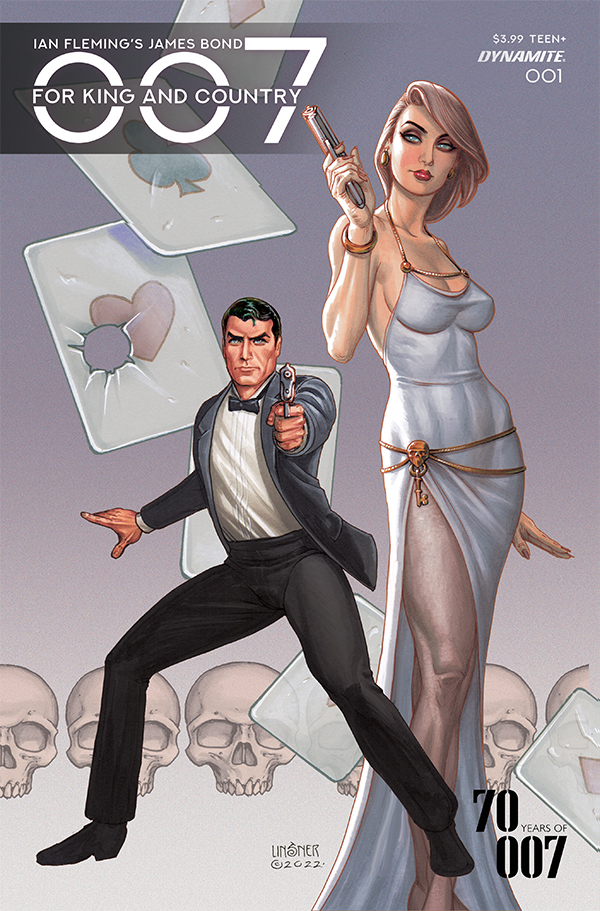
What It Means To Be Cool- Writer Phillip Kennedy Johnson Talks `007: For King And Country’
by Tom Smithyman
James Bond is back and just in time for his 70th anniversary. The new series 007: For King and Country, debuts this week with Phillip Kennedy Johnson again taking over writing responsibilities for the suave British spy. In an exclusive interview with Comicon.com, Johnson discusses what makes a good Bond girl, how he keeps the longtime spy feeling fresh and how writing is like making jazz music.
Tom Smithyman: You’ve had a chance to write Bond before. What is it about the character that makes him so interesting to write?
Phillip Kennedy Johnson: On the surface, he’s the very personification of what it means to be cool. Cool under pressure, always put together, has the car, has the gear, gets the girl, always has the perfectly biting quip. It’s SUPER fun to write dialogue for a character like that. But underneath the cool confidence and the hard exterior, he’s damaged and cynical. He pretends not to feel any particular way about the things he’s done and the people who die all around him, and he has complicated feelings about his reasons for doing what he does. And for me personally, writing different styles and dialects of English than I usually get to write is mad fun. 007 is a complete joy to write, full stop.
Smithyman: You’re bringing back Bond girl Gwen Gann, your creation from your previous series 007. In addition to being a 00, what makes Gann different?
Johnson: There’s a line from one of the novels in which Bond refers to his latest conquest as “ten years his junior and five years too old.” We’ve seen that attitude from Bond pretty consistently over the years, and I thought it would be more interesting for our story’s Bond girl to change it up in some notable ways. Gann is still hot as hell and up to her neck in intrigue and mystery, but she’s also a little older than Bond, and someone with whom he already has history. Instead of a fling that Bond promptly walks away from, she’s the one who got away, who he remembers with great affection and greatest respect. 
Smithyman: When I was growing up, a lot of the Bond movies felt very cut-and-paste. How do you keep the stories feeling fresh after 70 years?
Johnson: I grew up on John LeCarré novels, and I wanted to see a 007 story that explored more of Bond the spy. We typically see Bond ride in, give everyone his real name, go straight for the mark’s girlfriend, kill a ton of people, blow shit up, and generally make a ton of noise. That’s not how spies do things. It’s still 007, and there are still all the cornerstone elements that make the franchise what it is, including the cars, the gear, and a TON of action. But I wanted to also see Bond use some spycraft and operate more in the shadows than he usually does, so we’ve made space for that as well.
Smithyman: In addition to writing comics, you are a trumpet player, composer and lover of jazz. How does the freestyle nature of jazz compare to your writing process?
Johnson: To me, the most similar element between making music and making comics is the collaborative nature of both. Ideally, there’s a ton of interaction happening between the creative team all the way through both processes. If you replace any one member of any jazz combo, including the less obvious roles like the bassist or the chordal instrument (usually piano or guitar), the entire product COMPLETELY changes.
The same is true of any comic. Even nuanced little differences in color palette, lettering style/placement, or line width that are subtle enough that you might not consciously notice can have an impact on the tone, energy, or rhythm of a story.
There are also lessons of form, pacing, and flow that I think apply to many different mediums, including music and visual storytelling. Jazz musicians use universally recognized songs called “jazz standards” as vehicles for stylized melodies and improvised solos, each musician putting their distinct mark on songs that have been played for a hundred years in all kinds of ways.
Go to any Artist Alley in any Comic-Con in the world, and you’ll see comic artists drawing commissions of iconic comic characters in exactly this way. Their My Funny Valentine, All The Things You Are, Bye Bye Blackbird, etc. are Batman, Superman, Spider-Man, Deadpool, and all the rest. Those are the vehicles through which comic artists express their skill, even while inventing their own characters and stories the way jazz musicians write their own originals and drive the medium forward. I could go on for whole chapters about this. 
Smithyman: Do you remember the first Bond movie you saw?
Johnson: When I was about 11, I spent a weekend with my grandmother, who watched a fair bit of TV at that time. One of those old TBS 007 marathons was on, and holy shit did we watch a lot of Bond that weekend. I was struck by how varied the actors’ takes on Bond were, and in those pre-Daniel Craig days, I liked Sean Connery’s take by far the best.
Smithyman: OK, hear me out on this. You wrote a well-received Superman arc. Henry Cavill played Superman in the most recent movies. Cavill is supposedly in the running to be the next James Bond. You’re trying to send us a signal here, aren’t you?
Johnson: It’s gonna be hard to replace Craig for me, man. Going forward, I think I need my Bond to have that same physicality, that same confident, threatening “I-Dare-You” in his eye, and to carry the same unspoken threats in his manner and delivery. A lot of the earlier guys LOOK the part, but now that we’ve had Daniel Craig for a while, some of the earlier Bonds they seem too foppish and unthreatening by comparison – too into their women and boozing and looking cool to be bothered with the business of killing people. I know those other elements are also part of the character, but first and foremost, I want my “blunt instrument” Bond. I can’t go back. 
Smithyman: So that said, who would you like to see slip into the driver’s seat of the Aston Martin?
Johnson: After how they left things in No Time To Die, I imagine they’ll want someone younger than my choice, someone with tons of years to give the franchise. But for my money? Tom Hardy.
Smithyman: You heard it here first, folks! Thanks for the time, Phillip, and best of luck on the new series.


