
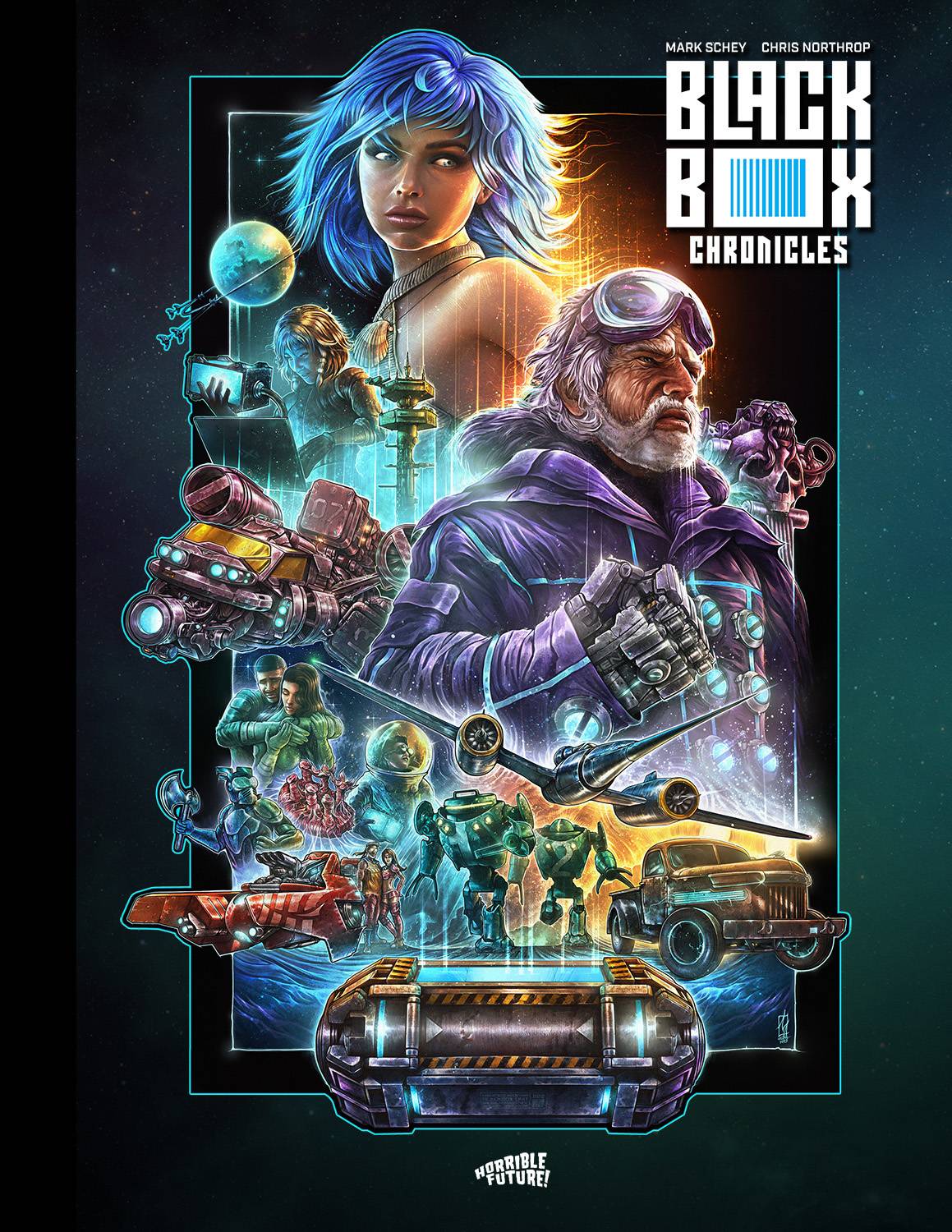
Hard Sci-Fi: Discussing ‘Black Box Chronicles’ With Writers Mark Schey And Chris Northrop
by Tom Smithyman
The most successful science fiction anthology in Kickstarter history will hit book stores next month with the release of Black Box Chronicles. That book has 15 intertwined shared-universe stories from top creative talent, including David Mack, Michael Avon Oeming, Taki Soma and David Messina. Just a few days later, Black Box: Design Space will also be released, featuring schematic drawings and paintings of spaceships and other technology in Chronicles. In a Comicon.com exclusive, co-writers Mark Schey and Chris Northop of Horrible Future discuss a dual launch and the nature of “hard sci-fi.”

Tom Smithyman: Black Box Chronicles originally started as a crowdfunding campaign on Kickstarter. You blew past your original goal of $7500 and hit over $100,000. How surprised were you when over 1600 people backed the project?
Mark Schey: We were fortunate enough to have some fantastic talent on board, so we certainly hoped their fans and the concept would draw people in. To our knowledge, we’re the highest-grossing sci-fi anthology in Kickstarter history. That’s certainly not something we expected on our first outing as Horrible Future and we’re deeply grateful.
Chris Northrop: There was what I was expecting and where we ended up at. I expected it to do well. It did fantastically. I’m extremely thankful. It validates all the hard work and our future as…Horrible Future.
Smithyman: And now you’re bringing it to the masses. Do you think a wider audience will be as receptive as the Kickstarter crowd?
Shey: I’d like to think having a successful Kickstarter is indicative of consumer demand. Ultimately, it’s going to come down to the reception and word of mouth. Chris and I made the book we wanted to, while challenging ourselves, building new professional relationships, and becoming better at what we do. The themes are important and timely to me, but new intellectual property is tricky and the retail shelves are crowded. I’m cautiously optimistic it will find its audience, and we have a lot more stories to tell including an original graphic novel and other related projects in development.
Northrop: Kickstarter is a good indicator of how wider audiences will receive books. Yes, you have a specific audience there. It is certainly a direct sale to Magnetic Press’ built-in audience, but it absolutely surpassed that number. If a Kickstarter campaign exceeds its funding goal by a wide margin, it validates that there is demand for the product in any market.
Smithyman: At almost the same time, you’re also releasing Black Box: Design Space, which features many of the ships in the stories. Isn’t it risky releasing both at the same time? Why did you make that decision?
Schey: We had a substantial amount of material from our concept artist, Shane Molina. He’s brilliant, and his enthusiasm is infectious. Because of this, a lot of the art was already done. Additionally, our publisher, Magnetic Press, has a lot of collectors who enjoy the high production value of the books and slipcases. Adding a second book gave us a unique slipcase for our backers. We also thought it would be entertaining for all readers to have a “visual encyclopedia” of ships, locations, and technologies outside the main book. In terms of risk, every book you make is a risk. We were already all-in on Black Box Chronicles and had the support of our publisher. If you have the opportunity to get more art into the world, I think you should take it.

Smithyman: You’ve talked about Black Box Chronicles as “hard sci-fi.” Are you making the distinction between stories like yours and those that veer toward science fantasy? What makes hard sci-fi?
Schey: Specifically, we steered away from magic and fantasy in Black Box Chronicles. The technology progresses substantially beyond what we have today, but we tried to make it all theoretically possible. For example, in one of the stories, we have an orbital station known as The Loop, which is a decommissioned military base that’s now a race track. You’ll see in Design Space that Shane’s original concept art was visually awesome, but the original design was too large and close to the planet. I asked him to make a new version closer to a geosynchronous orbit and use counterweights to keep it in a stable orbit.
At the same time, this is still sci-fi that takes place centuries from now, so readers will still be seeing “fantastic” things. But we try to explain them with our current understanding of where science and humanity are heading. If I had to place it on the sci-fi spectrum, I’d put us somewhere between The Expanse and Star Trek, but with an emphasis on human drama like The Last of Us.

Smithyman: You have done an amazing job of assembling some of the top artists in comics including David Mack, Michael Avon Oeming and Zach Howard. What was your pitch to them to get them to contribute to this project?
Schey: Thank you. It certainly helped that we started with Mike Kennedy of Magnetic Press greenlighting the project very early on. While we’re Magnetic’s first original IP, their reputation for producing stunning, Eisner-nominated books opened doors. In terms of the pitch, every story in the anthology is based on the recovered flight data recorder of a crashed spaceship. I think it’s easy, especially for professional storytellers of this caliber, to immediately understand how this could be a fun sandbox to tell dramatic stories. David Mack agreed to do a cover very early on and I’ll be forever grateful. I met Mike Oeming through longtime mutual friends and still speak with him and Taki Soma regularly. Everyone else was through Chris and our relationship with Magnetic.
Northop: My position at Magnetic Press was certainly helpful. Outside of that, I checked out a list of artists I know, having worked in the comic book industry for the past 10 years. Some of these artists I’d already built connections with. I’ve worn different hats in the industry, from colorist to writer to letterer, at places like Legendary, Top Cow, and Archaia/Boom. That said, I also came across a few new artists. But when I told them about the project, they were all excited to dive in and illustrate their stories. Now I consider them all friends, so it was a very rewarding experience making Black Box Chronicles.
Smithyman: Was it at all difficult working with so many different artists, or was it easier to flesh out the mosaic of stories you were trying to tell – as well as meet your many deadlines?
Schey: This was the most exhausting part of the project. Chris and I were creating a new sci-fi universe while also juggling the schedules of about a dozen art teams who work in slightly different ways. And we were always looking for ways to add connective tissue to these independent stories, which further complicated the process.
Assigning the right artists to the right stories (playing into their artistic strengths) was important. We also had to adjust story lengths at times almost until the day the book was delivered to the publisher. Sometimes an artist would say, “I can do this story for you but only 10 pages,” so we’d have to trim it. Or, we’d finish a story, and the artist would have unexpected downtime and we’d add an additional three pages. At the same time, I wouldn’t change anything because we learned so much about collaboration and expanded the list of artists that we’d love to work with in the future.
I also love how each artist brought a different interpretation of the world. Chris is an excellent producer and I have experience producing for television, so I think that helped us keep everything manageable.
Northrop: Whew! Project management… yeah. This project really put me to the test. I’ve had some whopper projects in front of me in the past…but this was a hell of a task. Keeping everything on schedule was a real puzzle. Every creative on this book either has kids, other jobs, full schedules working on ongoing series, etc. That’s 13+ people with 13+ sets of needs and considerations to be met.

Smithyman: What is the writing process like with two of you scripting? Is it a 50-50 split on each story or does one take the lead and the other polishes?
Schey: Independent of the writing credits, every story has both our fingerprints on them. It was definitely a collaboration. Some of them we’d write 50-50 in real time, while others we’d go off on our own with the other doing a polish. However, we’d always do a polish (or 10) together and make suggestions for each other’s work. A huge benefit was that Chris lettered the project, so we’d do a readthrough on every story and tweak it throughout the process.
Northop: (laughs) It was a lot of nights going back and forth about each and every story. Mark has a lot of similar personal experiences to me concerning some of the subject matter in certain stories. So it served as a way to work things out we both find important.
Smithyman: OK, this is a dark question, but bear with me. Since Black Box Chronicles is all about recording people’s last moments, what would you think your personal black boxes will reveal?
Schey: This is a fantastic question because it’s exactly what this book is about when you strip away the science fiction. It’s meant to have us reflect on our own mortality and place in the universe. I’d like my Black Box to be a boring one, recording me at an old age surrounded by my family. Many of the fears of my personal Black Box are reflected in the stories, from losing a child to seeing a family member succumb to Alzheimer’s, which was inspired by my grandmother.
Another story is based upon the grief I’ve seen surrounding the death of my sister-in-law and a main character is named after her daughter, my niece. I don’t mean to sidestep your question, but the more personal stories already reflect what could realistically be on my Black Box.
Northrop: I’m inclined to agree with Mark on this one, mostly. It’s a great sentiment, yet I can’t help but envision going out in a blaze of glory by taking on an even larger and more complex project. Successfully tackling endeavors like this can be compared to attempting to land a jumbo-jet on a tiny runway. My hope is that whoever reviews my Black Box would be left thinking, “Wow, that was truly impressive.”
Smithyman: You’ve already achieved something pretty impressive. Best of luck with the retail version of the book.
