Love And Gardening: Reviewing ‘Poison Ivy’ #20
by Scott Redmond
Overvview
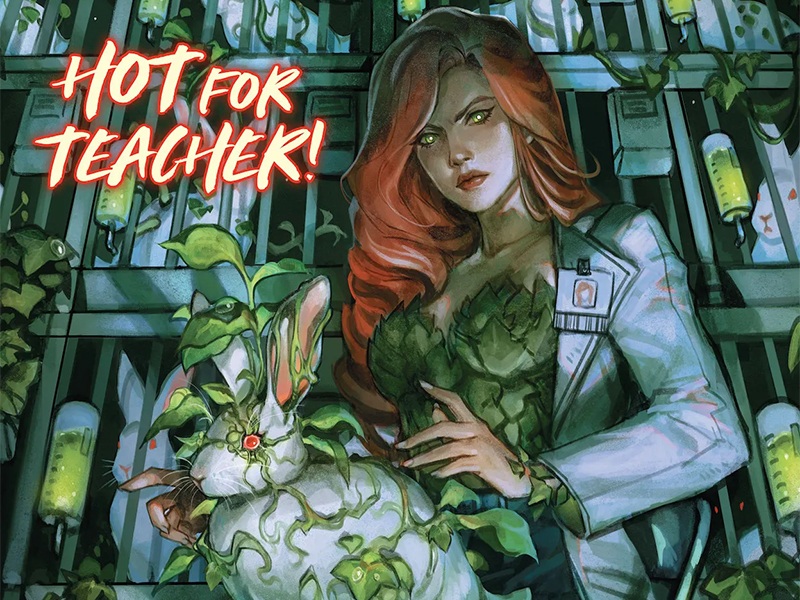
Life continues to flash by Pamela Isley’s eyes as ‘Poison Ivy’ #20 continues to lay out the story that began it all for the popular eco-villain. Everything about this series continues to just fire on all cylinders, delivering one of the best solo character books that is on the stands today.
Overall
10/10A couple of choices, whether good or bad, is all it takes sometimes to reach a life-altering crossroads situation. Love in the wrong place, jealousy, professional rivalry, and putting faith in the wrong man. Those are but a few choices that led Pamela Isley to her ultimate poisonous destiny.

The long-awaited in-depth origin story for the leafy villainess continues in Poison Ivy #20. Another beautiful showcase from G. Willow Wilson, Marcio Takara, Arif Prianto, and Hassan Otsmane-Elhaou.
Comics of a super variety are known for big bold action scenes. Heroes and villains smashing all over each other. Yet, some of the most compelling books I’ve ever read comic book wise have had not a lick of action (of the fighting variety) to be found. This would be one of those stories.
Batman and a few of his rogues are not strangers to having their origins told repeatedly (ad nauseam in some cases). Poison Ivy is one of those that has avoided this in the past, which is a shame. However, it’s also not because it gave this creative team the room to run with all the various threads and bits dropped in the past to create something so rich.

Willow gets this character so much and never shies away from the darker sides of things. We witness how Woodrue led her down a destructive path, that she chose to continue to follow despite knowing how terrible he was. We’ve been taken on quite the journey since this whole series began. This latest arc brings so much of it full circle, helping complete the journey of really moving Ivy to the character tiers she has long deserved to belong to.
Bella Garten, later known as the Gardener, is a new character. One of many to debut during the James Tynion IV and Jorge Jimenez era of Batman in 2021. Her past with Ivy was a big part of that story and her future appearances. How she is woven into the back story so seamlessly is not surprising. What stands out though is the familiarity that allows this brand-new character to feel like one that has been around for decades.
Character-rich stories are powerful but work best when visuals fully display the human experience. Emotions, body language, powerful sequences that have tangible weight to them. Takara does that with relative ease, issue after issue.

Issues with characters talking require a different touch than those full of action. The latter story can have big sequences full of fluid movement that keeps the eyes engaged. One of the ways to keep a talking head issue in that realm is through paneling choices. Here we see that as the panels shift and move, giving us a lot of very tight up-close shots. Characters’ emotions are right there in our faces, as are all the moments.
We’re not passive observers but actual participants in this story. Backgrounds that bleed away, gutter white space as frames, panels of every size, shape, and variety, and more achieve that sense of movement. Even when the characters themselves are relatively stationary for chunks of time.
Richness is always felt in Prianto’s colors. Vibrant and powerful, while being tonally muted in different spaces. Creating that duality, we love of a world that is familiar but also outlandish to our sensibilities.

Shadows and darker tones are added to the mix, keeping the harsher feeling of this series close to the surface. Eco-horror was the flavor of this book from the very beginning. Even as those elements take a momentary step back, the horror vibes are still very prevalent. Rather than eco-based, the horror is coming from Woodrue and the threat that men like him present.
Takara and Prianto make sure we feel that every moment the man is on the page. He becomes more and more menacing as we dive deeper into the story, often in silhouette. Brighter colors take a step back, as if life is being drawn from them, as the heavier darker tones grow in size.
Helping with the variety of emotional turns is the always stunning work that Otsmane-Elhaou delivers time and time again. It’s not just making sure we can hear the volume or tone of a given moment or the personality and emotion of a character. It’s taking those to a larger level with the very dramatic shifts in the lettering for dialogue or captions. There is no mistaking or misinterpreting what we’re meant to hear or feel at any given moment.

Letting the bubbles and fonts shift for different characters, speaking to personality traits or emotions that should be stoked by their presence. White font on black backgrounds, no bubble or box in sight. Shifting of cases for big emphasis on particular moments.
It’s all small things in a way but are also major things. It’s these things that allow us to truly get the complete picture of a story. Sure, the story works without these flourishes, but it would not reach the heights that this completed collaboration finds month after month.
Poison Ivy #20 is now available from DC Comics.