
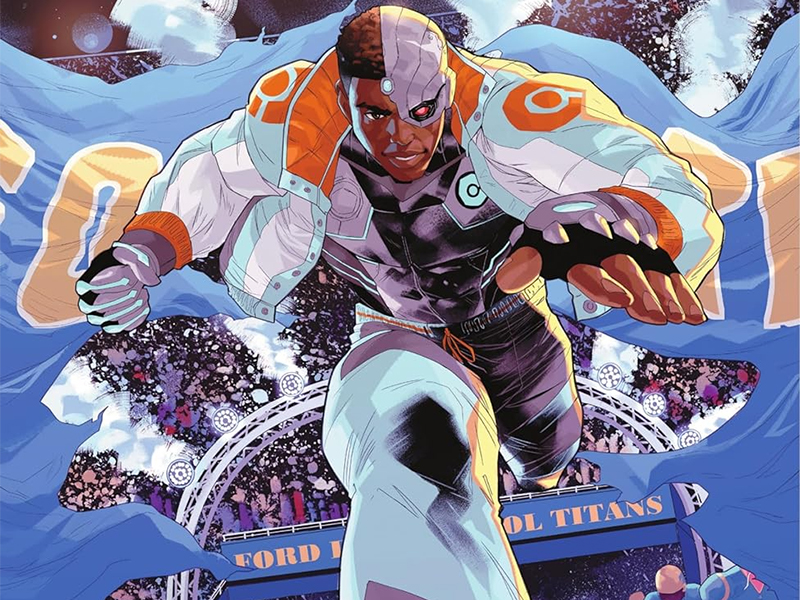
Skin Of Metal, Heart Of Gold — Reviewing ‘Cyborg: Homecoming’
by Scott Redmond
Summary
One of the hearts of the Titans gets his much deserved spotlight once more, in a big superhero romp with such heart. An emotionally rich powerful story that resonates so much both for societal but also relatable human reasons.
Overall
9/10Booyah! When a new dawn began for the DC Universe, Titans stalwart Cyborg was one hero that got to rise. Once more, the human and machine hybrid was a headliner of his own series showing how this proverbial Tin Man has a massive heart of gold.

Cyborg: Homecoming, a six-issue series, has now been collected for the complete reading experience. The series is from Morgan Hampton, Tom Raney, Valentine De Landro, Travis Mercer, Bruno Abdias, Michael Atiyeh, and Rob Leigh.
I love the Titans, both teen and adult editions, and Victor Stone is up on the list of characters I love the most. There is the whole human vs technology aspect to the character as well as the great friendship with Beast Boy. But chiefly he’s a very intriguing Black character with heart and brains.
Back during the whole New 52 era they tried to make Cyborg bigger by rebooting him as a Justice League Founder, but he’s always been pretty huge. My man here is not only in comics regularly but the Teen Titans/Teen Titans Go! version has been in pop culture for two decades. He’s been in big-screen films and is a regular on the Doom Patrol TV show. In the comics, he’s back with the Titans, the Justice League stuff still there mixed into his origins. The character is far better for it.
This is where he belongs.

Right away, Hampton taps into that energy. Giving us a fun and welcoming introduction that thrusts that title character right into the thick of things. Cyborg single-handedly taking on, and taking down Mammoth and Gizmo, perennial Titan foes, is a solid place to begin. It’s familiar, while also showing off what this character can do. Our peek into the heroic works is a good segue into the deeper emotional elements of the story.
This is a father and son relationship story in a way, but one that has flaws and issues. It’s not often that we get to see stories with a Black hero getting to be vulnerable. Victor Stone, though, wears his heart on his sleeve and doesn’t shy away from his emotions. The broken relationship with is father has molded him in various ways.
There is no shying away from how tough the relationship is between Victor and Silas. A controlling father who is never happy with what his son chooses to do. While the son pushes back against this, he also seeks validation, knowing it won’t ever come. All of this is perfectly blended with the overall story of Solace tech and the dangers that tech can bring if we allow it to control and replace people.

What makes that second part of the story work so well is that Hampton hits the points without needing to shout them. We hear the points of view of everyone involved, while understanding one point is closer to correct than the others. We’re not surprised to find out that Solace is hiding something and might have something to do with Silas death.
I love that this story is heavily centered around Black characters. From the title character to his family and supporting character and even his likely foe. Yet, it never has to openly point that out. It treats all of that as if it’s completely normal because it is and should be.
I hope we see more from Hampton, either with this character or others. I’d love to see him take a bigger crack at the Titans, maybe in a one-shot or mini-series, or even the main series down the line.

Speaking of guiding hands, calling upon Raney, a veteran in the superhero field of comics, artistically works greatly for this series. Raney has a sort of timeless classic appeal to his work, with enough modern flairs to make it fit the time. Character facial expressions are on point, the motion is smooth and fluid, and there is an almost whimsical rough appeal to all of the work. It works perfectly because Victor Stone’s story is a rough one, and the overall story does not shy away from this.
I really dig it when artists set up panels in a way that allows for white space that can perfectly frame the panels. It breaks things up some but also just creates a very intriguing visual effect. Especially when the panels themselves are slipping and sliding around the page in various shapes and styles. Stacked over each other or slashing across the page, leading right into a big collage double page spread origin montage that distills the story down to simple moments but powerful ones in the right artistic hands.
De Landro’s pages are quite different in style and tone to those from Raney, much more ordered and detailed but still somewhat rough. In a way, they very nicely fit the persona that we see of Silas as they heavily feature him in the moments before and after his death.

Mercer’s style is one that really works for this book but also superhero stuff in general. It has a very light, slicker, and smooth, type of appearance. Just the right amount of exaggeration reminds us these aren’t real characters, grounded by settings and spaces that have depth and tangible reality to them. Every emotion is not only clear on the page but feels like it’s coming off in waves we can feel.
Love the choices for paneling that come into play here, especially on the action pages. It allows us to live in the moments even more, right there alongside Cyborg and feels epic. Characters have presence and motion, energy crackling all around. Some of those action pages where all background fades, just homing in on the characters, debris, and action are the type that stick with you afterward.
Abdias’ style pulls back on the exaggeration/whimsy we see from Mercer, going more for the grounded more real type of feel. It works quite well as it really lets us sit with the characters, eschewing all the fantastical trappings of the story (even as they are in a digital space) to focus on the human elements at play. That’s not to say there aren’t big bold dynamic moments, as all the pages in Solace’s mind show off.

Again, the action is framed so perfectly with us right there in the mind space with the characters. Both sets of pages hit home what Cyborg is capable of doing beyond being a Boom Tube taxi or guy with an arm blaster. Makes one wish the character had a full-time series presence and was more focused on how awesome he can be.
We see the weight of this story and the various artwork styles in Atiyeh’s color choices. Heaviness is translated from the more muted color palate, allowing for some of the more vibrant elements (chiefly the digital/superhero stuff) to pop even more. It creates a grounded sense that makes the main aspects of the world feel real to us. This is just a space like the ones we know, but there happens to be robots and other stuff popping up.
There is a lot that Leigh gets to bring to the page when it comes to a story like this. With the various heroes and robots, there are ways to throw in colorful or different types of speech bubbles and captions. I’m partial to the orange and blue, with a circuitry pattern, caption boxes for Cyborg that just pop. Leigh is always so good at capturing emotion and tone with the way that the letters are put onto the page.

We can hear exactly what a character is feeling and meaning with their words, making their voices crystal clear. Alongside that are the fun colorful, at times ominous, SFX that are front and center where they need to be. Lettering is so important to a comic because it helps finish creating this world for our visiting pleasure, and Leigh does it so well.
Cyborg: Homecoming is now available from DC Comics.

