
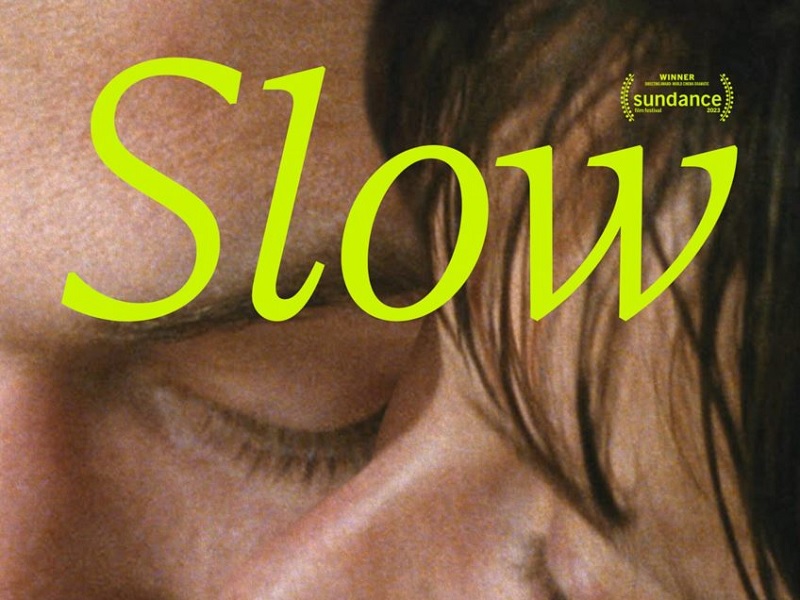
An Interview With ‘Slow’ Writer-Director Marija Kavtaradze
by Rachel Bellwoar
In Marija Kavtaradze’s second feature, Slow, Elena (Greta Grineviciute) finds herself questioning everything she took for granted about love after meeting Doyvdas (Kestutis Cicenas), a sign language interpreter who identifies as asexual.

Beyond showing what asexual romance can look like, Slow is a film that shows what can be achieved when people make accommodations for others. Whether it’s hiring an interpreter to teach a dance class (which is how Elena and Doyvdas initially meet) or creating virtual options, everyone can benefit from being open to new things and considering accessibility.
Chosen as Lithuania’s Oscar submission this year, find out what Kavtaradze had to say about writing and directing the film in the following interview:
Rachel Bellwoar: In the past asexuality has been largely ignored by pop culture (the main exception I can think of is Jughead from Archie Comics). Was that lack of a template for what a movie about asexuality should look like exhilarating or daunting?
Marija Kavtaradze: Before writing, I also knew Todd from Bojack Horseman, who realises he is asexual during the series. He’s a really cool character that I just love.
My first film was about mental illnesses, so there were plenty of examples and I knew exactly what I like and most also what I dislike about representation of mental disorders.
With asexuality it was tricky. There were so few examples that I didn’t have things that I am running from. But it was interesting, I tried to do research as well as possible, and be respectful to my characters and the community.
Bellwoar: Rather than emphasize verbal communication, Slow really shows how much people communicate physically. How has working on this movie made you rethink your use of music and silence?
Kavtaradze: I was thinking a lot about silence. I think the whole film is in a way a dance between silence and words, movement and stillness.
I really like writing dialogue, but with Slow I knew that certain dialogue has to be changed into movement. I looked at silence, dance, music like another form of communication. It was a very inspiring process.
Bellwoar: Slow is both Greta Grineviciute and Kestutis Cicenas first feature film credit on IMDb. With so much of the film revolving around them, what was the casting process like and when did you know they had the right chemistry?
Kavtaradze: I knew both of them before from their work on stage. Greta was the first one I cast, also I had her in mind when I was still working on my first screenplay draft.
We met for a reading and I instantly knew that I wanted to work with her. She has an amazing presence, and she reacts to even the smallest changes. For a director it’s the biggest gift. When we were looking for Dovydas, we would meet with actors already together with Greta. I’m really grateful for that. I could immediately see that Greta and Kestas will have a good chemistry. Of course, the chemistry I was looking for was different than if I was looking for a very passionate couple. We were looking for balance between humor, tenderness, romance, flirtation (but it had to be a special kind of flirtation, because usually flirting is sexual), and friendliness.
Actors jokingly asked me after the film: how did you know that the chemistry will be there? Probably it was just intuition and feeling that we will have fun creating together.
Both actors really loved their characters and even if they are pretty different from them personally, they were really rooting for them and their relationship.
Bellwoar: Both Dovydas and Elena are in professions that require them to be in close proximity to others (Dovydas as a sign language interpreter and Elena as a dancer). Did that create any extra challenges, in terms of blocking and personal space?
Kavtaradze: I would say it helped me to see and learn about characters more. I think it’s most interesting to see people in contact with others, I am rarely very interested in individual stories, inner conflicts. Of course, they are there, but I like seeing characters with other people. Connections are what really interest me and having them in their element, helped me in a way to explore these connections more.
Bellwoar: Before working on this movie did you have any connections to the dance world or to the deaf community?
Kavtaradze: I admired the dance world from afar and was always really fascinated by sign language. It’s so beautiful for me! I didn’t have a special connection, so I had to get to know both of these worlds. Greta (Elena) was very helpful with dance. She would answer my questions and recommend to me what to watch. We have a very strong contemporary dance festival in Lithuania – New Baltic dance. In this festival you can see some of the most interesting dance works from around the globe. In general, I would say that the dance community in Lithuania is very strong not only in artistic way but also in getting people to know and get interested in the contemporary dance field.
With sign language, I had a really big help from a very talented sign language interpreter Anzelika Terese, who at that time was also working in deaf kids’ school as well as working on her PhD about interpreting poetry to sign language. She consulted me before I started writing. Later, I and the actors took sign language classes where we also learned more about the culture, community.
Bellwoar: Of the different styles of dance, why did you choose contemporary to be Elena’s specialty?
Kavtaradze: It’s hard to say since it came naturally. Probably because I admired freedom, the experimental nature of it. Also because I was already thinking about Greta Grineviciute for a main role. She is an extremely interesting and inspiring dance creator. In film we only see her as performer and educator, but she also works as a choreographer, makes her own plays, also works on connections between dance and cinema, creates, writes, and teaches about dance films. She is currently working on her PhD about dance and cinema.
Bellwoar: Dovydas makes sure to let Elena know he’s asexual early. Can you talk a little bit about crafting that scene and figuring out the right time to start that conversation?
Kavtaradze: This scene probably had the most different versions during the writing / rewriting process. I knew one thing – I wanted him to tell her early on. I thought it’s fair from his side and I wanted her to be able to make this choice before they get too attached. It helped when I realized that he says it after a moment where something intimate happens.
I wanted this to be unexpected, a bit awkward, but very believable. We were looking for the right tone. The scene was way heavier when we first started rehearsing. And working on it, it became lighter.
Bellwoar: While a lot of the film is about Elena and Doyvdas, we do get to meet some of their family members and friends. Why do you think it was important to provide these tiny glimpses into who they were before they met?
Kavtaradze: Because we are so much influenced by people around us – family, and friends. I am mostly interested in relationships between people. I don’t know what kind of person I would be if I didn’t have certain people in my life. I think the same is true for characters in movies.
Bellwoar: What do you hope viewers takeaway from the title, Slow?
Kavtaradze: A feeling that love is worth it. No matter how it ends.
I talked to a barista from my favorite coffee place in Vilnius after she watched the film and she told me: right after the film I texted my boyfriend how much I love him.
For me – it’s the best takeaway and best compliment there can be.
Bellwoar: Was there anything you learned while filming Summer Survivors that helped with filming Slow?
Kavtaradze: Probably mostly I learned about myself, about communicating with my team. I think, in many ways, when I was making Slow I was braver and I listened to my intuition more.
Bellwoar: Thanks for agreeing to this interview, Marija!
To find theatrical screenings for Slow, click here. The film will be available on DVD and VOD this Fall.

