
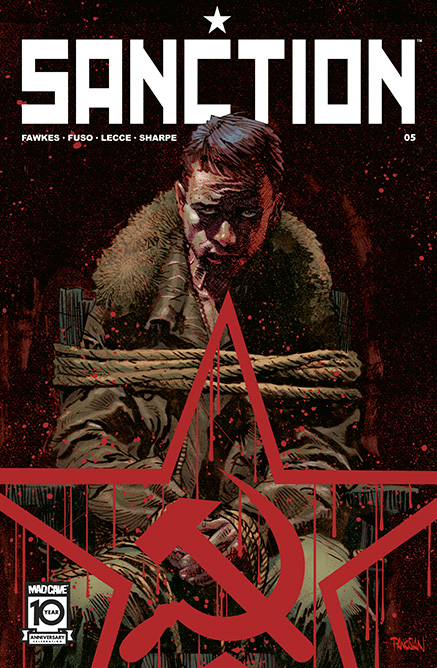
Review: ‘Sanction’ #5 Showcases The Limits Of Victory
by Austin Gorton
Overview
Sanction #5 ends the series on notes of both of triumph and defeat, a resonant conclusion which speaks to the power of the true villain at the heart of the story.
Overall
8/10Following the previous issue’s reveal that the actions of the Angel of Ice killer were being directed by someone within the Soviet state, Sanction #5 reveals the identity of that actor. It is a largely expected revelation, and hardly shocking. But surprise was never the goal; instead, it reinforces the true villain at the heart of this story. In doing so, the issue provides a conclusion to the series which is both eminently satisfying and deeply frustrating, one which feels eerily resonant in the modern day despite the late 1980s setting of the story.

(Spoilers Follow)
To say that the man behind the actions of the killer is the one Soviet official with whom Detectives Smirnoff and Dimitrovich have interacted the most in the course of the story is, again, hardly a surprise. Roger Ebert‘s Law of Economy of Characters is in full effect: there’s simply too limited a pool of culprits who would mean anything or be recognizable to readers established in the previous issues. But at the same time, the reveal hardly matters, because as writer Ray Fawkes has made clear over the course of the last couple of issues, the real villain of Sanction is the Soviet state, the oppressive regime more interested in presenting a (largely false) veneer of order and prosperity than in actually improving the lives of its citizenry.
This fact is underscored throughout the issue via a clever device employed by artist Antonio Fuso. When Egorov is revealed, via a half-page panel, to be the man behind the Angel of Ice, Fuso draws him from the perspective of the captive Dimitrovich, such that Ergorov is seated at his desk, a large portrait of Lenin on the wall behind him and above his head. Throughout the ensuing showdown between Smirnoff, Dimitrovich and Egorov that constitutes the majority of the issue, Fuso stages the action so that hardly a page goes by in which that portrait (or a bust of Lenin also residing in Ergorov’s office) doesn’t appear. It’s a visual way of reinforcing the moral: the state is watching over all, and it is the state, ultimately, who is the true villain here. And in the end, it is the state who emerges victorious.

While both the Angel of Ice and Egorov are brought to a form of justice, it comes at a cost. The central tension between Smirnoff and Dimitrovich has been that of the black & white morality of the latter running up against the more pragmatic grayness of the former’s moral code. It’s idealism vs. cynicism, and in the end, cynicism wins. Because while Dimitrovich would sacrifice himself in the name of truth, he won’t sacrifice his wife, or even Smirnoff. He ultimately realizes that Smirnoff is right that the state would never let the truth come out. To save the people he cares about, Dmitirovich must sacrifice his ideals.

It’s a clever way to end the series as both a win and a loss for the characters. In ending the threat of the Angel of Ice and his handler, Smirnoff and Dimitrovich have scored a significant victory. Yet, they alone are not enough to overcome the oppressive power of the state, and thus, even in victory, must subsume themselves to its power. The tension between those two realities ends the series on a strong note, one which underscores that the setting of the story is more than just a gimmick. Yet it also speaks to the universality of the story, that some evils can’t be beaten by determined investigations and fisticuffs, that the systems which enable — implicitly or tacitly — evil to flourish are as culpable as the performers of evil, all the while being significantly more difficult to dismantle.
