
An Interview With ‘George Cukor’s People: Acting For A Master Director’ Author Joseph McBride
by Rachel Bellwoar
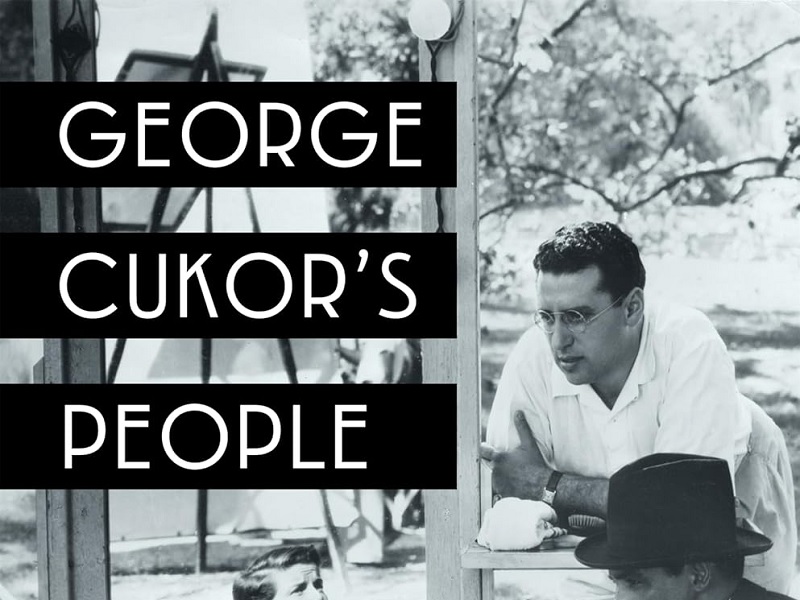
From celebrating the dreamers, to being responsible for some of the best film adaptations of literary and theatrical works, to pushing the envelope during the studio era, with films like Sylvia Scarlett — which wouldn’t be recognized for their greatness until much later — George Cukor is a name that is synonymous with great cinema. He’s also the subject of Joseph McBride‘s latest book, George Cukor’s People: Acting for a Master Director. For more on the project, check out this interview with McBride below:

Rachel Bellwoar: As someone who’s written a number of books on directors, including Ernst Lubitsch and Billy Wilder, what made you choose George Cukor as your next subject?
Joseph McBride: I usually take a long time mulling over my subjects before I write about them, and often they are subjects I’ve written about in the past, more tentatively perhaps, or in a way I’ve found only partly satisfying. I tend to choose subjects I think are misunderstood or have been mistreated. Otherwise why write about them, unless you have something to add or correct? It takes a lot of energy to sustain the research and writing of a book, and I find that I tend to choose a subject because I feel angry about an injustice that has been done to or by the subject or people around the subject. I like how John Ford responded in 1936 when an interviewer asked, “Then you do believe, as a director, in including your point of view in a picture about things that bother you?” Ford said, “What the hell else does a man live for?”
In the case of George Cukor, I’ve long found him an underrated, misunderstood director. Despite the fact that most cinephiles have several Cukor films they would describe as favorites, how he actually worked has tended to be elusive from critics and film historians. Since he deliberately worked through his actors in a seemingly self-effacing, “discreet” way (one of his favorite words, and a key to his life and work), critics have mostly been at a loss to analyze his films, since the art of film acting is so little understood, and few writers have found the vocabulary to analyze it clearly. Cukor also believed in fidelity to what he called the “text,” usually a play he was adapting with the help of one or more of Hollywood’s top screenwriters.
And those admirable tendencies of his ironically have contributed to his not being regarded as an auteur, itself a seriously misconstrued concept, as I discuss in detail in my introduction to the book. My own writing about Cukor since I first tried to deal with him in 1971 was mostly unsatisfying to me. I felt I had not solved the problem of how to approach his work meaningfully, even though I thought I did a rather good job of analyzing one remarkable performance in a Cukor film in an essay I wrote for Film Comment in 1973 on actor-director Lowell Sherman’s portrayal of a self-destructive alcoholic director in What Price Hollywood? (1932). I used that essay as a template for how to write George Cukor’s People: Acting for a Master Director.
Bellwoar: Rather than being able to rely on approaches you’ve used before, what was it like trying to figure out a format for this book that would best get across what set Cukor apart from other directors?
McBride: In my book on Billy Wilder, I made the decision that once he became a Hollywood director, I would abandon the chronological approach that is common in books about directors and instead organize that part of the book thematically. I found it worked well and seemed more stimulating than the old approach. That helped embolden me when I wrote the Cukor book to study his work through essayistic portraits of his actors, both stars and character actors. The book is an experiment in film criticism, and that seemed the best way to deal with Cukor, since he put his actors first and revealed himself through them. But I was concerned about whether this approach would work and whether I was up to the challenge. Once I started re-watching Cukor films, taking copious notes on them, and writing the essays, I was delighted at how easily the book flowed. I also broke with habit by writing the first draft in longhand, which seemed more intimate and personal.
I found that I was well-qualified to write about acting because of my varied experience as a screenwriter, a reviewer of many films and plays for Daily Variety, and an actor for Orson Welles for more than five years in The Other Side of the Wind (1970-2018). On the five American Film Institute Life Achievement Award specials I co-wrote between 1980 and 1984 with producer George Stevens, Jr., I had the rare opportunity for a youngish screenwriter of writing speeches for and with many Golden Age stars and rehearsing their speeches with them. So with all that behind me, George Cukor’s People became one of the most enjoyable books I’ve written, and I hope that comes across to the reader.
Bellwoar: Each chapter focuses on different actors Cukor worked with or more specifically the performances he was able to pull from them in his films. Can you give an example of an actor whose performances with Cukor stand out compared to their work with other directors?
McBride: Joan Crawford shines in her three films with Cukor, The Women (1939), Susan and God (1940), and A Woman’s Face (1941), which explore differing aspects of her star persona. She was often limited by her image as a hard-driving, self-centered dynamo, but Cukor saw the vulnerabilities lurking beneath her tough veneer and appreciated her qualities of independence and persistence. He also recognized her dark side, the side that caused her maniacal abuse of her children and enabled her to play disturbed, obsessive characters onscreen. As Cukor excelled at doing with stars, he understood and drew out Crawford’s inner nature and enabled her to be more comfortable with playing sides of her personality she didn’t often display, at least with such a rich array of nuances.
Crawford’s scheming shopgirl in Cukor’s The Women has a desperate quality and class resentment underneath her hardness that keeps her recognizably human despite her foul behavior. Her religious zealot in the satirical Susan and God is both hilarious and outrageously touching as she drives her friends to distraction. And her deeply traumatized character in A Woman’s Face is frightening and vulnerable as she goes through experiences that test her ability to navigate in a world of people who don’t share her deformity.
The lasting affection and admiration Cukor felt for Joan Crawford after directing her with such rare insight, and his extraordinary skill at critical analysis of actors, were evident in his remarks at a memorial event he organized at the Academy of Motion Picture Arts and Sciences after her death in 1977:
“She was the perfect image of the movie star, and, as such, largely the creation of her own indomitable will. She had, of course, very remarkable material to work with: a quick native intelligence, tremendous animal vitality, a lovely figure and, above all, her face, that extraordinary sculptural construction of line and planes, finely chiseled like the mask of some classical divinity from fifth-century Greece. It caught the light superbly, so that you could photograph her from any angle, and the face moved beautifully. . . . The nearer the camera, the more tender and yielding she became — her eyes glistening, her lips avid in ecstatic acceptance. The camera saw, I suspect, a side of her that no flesh-and-blood lover ever saw.”
Bellwoar: Cukor worked with Katharine Hepburn ten times, including her first film, Bill of Divorcement. Of the films they did together, why did you want to single out Pat and Mike as one that doesn’t get enough flowers?
McBride: I find Pat and Mike more organic, less rhetorical, more subtle than the more celebrated Adam’s Rib (1949). Both of those Cukor films starring Hepburn and Spencer Tracy are based on original screenplays by the brilliant team of Ruth Gordon and Garson Kanin. And they deal with feminist issues of equality, competitiveness, complementary strengths, and the ability of unconventional couples to transcend the rigidity of traditional gender roles. Pat and Mike does so in a lightly humorous way, the style Cukor liked to employ while treating serious themes without preaching.
And that film draws spectacularly on Hepburn’s varied athletic skills as she plays a multi-talented sports star whose career has been held back by her domineering fiancé, a classic 1950s male chauvinist she discards to go for a jaunty ride with a raffish manager played by Tracy. His Damon Runyon-esque character casually believes in what he calls a “five-oh, five-oh” professional and personal relationship with this exemplary woman athlete, allowing her to maintain her independent spirit while he works with her to bring out her best. Cukor and Hepburn have a great time showing her actually golfing and playing tennis like a champ and even flipping Charles Bronson’s petty hoodlum around in this documentary-like, low-key romantic comedy of gender equality. Pat and Mike celebrates the joys of collaboration and unconventional relationships that help distinguish Cukor’s films and make them seem ahead of their time.
Bellwoar: Besides Pat and Mike, are there any other films in Cukor’s filmography that you feel have been wrongly forgotten or overshadowed by A Star is Born and My Fair Lady?
McBride: Sylvia Scarlett (1935) is a gem that flopped on its first release because it shocked or befuddled audiences with its gender-bending audacity; Katharine Hepburn masquerades as a boy for most of the movie and is charmingly awkward when she tries to have a go at being a girl. The film eventually became a cult classic but it still is too little known. The Actress (1953), based on an autobiographical play by screenwriter Ruth Gordon, is also one of Cukor’s most personal works, since it captures the feeling of the early fascination with the theater that he and Gordon shared. She is played, somewhat incongruously, by Jean Simmons, who is too glamorous for the role, but Spencer Tracy gives a majestic performance as her surprisingly sympathetic father, a former sailor who belatedly reveals that he had his own youthful passion for the stage.
The Marrying Kind (1952), one of five films Cukor made with Judy Holliday, casts that gifted comic actress in a heartrending dramatic role as an ordinary woman coping with the difficulties of married life. The Model and the Marriage Broker (1951) has the rare distinction of featuring the great character actress Thelma Ritter in a comedy-drama about a lonely middle-aged woman who helps other oddballs find partners. Cukor’s late works Travels with My Aunt (1972), with Maggie Smith and Alec McCowen, and his first film for television, Love Among the Ruins (1975), the only teaming onscreen of Katharine Hepburn and Laurence Olivier, are splendidly sumptuous visually and feasts of brilliant acting.
Bellwoar: Many directors struggle with adapting theatrical or literary works for film, but Cukor made it one of his specialties. Why were his adaptations so successful and able to avoid feeling stagebound?
McBride: For the most part, Cukor’s is the style that conceals style. Jean Renoir was another director who believed in this kind of style: “Technique,” he said, “that’s a terrible word in art! You have to have it, but so completely that you know how to disguise it.” Cukor’s fellow directors understood and appreciated the subtlety of his self-effacing style more than most reviewers and film scholars have. When he transferred plays to film, he made it seem effortlessly cinematic with his fluid, creative and well-motivated blocking in relation to the camera, and with often virtuosic yet little-noticed camera movement. Martin Scorsese observed, “And yet even though literally most of the film had people talking in rooms, they were always movies. And I don’t know how he did it. I think it was the pacing of the actors, where the position of the camera [was], and that sort of thing. But I’ve always been a great fan of Cukor’s.”
One of his peers, King Vidor, recognizing this quality in Cukor’s 1933 film version of Somerset Maugham’s play Our Betters, wrote him, “I would never have tackled a subject with so little locomotion but you have a faculty of keeping it interesting in spite of this obstacle.” Late in life, Cukor reflected, “I came with the talkies, and it took me about three years to learn something about the camera — well, learning what not to do. For the first three years, I really didn’t know quite where I was, but somehow, even then, I realized that camera movement was very important. You see, on the stage they did not have much movement. People sat on the stage, and then they got up and crossed or made arbitrary movements so that it wasn’t static. I felt that in movies you had to have much more real movement.” Cukor’s camera is often dynamic, frequently moving in and out and around with his actors, sometimes in unusually long takes that, as he told me, made the scenes “more real, more truthful, less acted.”
Bellwoar: “Women’s director” also gets used a lot to describe Cukor. Rather than focus on the ways that label ignores the many great male performances in his films, was Cukor especially good at working with the female stars of his day or was he just more willing to work on projects that centered women?
McBride: That publicity handle is reductive in describing Cukor, since, as you point out, it slights his work with so many great male stars. And back in the day it served as code for “gay” in an often homophobic way, when “women’s pictures” were routinely denigrated by critics despite being popular with audiences and, as we later came to realize, rich in social observation. Cukor would get increasingly indignant over being called a “woman’s director,” but of course he worked brilliantly with many of the greatest actresses of his time — from Katharine Hepburn and Greta Garbo to Ingrid Bergman and Judy Garland and Claire Bloom and Maggie Smith — and created what he called a “climate” for them to excel. He was a master at helping his actors, both male and female, relax and delve more deeply into their personalities than they were accustomed to doing with other directors.
Part of his appeal to actresses was simply that they knew that unlike so many male directors of that era, Cukor wouldn’t hit on them. They also realized he was an instinctive feminist who respected them and treated their characters more subtly and eloquently than most other filmmakers were prone to do. Victor Fleming, a notably macho director, took over the direction of Gone With the Wind (1939) after Cukor was fired, partly because Clark Gable made a homophobic remark on set about wanting “to work with a real man!” But Fleming said of Cukor, “George would have done just as good a job as I. He’d probably have done a lot better on the intimate scenes. I think I did pretty well on some of the bigger stuff. George came from the stage and taught us what directing a dialogue scene was about. He knew. And nobody could direct a dialogue scene like George Cukor. It’s bullshit that he’s just a woman’s director. He’s not. He can direct anybody.”
Bellwoar: Having met and had the opportunity to interview Cukor a few times, is there anything you wish you could’ve asked him now?
McBride: I enjoyed talking with Cukor so much that I simply wish he were still around so we could have another one of our lively conversations. I guess I would ask him more about my two favorites of his films, A Star Is Born and My Fair Lady, and about the wonderfully daring Sylvia Scarlett, even if he probably would have shut down that discussion. And I wish I had been able to speak with him more about his double life and how he navigated it, as two interviewers for the gay publication The Advocate did with some success in 1982. But Cukor in that interview went as far as he was willing to go in addressing the subject, and I doubt anyone could have been able to coax him into dropping his lifelong discretion beyond that point. If he had, he wouldn’t have been George Cukor. His discreet, subtle, finely nuanced, and generous approach to human beings was what made him a master director.
Bellwoar: Thanks for agreeing to this interview, Joseph!
George Cukor’s People: Acting for a Master Director is on sale now from Columbia University Press.
