
‘Bereavement’ Successfully Explores Grief Through The Lens Of Sci-Fi — And An Adorable Robot
by Austin Gorton
Summary
Bereavement aims to be a sci-fi exploration of grief via the vehicle of a murder mystery whodunit. Ultimately, it succeeds in its first two goals far better than the latter.
Overall
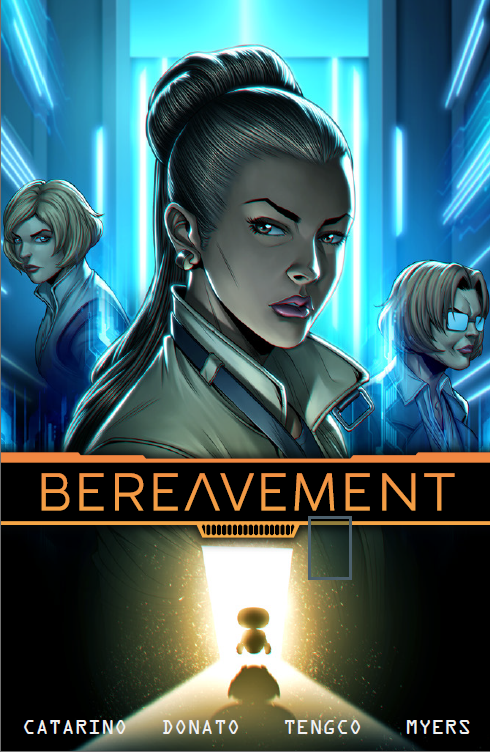
7/10Can a robot grieve? That’s the Pixar-ish question at the heart of Bereavement, a new sci-fi murder mystery comic launching soon on Kickstarter. Set against a futuristic outer space backdrop, it centers as its investigator not a detective, but a therapist, while its primary witness (and suspect) is a floating HERBIE or Wall-E-esque robot. The combination of these two notable variations on a standard murder mystery make Bereavement a unique exploration of grief, and ultimately it succeeds there much better than it does as a murder mystery.

Written by Bruno Catarino with art from Samuel Donato, Bereavement takes place on a space station in orbit around Jupiter in the year 2085. After the death of Amelia, a “scout” tasked with pushing the boundaries of exploration, her former therapist, Zara, is called in to investigate her death. It’s a classic “locked room” mystery, which quickly leads Zara to Amelia’s partner, an amicable robot named Leo.
What unfolds is an investigation that probes the depths of Leo’s grief and sense of self. Donato’s style is very smooth and polished, which fits the sci-fi setting well. It also makes for an effective juxtaposition between the inherent inhumanity of Leo — a pair of cold, silvery floating orbs with arms — and his grief. Yet Donato makes the most of Leo’s yellow dots-on-a-black-screen “face” to imbue the robot with character and make it clear how he’s feeling.

Meanwhile, Catarino effectively builds out the world of the story despite the relatively limited page count. Rather than bog down the narrative and distract from the themes with a lot of exposition, he is sparing with the details, revealing enough about the setting through dialogue and implication to get the general ideas across, and letting the art do the rest.
Less effective is the murder-mystery itself. Here, Catarino & Donato are likely hamstrung by the limitation of their format. It’s tough to build out an effective mystery in thirty odd pages without also having to establish a sci-fi setting while centering the story less on the mystery and more on the mindset of the victim and the people surrounding her. Without giving away the ending, let’s just say that Bereavement falls prey to Ebert’s Law of Economy of Characters; there’s simply not enough room to establish a large enough cast to effectively obscure the culprit. To say the most obvious suspect turns out to be the killer is hardly a spoiler; there’s just not enough choices for it to be anyone else.

That said, there’s still plenty Bereavement does well. If the goal was to craft a Wall-E-esque character in Leo, it succeeds. His plight and personality is compelling enough to make his ultimate fate heartbreaking. The fact that the story doesn’t get bogged down in exposition and instead trusts readers to sketch in the less necessary details is appreciated. For as much as Bereavement is less successful as a murder mystery, it’s still works well as an examination of grief which, given the title, is the more important element.
