
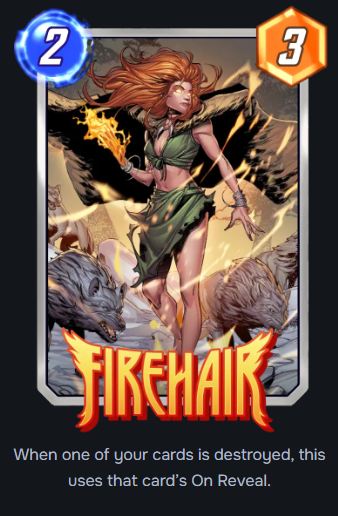
Snap Into Marvel: Firehair Introduces Phoenix To The Prehistoric Avengers
by Austin Gorton
Aliases: Lady Phoenix, Girl with the Hair Like Fire, Mother Phoenix
First Appearance: Marvel Legacy #1 (September 2017)
Powers & Abilities: Telepathy and Telekinesis

Comic Book Chronicles
Firehair is basically Prehistoric Phoenix. Also, kind of, sort of, Thor’s mom. At least, as far as writer Jason Aaron is concerned.

Born a million years ago, Firehair was abandoned as an infant due to her red hair, and raised by wolves. Eventually, she was discovered by Highwalker — a prehistoric Professor X-like figure — and joined his “Tribe Without Fear — a sort of proto-X-Men.
When the Tribe Without Fear were attacked by neighboring “anti-mutant” tribes, everyone but Firehair was killed. Despairing, Firehair prepared to kill herself, but was saved by the Phoenix Force, which was drawn to Firehair by her psychic abilities and rage. Tamping down that rage, she dedicated herself to protecting those weaker than herself.

To that end, she eventually sought out Odin and other beings of power, including Agamotto, the demonically-powered Ghost Rider, and Vnn, bearer of the Starbrand to form the Prehistoric Avengers. Together, they battled the Fallen, a corrupt Celestial, as well as Mephisto and a young Thanos. Romantically involved with Odin, his callous nature eventually led Firehair to leave Earth.
Millennia later, having both outlived their teammates, Firehair and Odin were drawn together again when Firehair served as midwife to a pregnant Gaea as she gave birth to Thor. After the infant Thor was killed by the Frost Giant Laufey (Loki’s dad), Firehair resurrected him, imbuing him with a portion of her power. For this, Gaea declared Firehair to be a second mother to Thor.

It’s difficult to square much of Firehair’s backstory with the established lore surrounding mutants as established by the X-Men titles. Chiefly, the idea that mutants — long said to be the “next step in human evolution” — could exist millions of years ago, before the evolution of, well, humans. Similarly, when Firehair, along with Star Brand, sacrifices herself to save existence from an alliance of multiversal Mephistos, her essence goes into the White Hot Room (aka Phoenix Heaven).
Again, Jason Aaron plays a bit fast and loose with established lore, suggesting that Firehair continued to influence the Phoenix Force to select redheaded mutant psychics from Earth in her image. This is an apparent attempt to explain the Jean Grey/Rachel Summers/Hope Summers lineage of hosts, each of which already had their connection to the Phoenix Force mostly explained. As a result, this this additional revelation about the Phoenix Force has been largely ignored outside of Aaron’s Avengers.
Fit & Finish

Like the rest of the Prehistoric Avengers, Firehair doesn’t have as long and varied a comic book history to draw on for variants. As such, the additional Firehair cards are all true variants of the same general caveman look. The George Kambadais card is interesting for the way it eschews the character’s eponymous red hair, while the Alex Horley variant once again channels the pulpy “jungle adventure” vibe of the Prehistoric Avengers.

Form & Function
Somewhat surprisingly, this is really the first Marvel Snap card to tap into Marvel’s Phoenix Force mythos outside of the Phoenix Force card itself. Both Jean Grey and Hope Summers, the two most prominent Phoenix Force-wielders in the game, have cards which focus on other elements of their powers/history (Rachel Summers, the other notable Phoenix person, remains absent from the game; an Excalibur season with Rachel, Captain Britain, Meggan, Jamie Braddock and Warwolves when, Second Dinner?).

As the first Phoenix Force-wielder in the game, Firehair’s ability appropriately channels the death/rebirth/redo element of the Phoenix Force’s game play. Just like that card revives a destroyed card and retriggers its On Reveal ability (if it has one), Firebird will duplicate the abilities of any destroyed card. Yet even though she’s just an avatar of the Phoenix Force, Firehair’s card is much more versatile, thanks to its lower cost and ability to re-trigger more than one On Reveal ability.
This means Firehair can slot into a wider variety of decks, whereas Phoenix Force kind of has to have a deck built around it to work well. Plus, Firebird is neither an On Reveal nor an Ongoing card, making the tools to counter it more limited. Between the versatility and the fact that Destroy and On Reveal cards are two big swathes of card types, Firehair seems well-positioned to become a staple of at least a few key decks within the meta, even though it’s not a dominant card on its own.
