
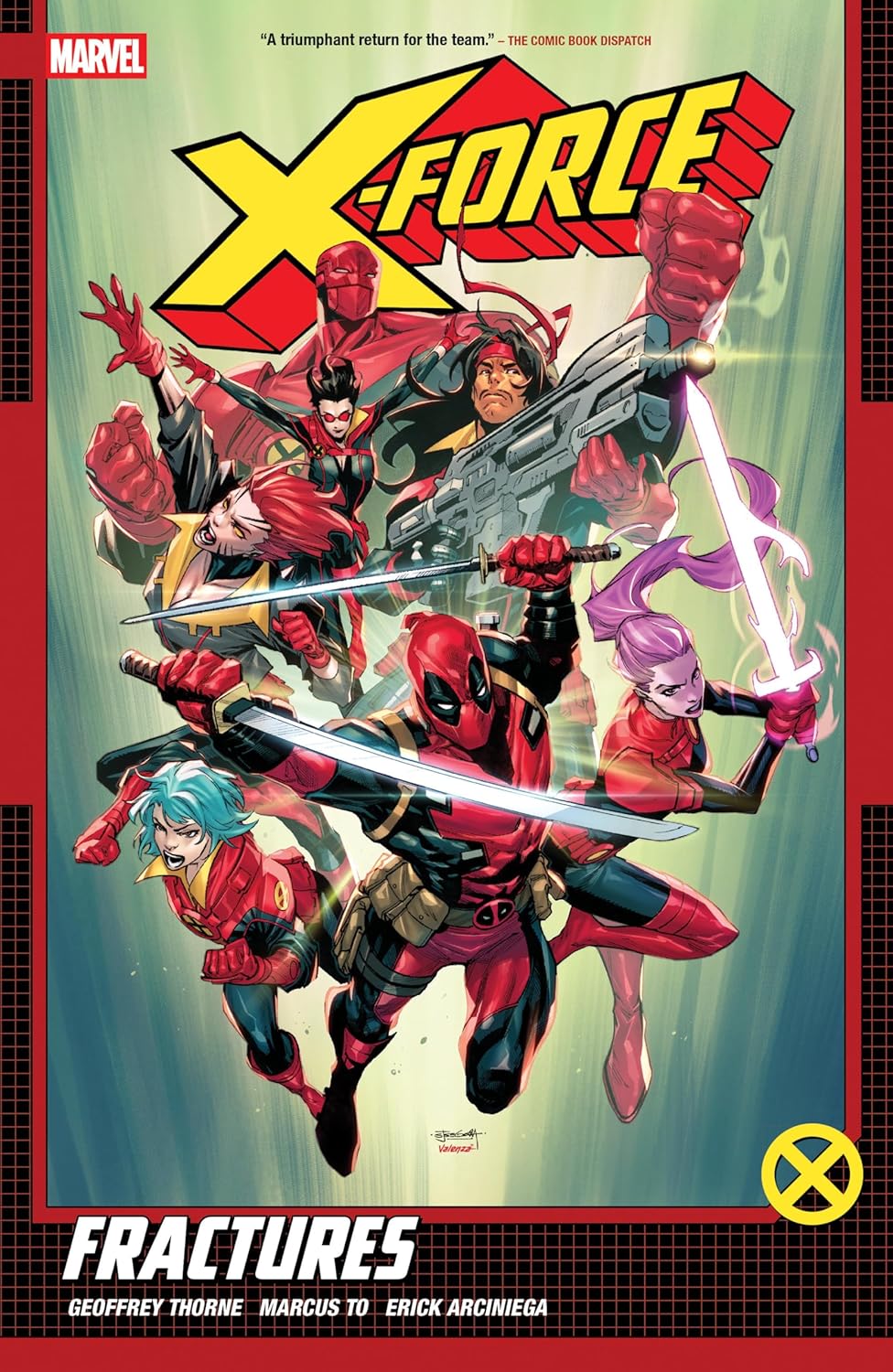
‘X-Force: Fractures’ Starts Strong, Looks Great, Ends Poorly — Review
by Austin Gorton
Overview
X-Force: Fractures starts strong with a solid premise and a fun mix of characters, but struggles to come into its own as a true team book before some unfortunate plotting decisions bring it to a unsatisfying end. But the saving grace throughout is the art of Marcus To, which ensures everything at least looks great.
Overall
6/10Since its creation in 1991 out of the ashes of the former New Mutants book, X-Force has become one of the bedrock X-titles. Nearly every major line-wide relaunch of the franchise has, sooner or later, offered up its own spin on the series.
Through the years, a number of different riffs on the concept have emerged, from the initial “hit them before they hit us” approach to the celebrity mutants of Peter Milligan and Mike Allred’s X-Force to the secret murder squad variation to the most recent “mutant CIA” iteration from the island of Krakoa. One of the key ingredients to early success in each new version is the reveal of how the different elements — plot, themes, characters — of past series are being rejiggered.

On those terms, X-Force: Fractures, collecting X-Force (vol. 7) #1-5 from Geoffrey Thorne and Marcus To is mostly successful. It offers a version of a direction that’s been done before in X-Force, but less often than some of the other directions. It introduces a lineup made up of relatively new characters to the X-Force banner, with just a handful who have been on versions of X-Force before.
The premise behind this iteration of the series is simple enough: the mutant inventor Forge has created a thingamajig that helps him locate “fractures” that threaten the world. He puts together a team to seal these cracks before they break and doom the planet. Comic book violence ensues. This setup isn’t terribly different from that of the Marvel NOW era Cable and X-Force book, but in the grand scheme of X-Force series, it’s not the most re-used setup.

It’s a premise that has some potential, along with a cast that includes some X-Force stalwarts like Sage, Betsy Braddock and Deadpool (in a one-off guest-appearance tied to the release of 2024’s Deadpool and Wolverine no less shameless for the fact that Thorne has Deadpool acknowledge it as such) as well as relative X-Force newbies like Rachel Summers, Surge, and the mysterious Tank. And the whole thing looks absolutely gorgeous.
In fact, the clear standout of the book is artist Marcus To’s work. The opening pages, in which Forge is watching a holographic recreation of an old X-Men mission, affords To the chance to draw an assortment of X-Men in their ’80s-era glory (and for readers to behold To’s versions of those characters). His action scenes are kinetic and shift perspective effortlessly without being confusing. Everyone looks fantastic in the sharp new red/black/yellow X-Force suits. And To has quietly become the definitive Betsy Braddock artist, to the point that the issue almost suffers just from her not being in it more.

Where X-Force: Fractures runs into trouble is the way Thorne deploys his cast. Forge, as the architect of the team, and Sage, who provides first person narration across most of the issues, as effectively the co-leads of the book. Everyone else gets relegated to a supporting role, at best. All throughout, Tank is mostly just there while Rachel and Betsy get little more to do. Surge, who replaces Deadpool on the team in issue #2, is in a similar boat, at least until the book’s ill-advised climax.
**Spoilers follow**
Nearly every issue collected in X-Force: Fractures features running (occasionally repeating) dialogue from Sage’s internal monologue, presented as narrative captions, sharing her thoughts in the moments immediately after someone has died. The final chapter of the story reveals that person to be Surge, who dies in the course of shutting down one of the fractures.
It’s a heroic death, to be sure, and given it promptly leads to Sage quitting the team, it seems unlikely the fallout from the death is likely to be breezed past in the regular churn of monthly storytelling. But at the same time, it feels like a waste of a character. Coming this early in the book’s run, it reads a bit like the slaughter of the first batch of X-Factor operatives in X-Factor #1, a way to say, “hey, now that mutant resurrection is off the table, death matters again!”

Except it didn’t really matter before the Krakoa Era, and it likely won’t now: then and now, any character death can be undone by a writer who wants to do it. It also doesn’t feel great that Surge is the character who dies. Given her most consistent characterization in this book is being “the one who is there to do good” on a micro level (vs. Forge’s macro level “save the world” mission) ie be actively heroic, and the fact that she’s the character with the least amount of publishing history (outside of Tank, the token mystery character), killing her off seems like a waste of potential.
Maybe Thorne will use her death to further define this iteration of X-Force. But that’s a concern for future collections. For now, it just reads like the climax of the story needed someone to die, so the character who would be missed by the fewest fans and had less “edgy” morality than the rest of the team drew the short straw. It leads X-Force: Fractures to conclude on an unfortunately sour note, made all the more disappointing for the fact that the rest of the book establishes a solid foundation for the series, and serves as an effective showcase for some lovely art.

