
Talking Psi-Judge Anderson And Free Comic Day With Alex De Campi And Silvia Califano
by Rachel Bellwoar
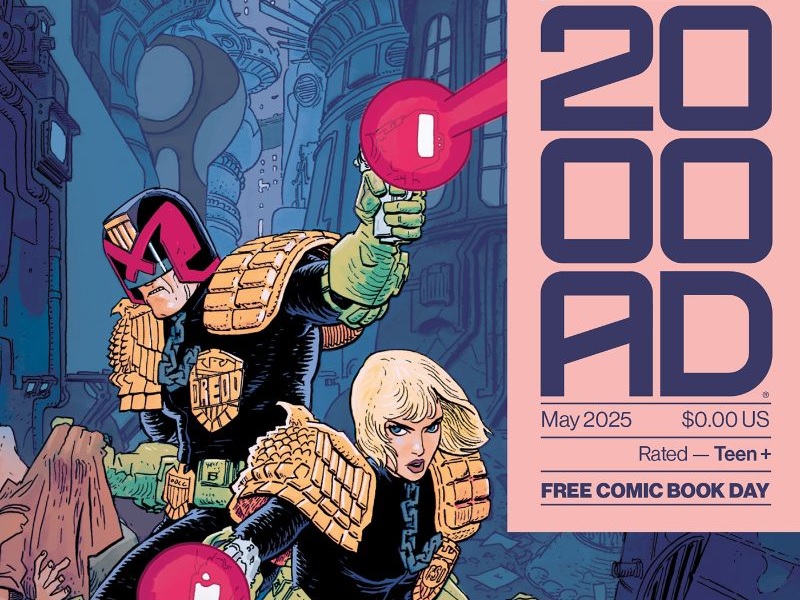
It’s hard to believe Free Comic Book Day is almost upon us. Celebrated every year on the first Saturday in May, this year 2000 AD is marking the occasion with another Best of 2000 AD issue. This one features a new Psi-Judge Anderson story by writer Alex de Campi, artist Silvia Califano, colorist Matt Soffe and letterer Rob Steen, and you can learn more about it in the following interview with De Campi and Califano:

Rachel Bellwoar: In the spirit of Free Comic Book Day and readers who might be encountering 2000 AD for the first time, who is Psi-Judge Anderson and what was your introduction to her?
Alex de Campi: In the Judge Dredd universe, there is a special division of judges with psychic powers of one sort or another: Psi-Division. Mega-City One citizens are tested at an early age and if they show evidence of psychic abilities, they are taken to be raised in a special facility for psi-judges. Cassandra Anderson was one such child–a precognitive telepath and empath, she can relive the dead’s last moments, access the astral plane, and (to some degree) read minds.
Silvia Califano: Cassandra Anderson is a mutant with psychic powers raised by the Department of Justice to become an instrument of control – in a world where law enforcement can keep an eye even on your thoughts. She’s a Judge, the ultimate form of control of chaos in a dystopian reality, hard as a hammer when needed but her abilities also make her critical of the system itself, open to doubt and often ironic. If Dredd sees the world in black and white, Cassandra brings shades of grey to the table. She has a razor-sharp brain and well… she could push Satan himself into a psychological breakdown.
De Campi:Psi-Judge stories generally explore more existential and supernatural horror than the fascism/satire/action-cruelty of Dredd. You can get really weird anywhere in the Dreddverse, but Psi-Judge Anderson stories invite a specific degree of Ari Aster/A24/J-Horror spooky weirdness that always feels fresh when handled by a competent team. Alan Grant and Arthur Ranson did amazing runs on the character and I would urge anyone who’s curious to grab their editions from the Essential Judge Dredd editions!

Bellwoar: What, if anything, can you share about “The Seer”?
De Campi: We haven’t seen Anderson for a while in the Prog, so readers may not be super familiar with her even though she’s one of 2000 AD’s classic characters. So in eight pages, I try to hit the classic high points of Anderson and the sort of “dun dun DUNN!!” of a good Anderson story. In short: a young salvage worker starts being able to predict the future after an accident in space. But she’s not a psychic, and she’s not a fraud. What’s going on?
Califano: Thanks to Judge Anderson’s abilities we will be projected from the rainy lower streets of Mega-City One to the largest dimensions in space and time that the human mind can imagine. Enjoy the trip!
Bellwoar: Overall I find I gravitate towards Psi Division stories more than Street Judge stories. Do you feel the same way?
De Campi: Oh yes, absolutely. I have to get very JG Ballard with Street Judge stories to make them work for me, and there are so many people who can do it better — Art Wyatt and Rob Williams do all-time Dredd stories seemingly with the same ease as breathing (buy A Better World! So good) whereas I have to really force myself to come up with good ideas.
Anderson, I have ideas for days — she has such a unique and specific vibe, and place within the larger Dreddverse even as she shares a location with ol’ Judgin’ Joe. Also obviously as a woman writer I like exploring the subtler elements of her experience as a female judge.
Califano: I love both, perhaps when I’m in different moods. In the Street Judges stories I like when the events are told from the angle of ordinary citizens. The Judges can be suffocating, liberticidal and manipulative presences and this climate describes life in Mega-City One well. In the stories of the Psi-Division perhaps the contradictory role of the Judges emerges more and this makes them interesting, in addition to the fact that through the mind we can explore the most intriguing and spectacular scenarios possible!
Bellwoar: Cadet Anderson’s been drawn by numerous artists. What features did you want to emphasize with your design?
Califano: I don’t have a specific artist of reference, because there are many artists who manage to express different aspects of Judge Anderson that I like. There are those who make her more physically statuesque, those who make her more seductive, those who make her more glacial, those who emphasize her vulnerable side… they are all interesting aspects and I would like to work more often on the character to find the right mix for me.
Among all of them, however, perhaps the one who struck me the most is Arthur Ranson’s Cassandra, extremely natural and… human!

Bellwoar: While Judge Dredd often wears a helmet, Cassandra isn’t wearing one in this story. Do you think that makes her easier to connect with than other judges?
De Campi: She never wears a helmet in her stories. It’s nice because it makes her very recognizable on the page, even in a crowded scene, with her pale-blonde bob. I think she doesn’t wear a helmet for handwavey Psi-Division reasons mixed with honestly she’s a hottie and fanservice reasons, but since she’s a character whose entire purpose is to be sensitive in a brutal city, it works so well.
Califano: In some way it says a lot about Cassandra. Dredd would no longer be himself without his helmet – with it on his face he is “the law”, Judge Anderson gives up the helmet as if being more empathetic and vulnerable were two sides of the same coin. And this is her proper strength.
Bellwoar: In superhero stories, good tends to triumph over evil but that’s not always the case with Mega-City One. Given that harshness, what keeps you coming back?
De Campi: Well, why do we watch horror? There is a catharsis to putting all the strange, unsettling, terrifying whispers at the back of your mind onto the page, and a similar catharsis for reading a story about those fears made into plot.
Mega-City One is also just so BIG. You can do anything in a city that large, any genre, any story, and it works. And sometimes you don’t need everything to work out okay, it would be insulting to slap an easy solution on such a messy city. Sometimes you just need to be reminded that small miracles exist, and so does kindness, and that drinking with apes is always a really bad idea.
Califano: Mega-City One is the place where anything that can go wrong socially and politically in our world has fully gone south. It is a dystopia where to ironize, often enjoying the chaos in an explosive way, and also to have a look at humanity fallen into the most unregulated violence.
There is no longer an absolute final good to reach or to hope for, you can only “Seek and know how to recognize who and what, in the midst of hell, is not hell” quoting the Italian writer Italo Calvino, and save what can be saved. It is a more nuanced and energetic way of narrating the reality that I feel is more captivating, especially when it is full of action and spectacular images!
Bellwoar: Thanks for agreeing to this interview, Alex and Silvia!
The Best of 2000 AD FCBD Special 2025 will be available in comic shops on May 3rd for Free Comic Book Day.

