
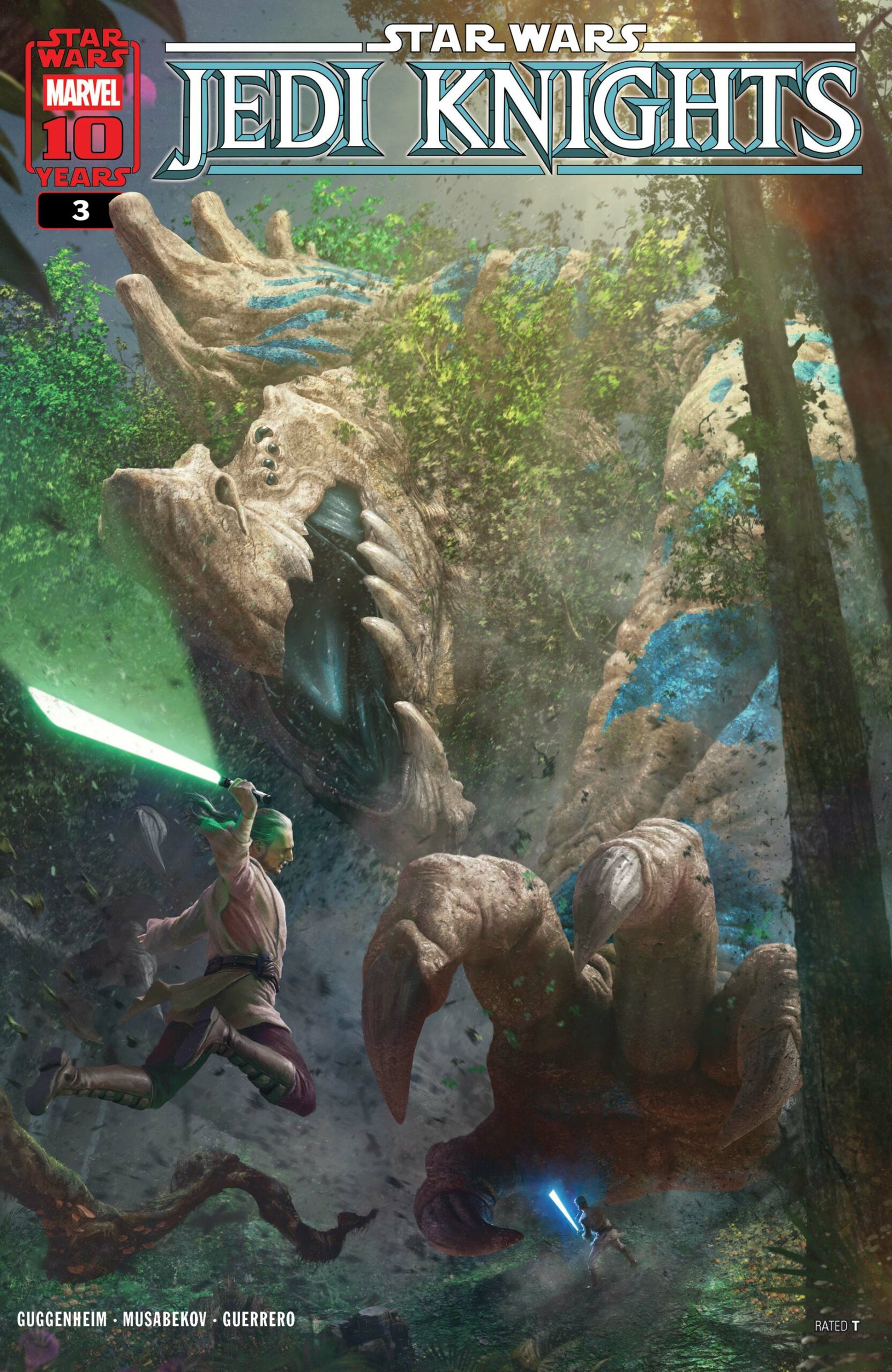
In ‘Star Wars: Jedi Knights’ #3, Bigger Is Better — Review
by Austin Gorton
Overview
Another fun genre mashup, Star Wars Jedi Knights #3 is also a visual feat of large-scale storytelling.
Overall
7/10Following on the heels of last issue’s “Yoda vs. Aliens”, Star Wars: Jedi Knights #3 is another genre mashup. This time, it’s Qui-Gon vs. Kaiju, as Obi-Wan narrates a tale of rescue on a planet populated by enormous shovel-headed creatures (named “kaijura”, as writer Marc Guggenheim gilds the nomenclature lily a bit; see also the story’s title: “Planet of Monsters”). But even moreso than the previous issue, this one succeeds on the back of artist Madibek Musabekov.

Befitting the scale of the story’s antagonists, Musabekov draws the entire issue as a series of full page spread. From the opening shot of the familiar Jedi T-6 shuttle cresting a mountain range to the shuttle quickly getting crunched in the jaws of a kaijura, from the discovery of Bail Organa’s crashed CR70 Corvette (the same design as the future Rebel Blockade Runner) to the pack of kaijura tromping down trees on their way to the corvette, Musabekov renders everything in as big a scale as the format will allow.

As with the previous issue, colorist Luis Guerrero elevates the finished product. Whereas before, the coloring was key in keeping the Jedi in focus as they battled a horde of darkly colored monsters in the shadows, in Jedi Knights #3, Guerrero has the opposite task. Guggenheim sets the entirety of the story during the day, in the midst of a brightly colored jungle. Thus, Guerrero must draw on an entirely different palette, keeping the action clear amidst various shades and depths of of greens, yellows and browns that permeate the issue.
But what really elevates the art is that Musabekov maintains the widescreen full panel approach even when the story doesn’t call for scenes of rampaging monsters chomping on starships. Scenes between two human sized characters or inside a ship are still rendered larger-than-life, with an incredible amount of detail thanks to the “zoomed in” focus. Even when the scales cross, such as Qui-Gon looking up at one of the kaijura or a kaijura grasping the corvette, Musabekov maintains the relative perspectives of each figure without sacrificing the sense of grandeur.

Certainly, this is a swift, breezy read. The full panel pages limit the amount of dialogue and captions, and the plot is fairly straightforward. There’s also no advancement of the subplot involving the mysterious foe targeting Qui-Gon. But Jedi Knights #3 is nevertheless an entertaining read elevated by some top-notch art.

