
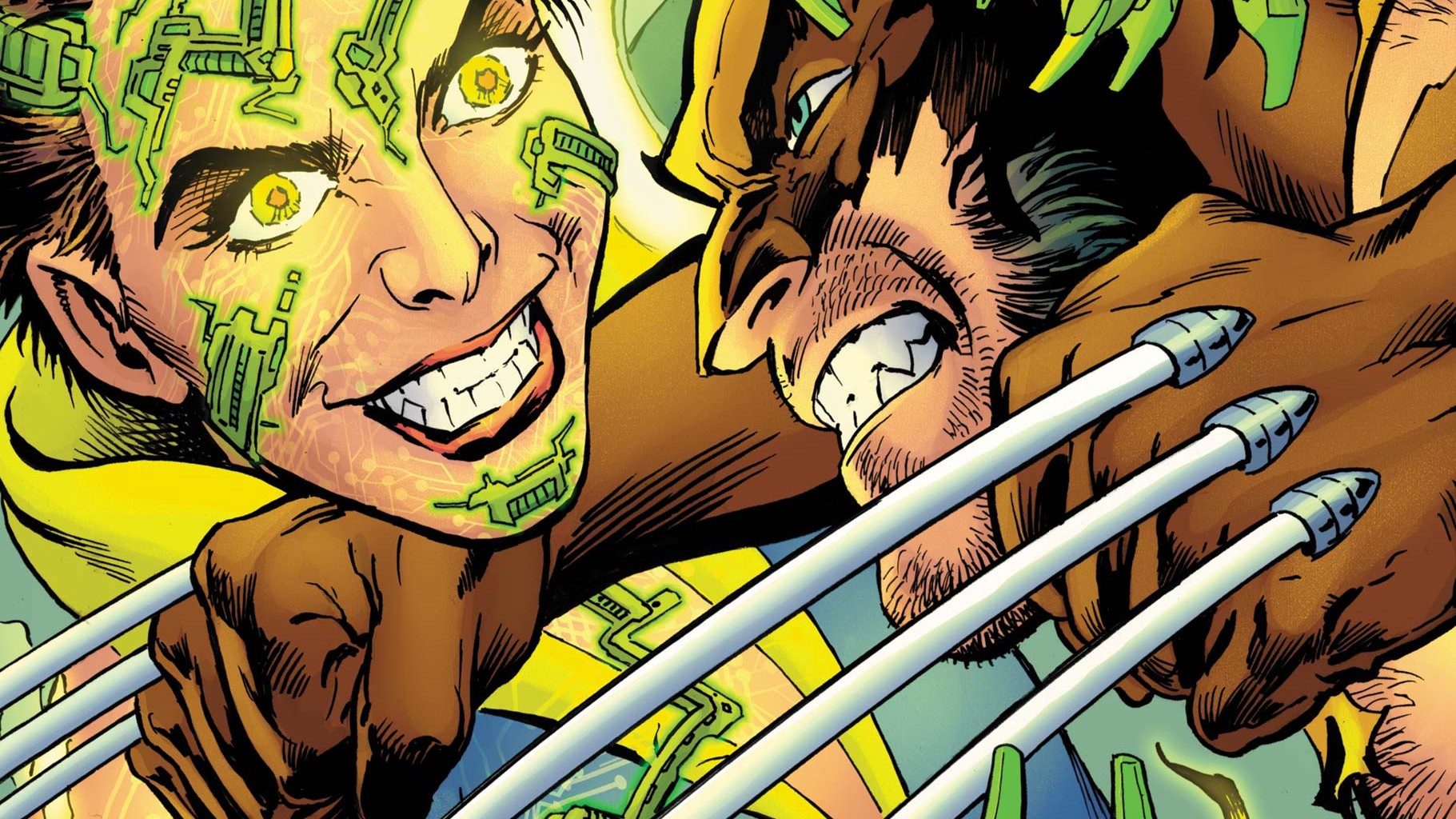
Previously On X-Men: ‘X-Men’ #21 Kills Time In A Good Way, The Rest, Not So Much
by Austin Gorton
We’re about a month out from the start of “Age of Revelation”, and more than a few titles seem to be marking time until it begins. Some are better at it than others.
Astonishing X-Men #34 by Tim Seeley & Edoardo Audino

The Astonishing X-Men track Morph/Changelings crimes to a seaside community filled with retired spies.
- The idea that Changeling needs to see a face before he can steal it suggested here is, I believe, a new notion and not something previously established.
- Banshee being able to clock a group of people as SHIELD agents based on one static image is enough of a reach that it undercuts the cool moment it’s trying to be.
- The fact that in addition to Changeling/Morph, Husk and Skin are shapeshifters of a sort is neat observation I wouldn’t have clocked on my own.

- Banshee being concerned about getting sunburned is relatable.
- It’s suggested that part of Morph’s powers allows him to change his personality to match those around him; this is likely an expression of his limited psionic abilities (which enabled his copied forms to be all the more effective), which Professor X once boosted to allow Changeling to impersonate him for a time back in the Silver Age.
I’m not sure if the plot here entirely hangs together, but this continues to work generally as a hangout book.
Avengers #29 by Jed MacKay & Farid Karami

With the “One World Under Doom” tie-ins behind them, the Avengers get back to dealing with the overarching plot of this volume.
- In the guise of debriefing Reed Richards, the bulk of the Avengers’ side of this issue serves as a recap of the Kang/Myrrdin plotline thus far.
- That effort concludes with the reveal that the missing moment/grail/MacGuffin Kang and Myrrdin have been fighting over stems from Reed’s recreation of the universe as part of the 2015 Secret Wars event (inspiring major motion pictures coming to theaters soon!).
- On the Myrrdin side of things, it’s revealed that he’s used his time manipulation abilities to run his knights through the various tribulation events, only to see them defeated, leading him to discard them by offering them to the Grandmaster as payment to his debt (from issue #24), at which point the Grandmaster summarily destroys them all.

- It still seems like Myrrdin is a guise worn by an established character; I’d guess Reed Richards given his involvement in this issue, but we’ve already got an evil alternate reality Reed running around in the Ultimate line.
- Then again, narrative cohesion across all their books hasn’t been Marvel’s strong suit of late.
Works well enough as a primer/catch-up issue, with at least a few significant new events/reveals happening to keep from being just a “clip show”) after all the crossover shenanigans. That said, there’s chatter that MacKay’s run is coming to a close sooner rather than later, and the complete punting of the Tribulation Events sure reads like an attempt to jump right to the conclusion as a result.
Deadpool/Wolverine #8 by Benjamin Percy & Joshua Cassara

The plot continues to inch along as Stryfepocalypse details his vision of the future and Director Talyn launches her assault.
- Stryfepocalypse’s plan involves repopulating the world with mutant clones, rendered via images reminiscent of the Krakoa Era resurrections.

- Donning a visor that provides a neural link to the new Legacy virus, Director Talyn edges ever closer to super-villainy.
- Deadpool and Wolverine once again don’t interact in this series they co-headline.
- The issue ends with the reveal of a Hulk-like Wolverine; this isn’t the first time such a notion has been deployed.
- The book hasn’t been solicited past issue #10, so presumably that’ll mark the end of this storyline. Then again, that could just be function of “Age of Revelation” mucking with all the solicitations since it’s doing the whole “cancel all the books and relaunch them with new titles” routine.
It’s nice to have Cassara back and but the incremental plotting continues to befuddle.
Check out Scott’s full review of the issue here.
Emma Frost #3 by Amy Chu & Andrea Di Vito

Emma races to stay ahead of Sebastian Shaw.
- Emma’s nightmares which open the issue and get deployed again later during her encounter with Liu including flashes of her childhood is largely consistent with her backstory as established in her early 00s solo series; given this series placement after “The Dark Phoenix Saga”, including images of the X-Men amongst her tormeters makes sense, given how much Phoenix messed her up in the opening act of that story.
- The scene where Emma gives advice while on a ferry in Hong Kong is sweet, and speaks to her future as an educator.

- Emma using her telepathy to make the goons attacking her think they’re being hit with various super-hero moves is a much better way to establish her as a capable combatant than just having her also be good at fighting or doing the “I read the mind of a martial artist” routine.
- Di Vito’s art continues to be the highlight of this book.
This issue feels a little water-treading; it’s ultimately just about confirming Emma’s on her own, which probably could have been achieved with more brevity. Also, now that she’s actively and openly in conflict with the villainous Hellfire Club, the disconnect between depicting Emma more or less in the same way as she comes across in present day stories in a story set at a time when she was still more overtly villainous is much more palpable.
Phoenix #14 by Stephanie Phillips & Roi Mercado

Jean pushes back against the notion that she must destroy her sister.
- Sara’s followers Vex, Kel and Rho have disappeared between issues; it seems like the idea is the action has moved into the White Hot Room, and they’ve been left behind.
- The flashback in the middle of the issue seems to be a slight retcon to Jean’s history, as it seems to present a psychic experience (the dead woman speaking through Jean) before her powers manifested as a result of Annie Richardson’s death (as first chronicled in Bizarre Adventures #27), though it’s not outrageous for her to have brief flashes of telepathy prior to that in ways that didn’t immediately scream “super power.”
- More troubling, it’s not terribly clear how this particular flashback ties into the main events beyond, “shows a random anecdote from Sara and Jean’s childhood together.” Feels like it’s just there to eat up some pages.
- Jean references the death of the Grey family in Uncanny X-Men #468 and the destruction of the D’Bari in X-Men #135 as examples of the mass deaths caused by Phoenix in one way or another.
- The various cosmic entities which turn up at the end of the issue are all in their new looks from the G.O.D.S miniseries.
- Eternity is amongst them, despite playing a key role over in Storm that would preclude involvement here, so this either takes place before or after the events of that series (not that, again, Marvel currently seems too concerned with making that kind of stuff line up).
- The former Phoenix hosts who show up at the end are Rook’shir (the ancestor of Korvus — the guy with the big sword in Ed Brubaker’s “Rise and Fall of the Shi’ar Empire” storyline — who became a Dark Phoenix), Fongji Wu (who was an Iron Fist and Phoenix host who appeared in New Avengers (vol. 2) #25-27 as part of the “Avengers vs. X-Men” crossover), Rachel Summers (Jean’s alternate reality daughter who was Phoenix for much of the 80s and early 90s and currently operates under the name Askani, more recently in the latest iteration of X-Force), Quentin Quire (aka Kid Omega, currently appearing in X-Men, who briefly gained possession of the Phoenix Force in Jason Aaron’s Mighty Thor) and Hope Summers (who was possessed by the Phoenix in the aforementioned “AvX” and was revealed to be a child of the Phoenix during “Fall of X”).

- Notably this is not all the former Phoenix hosts, only the ones who “transcended the physical world, living or dead.” For most of them, that status is pretty self-explanatory: Rook’shir and Fongji Wu died centuries ago, Quentin is said to have transcended the mortal plane in New X-Men #139 before returning to “normal” life, and Hope entered the White Hot Room at the end of the Krakoa Era. I’m not sure what explains Rachel’s presence, but she’s gone through enough whacky stuff through the years (including several instances of time travel/reality hopping) that there’s probably something in there which justifies her inclusion. (Ed. Note: Probably could be based on her time in limbo-lowercase between leaving Excalibur and returning to regular appearances around 2003/2004.)
- Then again, the White Hot Room exists outside time/space and thus you could argue every host has thus existed outside the mortal realm, so they all could/should be present here.
Whether or not this series comes back after “Age of Revelation”, it’s been announced that the next issue is Stephanie Phillips last. On the one hand, there’s a nice bit of “writing to the finale” here, as what is now clearly the theme of the series overall, the conflict between Jean as a human and Jean as a cosmic being, is underscored (with Jean continuing to refuse to sacrifice Sara for the Greater Good even as Sara herself comes to realize it’s for the best, citing all the times she didn’t use her power for personal gain to say she’s owed this one). On the other hand, this is another issue this week that feels like it’s killing time in order to synch up the conclusion of its overarching story to the break before “AoR”, particularly in the form of that superfluous flashback.
Wolverine & Kitty Pryde #5 by Chris Claremont & Damian Couceiro

Kitty and Ziggy switch back, and the mystery of the Snow Samurai is (sort of) revealed.
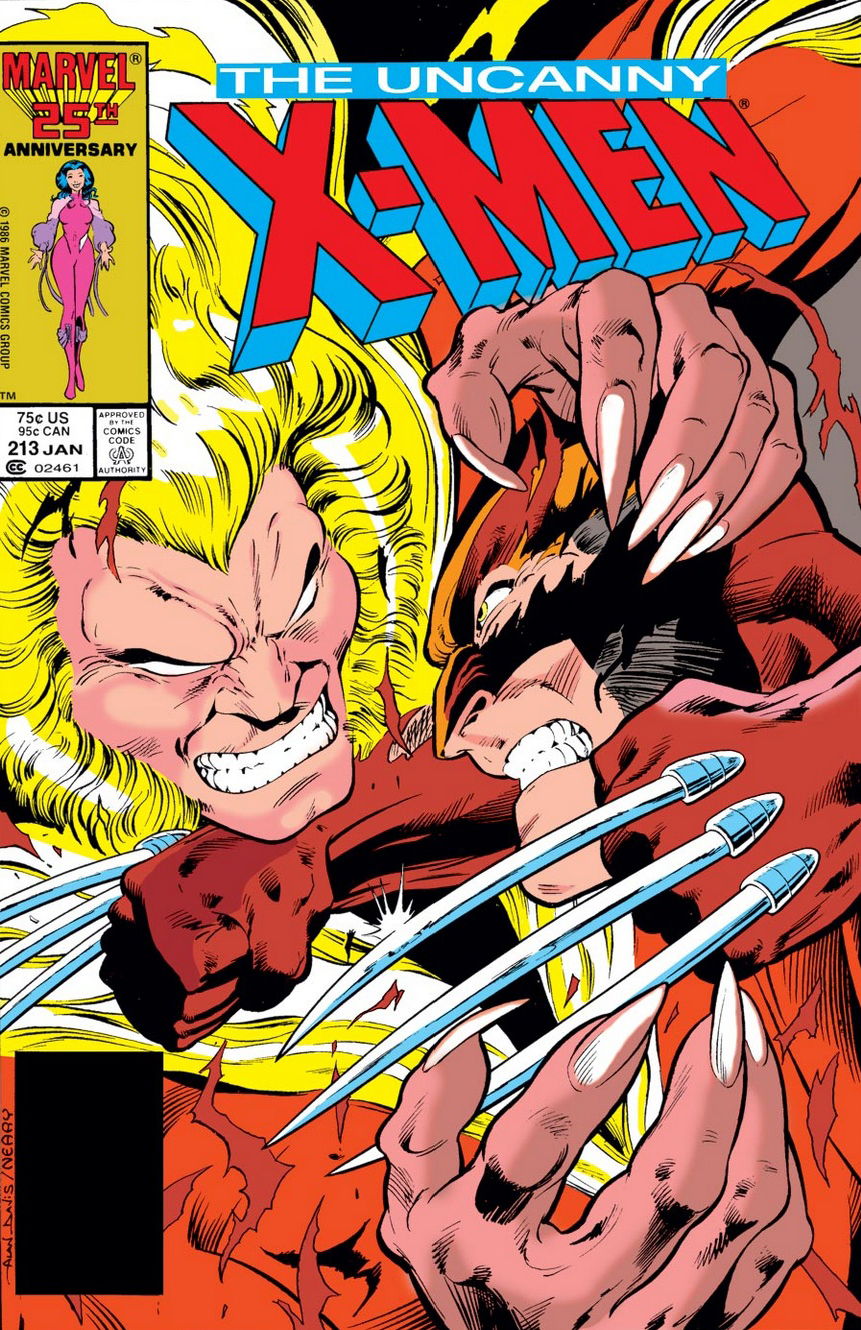
- The cover of this issue by Alan Davis is likely an homage to Davis’ cover for Uncanny X-Men #213.
- I still don’t love Coucerio’s art here (it looks too much like Al Milgrom’s crappy art in the original Kitty Pryde & Wolverine miniseries, which of course makes it perfectly appropriate for this follow-up miniseries) but I do think it largely works, and appreciate how much different it looks compared to the current Marvel House style, while still not coming across as a complete throwback. I hope we see some more work from them in the X-office soon.
- The idea Claremont seems to be going for here is that Ziggy and Kitty’s personalities are starting to meld as a result of their body-swap, which at least smooths the edges a bit off the speed with which “made a bunch of Sentinels” Ziggy embraced Kitty as a sister-like friend.
- Less effective is the reveal of the Snow Samurai, which Claremont seems to be introducing as a kind of “house spirit” of Clan Yashida, but it’s not terribly clear.
- It does seem to be done in the effort of establishing a new status quo in the Wolverine/Mariko relationship — or rather, providing narrative context for how their relationship is depicted after this story chronologically by Claremont, which is to say, not much at all (broader concerns don’t allow Claremont much time to touch on it in X-Men, while he quickly leaves Wolverine’s solo series, such that when Larry Hama kills Mariko off in Wolverine #55, it reads more like an acknowledgement of their stalled relationship than a true tragedy). Basically, not unlike the earlier notion that Wolverine and Mariko can’t be together until Mariko cleans up Clan Yashida’s act, the idea here is that while both still love each other, both also have commitments to larger missions that come first.
- Similarly, the conclusion to Kitty’s arc in this story, which synchs her up with where she’s at when she and Wolverine return to the X-Men in Uncanny X-Men #192, also sees her leaving behind the costume she adopted in this story (which is more or less what she will later wear during “Fall of X”), saying it represents her being able to stand on her own, but now, she needs to go back to being a teammate, but will come back for it someday (which she does, in “Fall of X”, when she more or less operates as a solo operative).

- Whether or not that’s Claremont taking a shot at her “Fall of X” characterization or being a team player and helping further justify it, you decide (I initially read it as the latter, for what it’s worth).
This issue is ultimately more denouement than climax, but it mostly works. As Wolverine-centric retro Chris Claremont miniseries go, in the end, this is one of the better ones. It’s not without its flaws (and its tics) and I recognize I’m showing my age here, but I’d still mostly rather read Claremont doing familiar Wolverine riffs than the sort of ephemeral, consequence free stories unfolding in the “main” Wolverine title.
X-Men (vol. 7) #21 by Jed MacKay & Netho Diaz

With Cyclops still in local jail, Magik leads a team to put an end to the Upstarts.
- The title of this issue is “Upstarts II”, making it a direct sequel to issue #4 (“Upstarts”).
- The riot Quentin started to get a girl to notice him is a reference to the “Riot at Xavier’s” story from Grant Morrison’s New X-Men.
- Neither Fitzroy nor Sugar Man seem to know that it’s 3K who is making humans into mutants, despite the fact that Agent Lundqvist knew last issue, which suggested 3K had announced it as part of their Hellfire Vigil cut-in.
- As before, this iteration of the Upstarts is Fitzroy, along with Ocelot, Orbit and Orifice, part of O-Force from X-Statix #1.
- Fitzroy describes using his powers to teleport blasts from Orifice around the battle as a “mutant circuit”, though he’s using it mostly mockingly.
- Jen’s quasi-breakdown that serves as the emotional arc of this issue culminates with her adopting a new reptilian form and seeming to agree with Fitzroy’s assertion that she enjoys using her power to dominate others.

- Juggernaut kills Ocelot — an avowed serial killer — in cold blood. It’s debatable whether this is meant to represent a dark departure for Juggernaut (in part because he more or less gets goaded into doing it) or just (somewhat more dark) business as usual.
- The last few pages feature Sugar Man arriving at the Spire Vile, the headquarters of the Arakkoan Locus Vile. Their leader, Tarn the Uncaring, is the dead boss he’s referencing (Tarn died in X-Men Red (vol. 2) #3).
- Arakko was left in the charge of Apocalypse in the Heir of Apocalypse miniseries, and was attacked by an Inhuman in Power Man: Timeless, but as largely been off the grid since “Fall of X”. That said, MacKay seems to be leaning into the place, between this and the return of Bei a couple issues ago.
The third issue in a row that represents a much better way to kill time before a big storyline takes over, with MacKay doing mostly self-contained stories that nevertheless move one or more ongoing plot or character arcs along; we got the return of Doug, another Cyclops/Lundqvist showdown, and now the seeming wrap-up of the Upstarts subplot. All while, presumably, moving Jen closer to where she needs to be for “Age of Revelation.”