
King And Courtenay: Reviewing Joseph Losey’s ‘King And Country’
by Rachel Bellwoar
There are the monuments commemorating war, and there’s being in the wet, muddy trenches. Joseph Losey‘s King and Country begins with close-ups of the former. It could be the opening to a documentary until an explosion jumpstarts the opening credits, setting the cold, damp scene. Instead of building to the introduction of soldiers, however, another explosion goes off and still photographs are shown instead. One of those photos is of a dead horse. The other is of a human skeleton. When the skeleton morphs into a still alive Tom Courtenay the movie finally begins, but for how much longer? Courtenay’s Hamp is facing trial for desertion and, if found guilty, the punishment is death.

Losey could’ve cut that footage and just started King and Country with Courtney playing the harmonica. That would’ve been the more commercial approach, but by starting with archival images Losey reminds viewers that World War I was real. He also draws a contrast between the statues, which don’t really capture the ugliness of war, and the lived experiences of the soldiers who fought in it, as portrayed by very human actors. All five senses are called upon as Losey paints a picture of war that is miserable and makes it a no-brainer why Hamp would want to leave, yet during the trial, “shellshock” will be dismissed and treated like a dirty word, irrelevant instead of central to the case at hand.
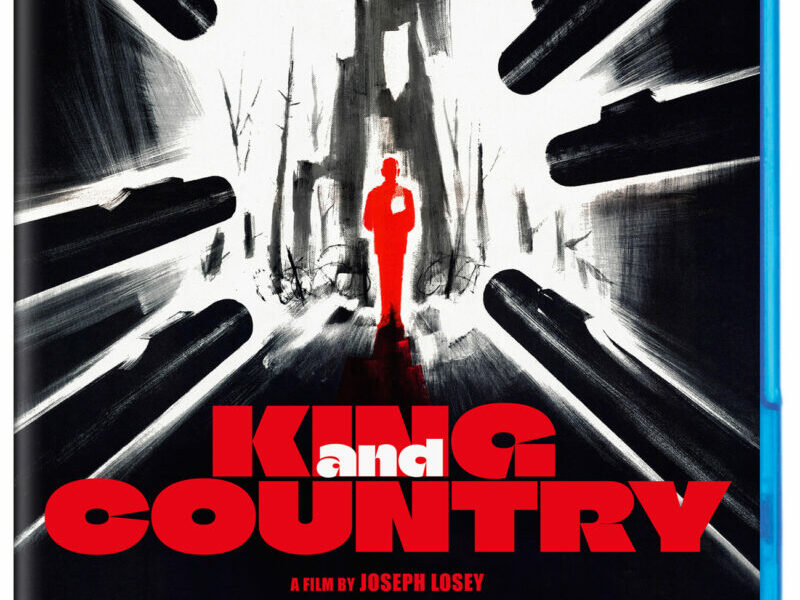
Given the care that was taken to choose these opening images, the font used for the title card is surprising. The lettering looks more fit for a circus than a war picture, cartoonish and unserious, but that’s the tight rope King and Country walks. It’s a film that points out the ridiculousness of war, which isn’t actually funny but is so dark that sometimes the only option is to laugh.
The way Dirk Bogarde’s Captain Hargreaves is introduced makes it seem like he’s going to be a poor representative for Hamp in court. Given how quickly he starts to take the job seriously, it’s easy to forget how he came in, yet that’s probably intentional, too. Nobody thinks they’re going to become hard, and it doesn’t take long for Hargreaves to be reminded of Hamp’s humanity, but the fact that he needed reminding says everything about what trauma and peer pressure can do to a person.
King and Country is a heartbreaking, depressing, cynical film that hits hard because it’s meant to and because its message clearly hasn’t sunk in and needs repeating. Bogarde and Courtenay give blistering performances. If it seemed weird to specifically bring up the dead horse photo earlier, the reason I did is that this film reminds me a lot of Sydney Pollack‘s They Shoot Horses Don’t They, with all the content warnings that come with that comparison.
King and Country was released on Blu-ray before by VCI but the new commentary on Kino Lorber’s Blu-ray by film critic Simon Abrams is fantastic, going over Bogarde’s collaborations with Losey and his particular involvement and interest in this film (including rewriting his lines) as well as the differences between John Wilson‘s play and Evan Jones’ screenplay (like the addition of a soldier Greek chorus). Abrams names all of his sources, too, a transparency that shows how well-researched his commentaries are as a rule and leaves listeners with a tremendous further reading list to boot. There’s also a clip from an interview Bogarde did in 1964 and a 2023 interview with Courtenay that was on BFI’S region 2 release.
King and Country is available on Blu-ray now from Kino Lorber.

