
Retrospective: Thirty Years Of Paul Thomas Anderson (Pt 1)
by Paul Ceruti

Thirty years ago, Paul Thomas Anderson’s debut feature, Hard Eight (originally titled Sydney), premiered at the 1996 Sundance festival. In the decades since, the initials PTA have become enshrined in film culture, denoting one of the most beloved and widely discussed writer-directors working today. His tenth feature film, 2025’s One Battle After Another, has been a hit with cinephiles and general audiences alike, grossing over $200 million and dominating year-end lists. It’s now up for thirteen Oscars and favored to win Best Picture and Best Director.
Whether or not Anderson gets his flowers this year, he persists as one of the essential filmmakers of our time. The following will trace Anderson’s filmography from the beginning, tracking his influences, his frequent collaborators, and his progression as an artist.

Hard Eight (1996)
Conceived as a vehicle for veteran character actor Philip Baker Hall and supported in its early stages by the Sundance Institute, Hard Eight is an expansion of Anderson’s independent short film Cigarettes & Coffee. Hall returns as Sydney, gentleman gambler and surrogate father to John, played by John C.Reilly. Sydney finds John down and out with $6,000 in funeral expenses for his departed mother. In an act of unusual charity, he takes John in and teaches him all there is to know about casino hustling.
Hall’s performance is tender, understated, and enigmatic — a 180-turn from his portrayal of raving ex-president Nixon in Robert Altman’s Secret Honor, his only previous lead role — and his casting is an inspired choice. By elevating one of cinema’s greatest “that guy” actors to leading man, Anderson displays an early knack for pushing actors beyond their usual range. Fans have speculated that Hall’s character is one-and-the-same with Sidney, the mob associate he played in Martin Brest’s Midnight Run, but Anderson hasn’t confirmed it one way or the other.
Hall shares a memorable scene with a young Philip Seymour Hoffman, playing a cocky craps player at the same table as Sydney. Hoffman and Hall are electric together, making the game of craps look as thrilling as ever even to those who don’t understand it. The PSH-PTA partnership would go on to produce some of the finest work of Hoffman’s career, as we’ll later cover.
Hard Eight also introduces us to a major PTA theme, probably the dominant theme of his career: dads! By all appearances, Anderson had a loving relationship with his own father, TV and radio personality Ernie Anderson. The senior Anderson’s voiceover credits include The Love Boat and America’s Funniest Home Videos, but he’s best known today for his horror film presenter persona, Ghoulardi. The character was campy and playful, and his influence on later programs such as Elvira: Mistress of the Dark and Mystery Science Theater: 3000 can be plainly seen. Anderson also tested the waters of acceptable 1960s television by slipping beatnik slang and drug references into his Ghoulardi show, planting the seed perhaps for PTA’s own irreverent style.
Although Hard Eight was a minor hit at Sundance ‘96 and the Cannes festival later that year, New Line Cinema took notice and advanced Anderson funding for his next picture while the final cut of his debut film was still in progress.

Boogie Nights (1997)
You’ve probably seen this already, but if not, it’s the one where Mark Wahlberg wears a giant prosthetic dong. Expanded from a short film Anderson made at seventeen based on adult film star John Holmes, Boogie Nights tells the rise and fall of Dirk Diggler (Wahlberg) over the 1970s and ‘80s. Burt Reynolds, in prime 1990s reclamation casting — think John Travolta in Pulp Fiction or Bill Murray in Rushmore — co-stars as silver-haired porn auteur Jack Horner, a patriarch of sorts with pretensions toward serious filmmaking. His dream, shared by certain real-life New Hollywood figures just across the Valley, is to make a porn film so compelling that the audience sticks around even after they’ve, ahem, finished. Dirk is more interested in stardom qua stardom, and as the porno chic era draws to an end, Dirk’s and Jack’s egos clash.
In other words, it’s another father-son drama from PTA. Scaling up from Hard Eight, Anderson broadens the family dynamic across an all-time ensemble cast consisting of Jack’s on-camera regulars, the workaday schlubs behind the scenes, and the leery, middle-aged moneymen on the periphery. There’s not enough space here to cover every performance, but special mention must go to the PTA regulars making their debut: Julianne Moore, William H. Macy, Luis Guzmán, Ricky Jay, and especially Alfred Molina as drug dealer/mixtape enthusiast Rahad.
Boogie Nights follows the Goodfellas formula of mixing high times with harrowing acts of violence and degradation — and a constant stream of nostalgic tunes dampening the tonal whiplash. Cue “Fooled Around and Fell in Love” as Macy’s character is publicly cuckolded, or “99 Red Balloons” as a man is shot in the chest. There’s no voiceover narration like in Goodfellas, but that doesn’t stop the movie from playing like its own feature-length trailer. Anderson, a prolific music video director, seems to start with a song and build out the scene from there, the best example being the medley of “Sister Christian,” “Jessie’s Girl,” and “99 Red Balloons” over the climactic drug heist. Style-wise, Boogie Nights features the most active camera work of PTA’s career — the source of many an accusation that he’s just copying Martin Scorsese — serving ably here as the visual analog of an endless rail of cocaine.
Boogie Nights landed with audiences in 1997 as both a provocation and an undeniable work by a major upcoming talent. Critics’ awards and Oscar nominations followed, and even today, it’s not uncommon to hear it named Anderson’s best film.

Magnolia (1999)
Following the success of Boogie Nights, New Line Cinema told Anderson, “Here’s $30 million, final cut is yours. Go make your masterpiece.” Intertwining eight characters over a fateful, rainy day in Los Angeles, Magnolia is PTA’s sweeping, go-for-broke epic about trauma, forgiveness, and the mystical forces of coincidence. Clocking in at three hours, it’s Anderson’s longest film to date and arguably his most ambitious.
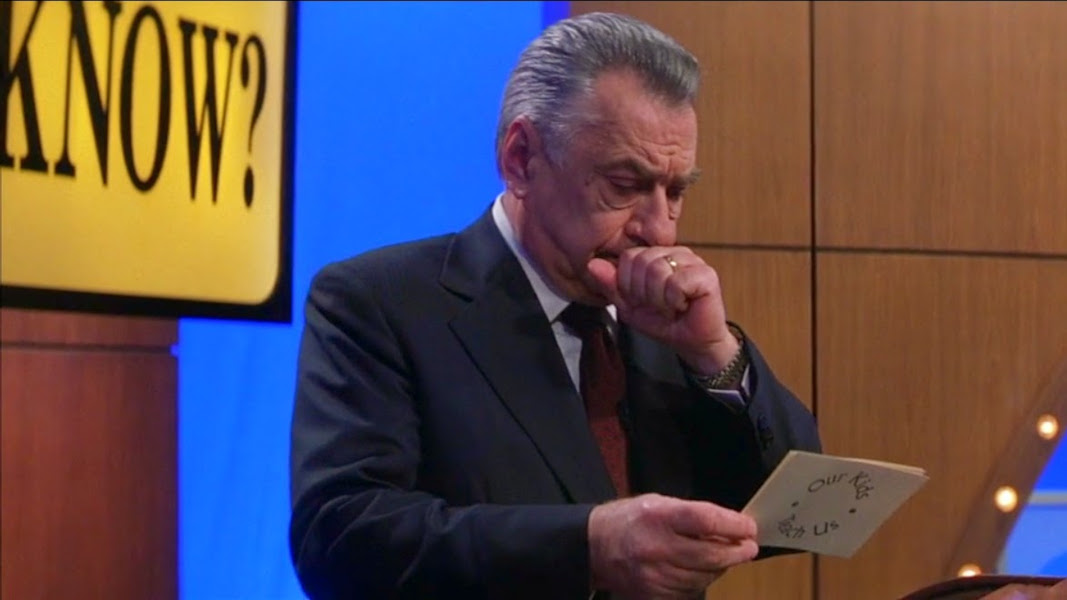
At the core of things are two dying fathers, which for those keeping count is four dads over three pictures. Jason Robards, in his final film role, plays a TV producer on his death bed seeking reconciliation with his estranged son (Tom Cruise). Philip Baker Hall plays Dad #2, a game show host whose recent cancer diagnosis prompts a confrontation with his troubled daughter Claudia (Melora Walters). Events unfold kaleidoscopically, drawing in half a dozen other characters one or two degrees separated from each other.
The film’s real connective tissue, however, is the soundtrack. Featuring songs by Aimee Mann and a driving Jon Brion score, the music is crucial to all the cross-cutting between storylines. Acts I and II unfold as an unbroken dramatic crescendo — a structure Anderson likens to The Beatles’ “A Day in the Life” — culminating in all the characters singing along to Mann’s “Wise Up.” It’s a bold stroke in a picture already brimming with boldnesses, but it ends up being the perfect fulcrum as the movie shifts gears to its quasi-biblical finale.
Magnolia is Anderson at his most earnest, a sharp departure from the hip, ironic style he deployed in Boogie Nights. At one point, he declared Magnolia “for better or worse, the best movie I’ll ever make.” To date, it’s without question his most personal. Conceived in the wake of his father’s death from cancer, there’s a palpable sense of the director’s own grief as Robards delivers his final (devastating) monologue about betrayal and regret. What does it all mean? The film teases a number of mystic meanings — who is The Worm, what is the significance of the number 82? — but the more direct message is the one restated throughout: “We may be through with the past, but the past ain’t through with us” … “And it’s not going to stop until you wise up.”
Part two of this series will dive further into Punch Drunk Love, There Will Be Blood, and The Master. Part three will conclude with Inherent Vice, Phantom Thread, Licorice Pizza, and One Battle After Another.

