
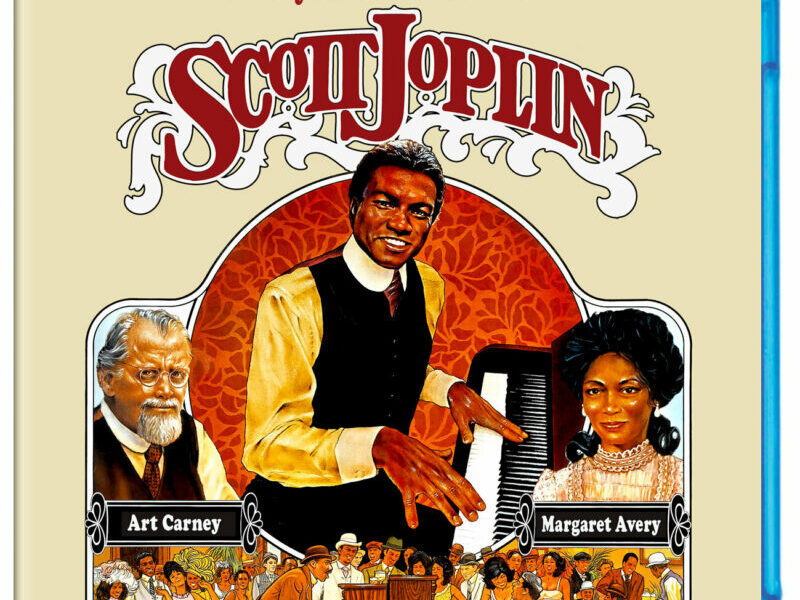
Starring Billy Dee Williams: ‘Scott Joplin’ Biopic Reviewed
by Rachel Bellwoar
Even if you don’t know the song by name, there’s a good chance you’ve heard Scott Joplin‘s “The Entertainer” before. From The Sting to ice cream trucks, it’s a song I’ll always associate with summer vacation because it used to play outside the arcade I visited as a kid.

As for the composer who wrote “The Entertainer,” Joplin was far from a one-hit wonder. Known as the King of Ragtime, Jeremy Kagan‘s TV movie Scott Joplin attempts to shed some light on his life. Using still photos to speed through his early years, the film begins with Joplin (Billy Dee Williams) making the decision to enter a piano playing contest in the hopes that a publisher will be there.
Joplin meets John Stark (Art Carney) alright. Not knowing who he is, Joplin accuses him of leaving a key flat on a piano he was supposed to tune. Luckily Joplin has a friend in the competition by the name of Louis Chauvin (Clifton Davis), and seeing as Stark has no reason to hold a grudge against Louis, he’s able to hear Joplin’s music with an open mind and realize what a genius he was from the start.
This whole sequence is the best part of the movie. Some of the other choices by Kagan and screenwriter Christopher Knopf are less successful. Take the relationship between Stark and Joplin. The film definitely doesn’t glamorize it. From the first time Joplin tries to assert his worth and make a stand for more pay, Stark doesn’t budge and it’s left up to Joplin to take the deal or not. This pattern continues and it raises a question — however much the film keeps asserting the importance of their relationship — does it really warrant the prominence it gets in this movie? At one point Stark starts doing the voiceover narration as though it’s what every biopic about a groundbreaking Black artist needs.
Then there’s the way the female characters are treated. Early in the film, Joplin has an encounter with a sex worker. The actress (I believe it’s Denise Gordy, although her credit on IMDB is just “The Girl”) doesn’t have any lines, but she does get a wind machine and it becomes this question of why are they building up this scene so much? Now, though, I’m starting to realize: are they trying to say this woman is the woman who gave Scott Joplin syphilis, because his health battles become a large focus of the film as well. Nevertheless, this staging (if that was the intention behind the staging) is so wrong and insulting.
Not that it’s much better for Margaret Avery, who plays Joplin’s “legitimate” love interest, Belle. Her role is completely underwritten and the film shows no interest in building her character or considering how Joplin’s medical secrets are affecting her. I also wish the film did a better job of providing context because, without knowing how much was known about syphilis and how it was spread at the time, it’s hard to know how to view Joplin’s actions. All the film does is keep insisting he became celibate after his diagnosis, but that emphasis feels added because this film would be airing on TV (and maybe it’s also true but, again, more context is needed).
Another montage of sheet music reveals the titles of other Joplin songs. But I wish, instead of a montage, that they had been the focus of this movie: Joplin and the creation of his music. Kino Lorber’s Blu-ray comes with a commentary by Kagan moderated by film historian Daniel Kremer. If I’m being honest, I tend to prefer historian commentaries and the outsider’s perspective with the involvement of or quoting of the artists directly involved whenever possible — a great example of this is Kremer’s commentary on Hurry Sundown for Imprint, which includes audio from an interview Kremer did with actor Robert Hooks. I also realize what a gift it is to be able to talk to the people who actually worked on these movies and preserve their stories. That has to come first, but I wish this Blu-ray could’ve included both: an extensive interview with Kagan (or this commentary) and a separate historian commentary.
Scott Joplin is available on Blu-ray starting March 10th from Kino Lorber.


