
Gugs, Nightgaunt, And Yithians With WizKids’ ‘Icons Of The Realms: Maddening Monsters Of Ravenloft’
by Anton Kromoff
Welcome to the table,
Before we dig too deep, I want to direct you to this piece I wrote about the amazing WizKids Cthulhu miniature. While you can enjoy the rad coverage of the Elder Thing, I’m directing you there at this current juncture because I feel it’s important for you to understand my thoughts on the works of H.P. Lovecraft before we move forward.
Please come back when you are done so we can talk about the rad eldritch horrors found in WizKids’ Icons of the Realms: Maddening Monsters of Ravenloft.

Another amazing set from the talented team at WizKids, The Maddening Monsters of Ravenloft contains some of the most iconic entities the Lovecraft Mythos has to offer.

First up, we have the Yithian on a 50mm base. The Yithians first appeared in Lovecraft’s story The Shadow Out of Time in 1936.
Yithians are also known in some circles as The Great Race of Yith. They are, more often than not, depicted as cone-shaped creatures who bend and move like a sentient tentacle. They have two thick appendages capped with crushing claws, and a third that branches out into strange ribbed tube-like protrusions. A fourth ends in a bulbous head festooned with eyes and writhing short tentacles.
While horrifying to look upon, it is believed that this form was not the Yithians’ original shape.

According to the mythos, the Yithians projected their minds into other species, turning them into hosts for their ancient intellect. The purpose behind this was to study the culture, lore, and histories of sentient species so they could chronicle the various entities of reality in their massive library city that contains tomes from the past, present, and future.
It is believed their current forms were once bodies of a sentient ancient Earth plant-like species that the Yithians swapped with to escape the destruction of their home world. I’m really curious to see what their abilities are going to be in the upcoming Dungeons & Dragons Ravenloft: The Horrors Within.

Next up is the Nightgaunt miniature on its 50mm base. Nightgaunt are some of my favorite species found in the Cthulhu Mythos. They’re creatures I have used at my gaming table many times over the years. These entities are vaguely humanoid in shape, though their limbs are elongated and end in hands and feet tipped with sharp claws.
Their faces are blank of expression in most of the mythos. This new version has what appears to be a maw that opens in fleshy mandibles and crimson eyes. This is a departure from what I know of the species, but is not unpleasant by any stretch. They do still have their strange leathery wings and long barbed tail.

Nightgaunt are typically a servitor species. They follow Nodens, the god of the great abyss found in the Dreamlands. Due to this aspect of their nature, they can be found as scouts, shock troopers, courier, and have even served as mounts for some sentient species who call the Dreamlands home.

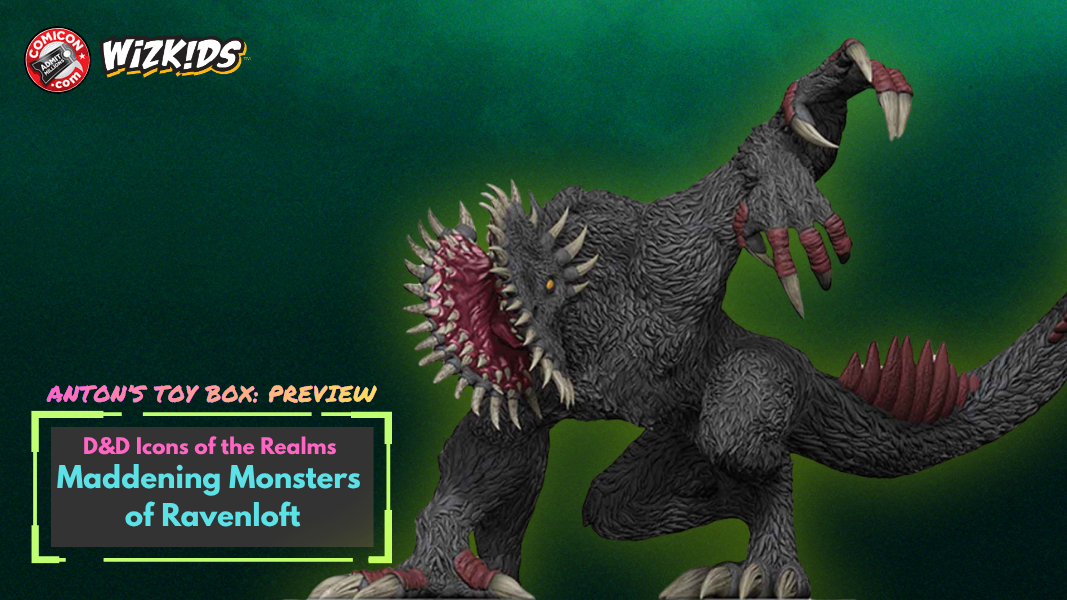
Last, but certainly not least, of this set is the Gug miniature on a 75mm base. The Gug is one of my favorite species in Lovecraft’s Mythos. They are both nontraditional in their form, and they have the ability to add a threat to the players, without the players having a ton of information on their origins to go on (unless they are deeply rooted in the mythos).
Gugs are typically very large, covered in black shaggy fur. They have a tail, two arms, and two legs. The arms of the Gugs split at the elbow into two forearms that end in terrible claws, giving them a very unique appearance among creatures at the table.

The Gugs’ most iconic feature is its head that splits open into a vertical maw, much like a Venus flytrap. The maw is lined with rows and rows of sharp teeth and set on each side by bio-luminescent eyes.
Gugs have shown up in Paizo’s Pathfinder TTRPG, as well as Sandy Petersen‘s Cthulhu Mythos TTRPG. In both versions, their society varies. In my home-brew games, these giant creatures inhabit cities that have been abandoned, making use of ancient tools, weapons, and systems to serve their own ends.
They are typically intelligent, but they do not have much time or patience for dealing with other species. It will be really interesting to see how they come to the table through the lens of this upcoming Ravenloft book.
Until next time, right now this collection is not set to release until October of 2026. As soon as I get more news on stats, mechanics, or lore, I will update you as I myself will be thrilled to find out more.


