
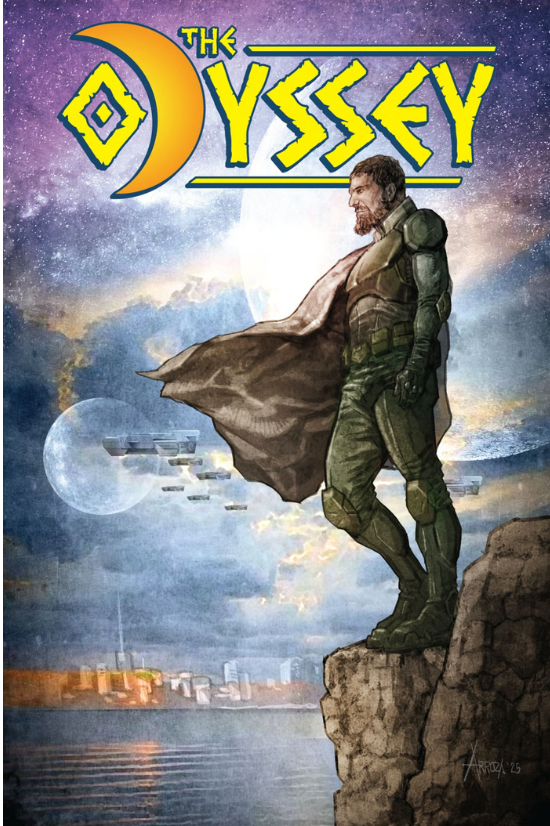
It’s The Journey That Matters — Talking About ‘The Odyssey’ #1 With Writer Bruno Catarino
by Tom Smithyman
Setting Homer’s classic The Odyssey in space? It may seem out there — literally — but Bruno Catarino and team are taking on the epic challenge. In a new crowdfunding campaign, the writer is trying to gin up support for the project, which is illustrated by Erwin J. Arroza. I caught up with Catarino to discuss the story, the campaign, and why he wanted to retell the famous story in this particular way.

Tom Smithyman: What do you remember about your first exposure to the original version of The Odyssey?
Smithyman: There have been a lot of versions of this story. Instead of asking why we need another one — because obviously you think we do — why did you decide to set this one in space?
Catarino: So, two things you need to know — probably revealing too much too early, but what the hell:
- I started writing for film originally, not comics, and most of my stories have existed in my head in the form of a movie before a comic.
- My original idea of X in space was not The Odyssey, but The Lusiadas, which is the Portuguese equivalent. It’s a 16th century epic written by Luis de Camoes that we are forced to study during 9th grade in Portugal. It’s as boring as you expect when you’re studying it, but it’s also a fascinating story that stayed with me.

Catarino: I think the main surprises came from how I’m portraying Odysseus, maybe not in issue #1, but going forward.
He’s often portrayed as a wise man, a hero, fair and honest, but the truth is he was still kind of barbaric to today’s standards. I plan to portray Odysseus as an anti-hero. He’s not a good man. He’s just a man who is willing to do almost anything to get back home to his family, and that “almost anything” is where the drama will come from. He will occasionally be hindered by his principles, but he will also compromise his own values a lot and struggle with who he is throughout the story. I often mention The Sopranos and Breaking Bad as influences of my version of The Odyssey, and that’s why. Plot or genre-wise, they couldn’t be further away from The Odyssey. But character-wise, that’s the kind of complex character development I want Odysseus to go through, and that I want to explore with this story.
It helped that I purposefully avoided to re-read the original or watch anything before I wrote issue #1. I wanted to go with just my memory of it and have free reign to discover the kind of story I wanted to tell, and I don’t think I’d be able to do it had I been too close to the source material. It’s likely to piss off some purists, but hey, they can go and tell their own version if they want something closer to the original. But in my view, if you’re going to copy the original, why bother?
Setting it in space was actually much easier than I expected. It’s not always easy to find the right sci-fi trope to change a character or a location to, but it’s also incredibly rewarding when you find out the solution.
The wall of Troy I always knew was going to be an energy shield. Athena I also kind of knew I was going to make her AI – after all, she’s the goddess of knowledge, right? Of course, back then I was thinking about the classic AI in sci-fi, not the slop we actually have nowadays, so that’s been a hard one to navigate. The Trojan Horse is very different from the original, and it took me a while to figure out what it would be, but what it is makes narrative sense in this sci-fi world much more than if it was just a “gift,” IMO.
For future issues, I have a clear idea of what some things will be: Scylla, Circe, Aeolus’ winds, the Underworld, and a few others, but then I have no clue what to do with the Lotus Eaters yet, for example. But I can’t wait to find the solution…

Smithyman: Is your goal to introduce this story to a new generation of readers or to tell a familiar tale with the source material — or something in between?
Catarino: All of the above, sort of. Maybe something in between is a more accurate response.
I definitely want to introduce the story to a new generation, but then again, Christopher Nolan’s movie is coming out this year too, and I’m sure it will do a much better job doing that simply because of how much more people will see it than they’ll read this book. I can’t compete with that. Hell, I don’t even want to. I think there’s room for both, especially since they will be so different. But if I go into this expecting to have the pop-culture impact that his movie will have, I’d be very disappointed.
Maybe a more honest answer is: I’m telling this story for myself, not for new generations and not for people who like the original and might want a new story. I had a story in my head that needed to be exorcised through writing and that’s what I’m doing. I think that’s the right way to go about it: tell the story you want to tell honestly, and chances are the audience for the story will be there and will find you.

Smithyman: What kinds of rewards are you offering backers?

Smithyman: You’ve worked with artist Erwin J. Arroza in the past. Why did you want to work with him on this story?
Catarino: Erwin’s work has an epic quality that this story needed. His artwork has a unique look that I don’t know any other artist who does that, and that’s what I wanted for this story. Something unique, that is not easily replicable. Problem is Erwin doesn’t often take on interior work — he does mostly covers. So I was pretty sure he was going to say no. When he said yes, it was a dream come true.
Working with him on this has been a delight, and every time he sent me a completed page, I’d be in awe at the quality of the work he put out. I hope he’s OK with me revealing this, but he himself has told me he considers this to be one of the finest works he’s done and how proud he was of it — which is saying a lot for an artist of his caliber who has been around for a while.

Smithyman: In the original, (spoiler alert!) Odysseus makes it home to Ithica, but his entire crew is killed over the course of the journey. If you had to meet your own end, Odyssey-style, how would you write it?
Catarino: I’m not going to spoil the ending, but I will say that in my version Odysseus will also make it to Ithaca. The circumstances will be very different though.
Odysseus will be back, but what kind of man will return home is the real question. Will he be the same? Or a completely different person? What of his son Telemachus and his wife Penelope? What kind of people will they be after such long absence?
Like you said: this is a story people already know, so there’s no interest in whether he gets back to Ithaca or not. It’s the journey that matters. It’s the transformations and the growth that the main character suffers (or not) that matter. And I think that’s where an adaptation of such a famous story can truly shine.
Hopefully the people who back it and read it will think that too…
Smithyman: Thanks for the time. And good luck with the campaign!
