
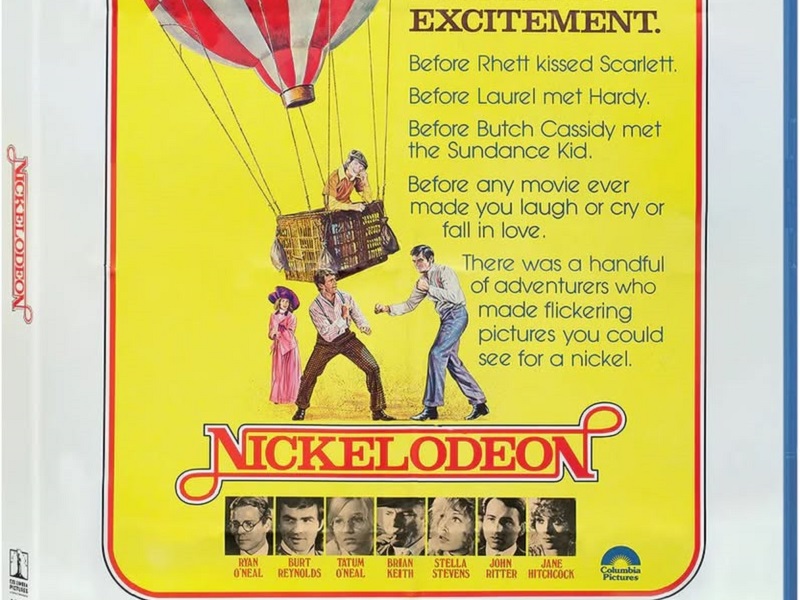
When Movies Were Black & White: Peter Bogdanovich’s ‘Nickelodeon’ Reviewed
by Rachel Bellwoar
Sometimes hearing the real stories is better than trying to recreate them. Such is the case with Peter Bogdanovich‘s Nickelodeon (1976). No, this is not a film about the children’s television network. “Nickelodeon” is a reference to the movie theaters that used to show films for a nickel. Set during the early silent days of cinema, Leo (Ryan O’Neal) is a lawyer who goes from the courtroom to being a writer to being a director in quick succession, without ever voicing any aspirations to work in the movies. Upon learning these jobs would pay, he just said “yes.”

Burt Reynolds’ Buck follows a similar trajectory of lying about knowing how to ride a horse and then ultimately ending up working as an actor. A running joke is that characters keep making fun of his clothing (particularly a loud plaid suit). Joke’s on them because that suit rocks. Rounding out the love triangle is Jane Hitchcock as clumsy actress Kathleen. Apparently, Leo is meant to be irresistible because Stella Stevens is forced to make eyes at him as well in a part that’s unworthy of her talents.
Considering a lot of the cast are Bogdanovich repeaters (like O’Neal and daughter Tatum O’Neal, who won an Oscar for Paper Moon), it doesn’t sound like most of the actors were Bogdanovich’s first choices. In the commentary for the director’s cut, Bogdanovich names John Ritter, Jeff Bridges, and Cybil Shepherd (The Last Picture Show) as his dream cast (not getting Shepherd seems to have been a particular blow). Ritter, while not the lead as Bogdanovich wanted, appears in a secondary part but is better utilized in Bogdanovich’s They All Laughed.
Sony’s 2-disc Blu-ray includes the theatrical and director’s cut on separate discs. While the runtime difference is minimal (around four minutes) the main contention seems to be that Bogdanovich always wanted to film Nickelodeon in black & white, so that’s what he’s done: changed the film to monochrome. The theory seems to be that in color the film gets taken less seriously. Now, I’ll admit I didn’t go back and watch the theatrical cut from beginning to end after watching the director’s cut, but I have to strongly disagree with Bogdanovich. In black & white, the slapstick comedy moments feel like blatant callbacks to the silent comedies of the 1910s — remakes that pale next to the originals — whereas color creates a separation from the source material that’s more appropriate for a behind-the-scenes story.
Without doubting Bogdanovich’s word that a lot of these events actually happened (and in the commentary, he shares specific anecdotes told to him by Leo’s namesake (Affair to Remember director Leo McCarey), as well as Allan Dwan (Heidi) and Raoul Walsh (They Drive By Night), I don’t find his fictionalized account more entertaining than hearing the actual stories.
The highlight of this set is a 45-minute audio interview with W. D. Richter, who co-wrote the screenplay with Bogdanovich. Moderated by Bogdanovich biographer Peter Tronguette (who also provides a visual essay on the film), I don’t understand the decision to have the interview play over the film like a commentary, but Richter essentially had to let another script he’d written on the silent film era be killed (there was financial compensation but still) and agree to start over on a new script on the same subject matter with Bogdanovich.
Bogdanovich can make good period movies based on true stories: I’d say The Cat’s Meow, about William Hearst (Gilmore Girls’ Edward Herrmann) and Marion Davies (Kirsten Dunst), whether factually accurate or not, is a much better time (and in color — again, I don’t think Bogdanovich is right about black & white improving Nickelodeon).
Fast-moving but without the depth to make viewers invest in the characters, Nickelodeon is available on Blu-ray from Sony Pictures and to purchase from Movie Zyng.
