
‘Mabuse Lives!’: Reviewing Eureka’s Pulpy German Box Set Of Eccentric Crime Films
by Rachel Bellwoar
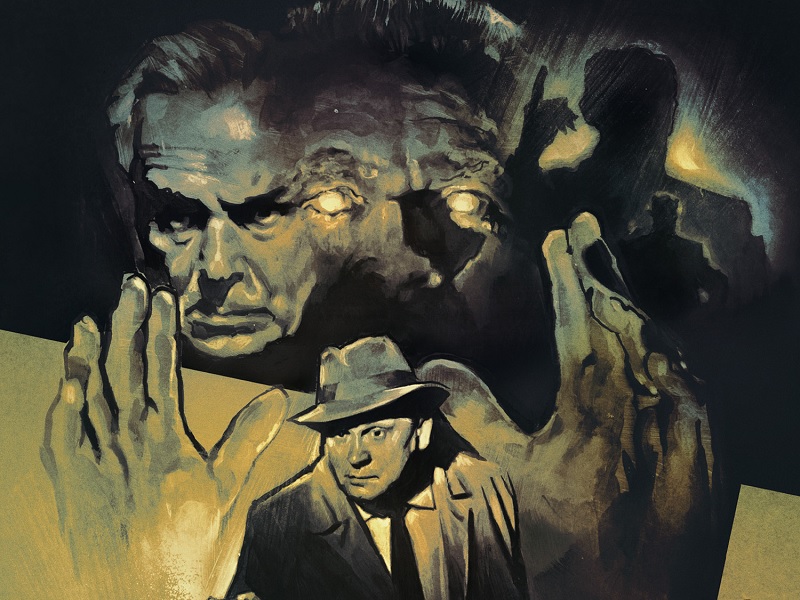
Like Dracula, Mabuse is an evil genius who can’t seem to stay dead in Eureka’s six-film Mabuse Lives! box set.

The 1000 Eyes of Dr. Mabuse (1960) is the first film in this box set but technically the third Mabuse film directed by Fritz Lang. It’s also his first since 1933’s The Testament of Dr. Mabuse (Dr. Mabuse the Gambler was a silent) and the one that kickstarted this cycle of Mabuse films produced by CCC in the sixties. In fact, 1000 Eyes would end up being Lang’s last film as director, and opens with the murder of a reporter. Somehow this is connected to other murders and disappearances where the victims were found to have spent time at the Luxor Hotel. Then there’s another character, Henry (Peter Van Eyek), who’s introduced trying to prevent a woman (Dawn Addams) from committing suicide at the Luxor, a blind psychic named Cornelius (Wolfgang Priess) and some atrocious rear projection driving.
The result, as film scholar David Kalat talks about in his commentary (his first of six and the only one not newly recorded for this release) is a film that can be very challenging to keep up with (there’s a reason Kalat keeps bringing up what it’s like after a first time viewing versus a rewatch and rewatching doesn’t even bring clarity – if anything, as Kalat points out, Mabuse’s behavior becomes even more confusing).
For instance, where the movie begins, with that reporter getting murdered? Completely forgotten about. It’s frustrating and makes you feel at fault when it might just be that this film can’t be fully comprehended. It has enough good things going for it, though, that that’s upsetting (whereas with a bad film you can just turn it off or let the inconsistencies go). It might’ve helped if the film had chosen a main character, like Henry or Inspector Kras (Gert Fröbe). It’s been a while since I’ve seen North by Northwest but that film had a clear point-of-view character who was equally confused about what was going on, making it easier to accept the plot twists. 1000 Eyes doesn’t.
One thing Lang has a lot of fun with is presenting Mabuse as this all-seeing criminal mastermind (if you’re familiar with Michel Foucault‘s panopticon, it’s very that). At one point the image gets fuzzy during a dinner scene and I just figured the film elements were poor but then the fuzziness was revealed to be intentional — we’re suddenly watching the dinner from a TV screen, meaning someone else (Mabuse) is watching. The 1000 Eyes are made literal.
The highs of Harald Reinl‘s The Return of Dr. Mabuse (1961) aren’t as high as the highs of The 1000 Eyes of Dr. Mabuse but the film’s a lot more coherent and easy to follow, as it sticks with Fröbe (playing a different inspector) and his investigation into what starts out as a man being murdered on a train but becomes a mind control drug that seems to be coming out of a prison. Return definitely has the best pyrotechnics and explosions out of the series – one poor woman gets taken out by a flame thrower. We also get the series’ first significant female character — Daliah Lavi‘s reporter — but she’s done dirty at every turn, with the constant suggestions that she should get married and the need for her to be saved by Lex Barker, Fröbe’s #2 and a man of many identities. In his introduction, genre film expert Tim Lucas brings up that Marc Brehm would go from being co-screenwriter on this movie to being a storywriter on Charade and that completely tracks with how many names Cary Grant‘s character goes through in Charade (Lex is the same way in Return).
Speaking of Lucas’ introductions, as with his introductions for Eureka’s Terror in the Fog box set, I feel they work better as postscripts. Then you can put a face to the names he mentions, unless you’re well-versed in German cinema.
The Mabuse films are far from the first to suggest physical difference can be a sign of immorality but the obsession with including shady characters who have club feet or leg braces and facial burns gets old.
Reinl’s The Invisible Dr. Mabuse (1962) gets off to a great start, with trap doors and the titular invisible person showing up at the theater with binoculars to catch a show. Barker’s Joe Como was better off as second fiddle, though, and didn’t need the promotion to leading man, while Rudolf Fernau is fantastic as a different character from the priest he played in Return (that’s the trick to these Mabuse films – use the same actors but don’t have them play the same person twice). Of course Mabuse wants to get his hands on the machine that can make people invisible.
Without having seen the original Testament of Dr. Mabuse, Werner Klingler‘s ‘62 version is a remake of Lang’s and a reboot for the franchise that introduces Walter Rilla as Professor Pohland. Poland is the doctor who’s treating a committed Dr. Mabuse and the best scene of the movie is when he attempts to hypnotize Mabuse. Mostly, though, the film is a kind of bland heist film where all of the evidence keeps pointing to Mabuse being responsible, but how could he be from inside an asylum?
Paul May‘s Scotland Yard Hunts Dr. Mabuse (1963) may be my favorite of the franchise, even if it unnecessarily moves the action from Germany to London. Picking up where The Testament of Dr. Mabuse left off, Mabuse is less of a shadowy figure in this one (as Lucas goes over). Major Tern (Van Eyck) has been called in to help locate an escaped prisoner who was an army surgeon. Now innocent people like a mailman are feeling the compulsion to kill and it’s up to Tern and his adorable mother (Agnes Windeck) to find out why. Klaus Kinski also appears.
This series finally loses the plot completely with Hugo Fregonese and Victor De Santis’ The Death Ray of Dr. Mabuse (1964), which returns Mabuse to being a talking silhouette but doesn’t really feel like a Mabuse film at all but a poor James Bond ripoff. This is one instance where listening to Lucas’ intro after the film didn’t payoff, because he recommends the longer, Italian version that’s included over the German dub, but how much better would require a rewatch to find out and once was enough for now.
Mabuse Lives! is available from Eureka and comes with an essay book. It also includes a great featurette written by David Cairns and Fiona Watson called “Kriminology” that’s more of an overview of the Mabuse films specifically than a general discussion of krimis. Mabuse films are hard to describe — pulpy, sometimes sci-fi crime films, they’re not all created equal but they do have eccentric plots that question what’s possible and eccentricity is always to be embraced.

