
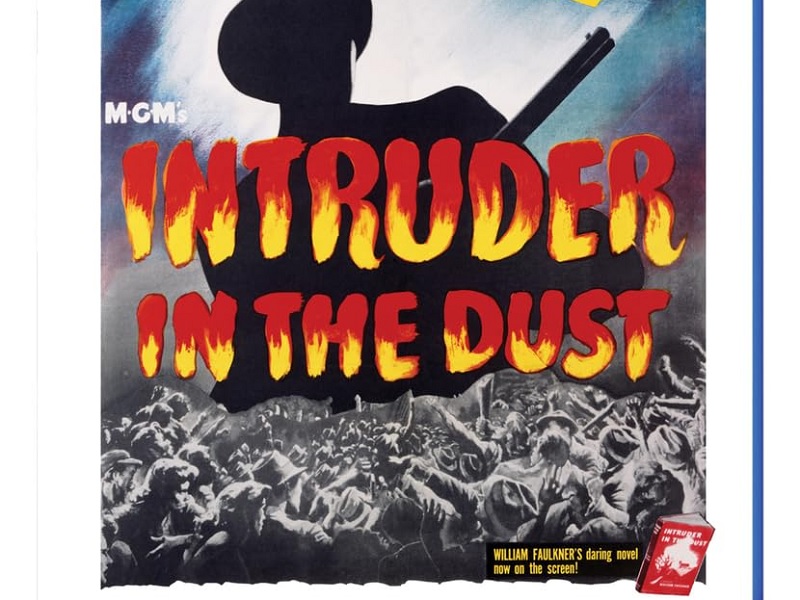
Racism In 1949, Or Why ‘Intruder In The Dust’ Is Essential Viewing In 2025
by Rachel Bellwoar
Warner Archive provided me with a free copy of the Blu-Ray I reviewed in this article. The opinions I share are my own.
One thing you can guarantee with Clarence Brown‘s Intruder in the Dust: there will come a point when you want to stop watching – probably more than one — and, especially the first time, it might be necessary to take breaks. I turned Intruder in the Dust off the first time I started it. I think it took quite a while for me to go back and finish it, too. Intruder in the Dust is an ugly movie. It’s a difficult movie. It’s also an incredible movie – the kind that I feel the general world who doesn’t watch “old movies” or makes blanket assumptions around them would never realize exists.

Based on a William Faulkner novel (Ben Maddow wrote the screenplay), the closest film to compare Intruder in Dust to is To Kill A Mockingbird, but John Stevens (David Brian) is no Atticus Finch and while Chick (The Yearling’s Claude Jarman Jr.) is probably only a few years older than Scout, those years make all the difference. There’s definitely a part of Chick that realizes his small town is racist and that something in his neighbors’ behavior is wrong but he’s complicit in it too.
White superiority is what Chick’s been taught. Breaking those beliefs proves very difficult and the casual way in which people make racist remarks in this movie, so confident that they’re speaking to likeminded people and so assured in the truthfulness of their fake hierarchy, is exasperating to watch. It’s a way more honest depiction of racism than most movies show (let alone a film that came out in 1949 before the Civil Rights Movement picked up in the ’50s), but its continued relevance makes it particularly upsetting, even though it’s ultimately a film that exposes these prejudices for being hateful and hypocritical.
Like To Kill A Mockingbird, Intruder in the Dust revolves around a Black man who’s been wrongly accused of a crime. Also like Tom (Brock Peters) in To Kill A Mockingbird, there’s a lot of question around whether Lucas (Juano Hernandez) will live to see trial because his alleged victim was white and apparently that means the same laws don’t apply. In fact, it’s so taken for granted that a lynching party is going to take Lucas out of jail that people are behaving like it’s an event. The same morbid curiosity that has reared its ugly head in every era, from the Salem Witch Trials to the guillotine during the French Revolution, is on full display in this movie but it’s no less skin crawling to see how many people show up and drive in from out of town to see a public execution. There’s no “innocent until proven guilty” for Lucas Beauchamp and yet the dignity of Hernandez’s performance and the power in his refusal not to react the way he’s expected to by his lawyer – who just assumes his guilt and repeatedly talks down to him like a child who needs to be chastised – is nothing short of revolutionary. The same treatment is shown towards the film’s “white trash” characters – it’s clear how the town feels about the Gowrie family, who are only tolerated because of their skin color, but Porter Hall brings a nobility to his role as the father of the man (David Clarke) Lucas is supposed to have murdered when he could’ve just been played as ignorant.
There are no white saviors in this movie – maybe Elizabeth Patterson‘s Miss. Habersham, but while there are white people who ultimately do the right thing, that doesn’t make them saints. If racism can be taught, however, this film also shows that racism can be un-taught and that makes Intruder in the Dust essential viewing.
Important films aren’t always visually bold but Clarence Brown’s direction and Robert Surtees’ cinematography are absolutely beautiful as well. At one point Chick goes to visit Lucas in jail and the way their conversation is filmed through a grate in the door plays out like a church confession. The central location of John’s law office is no accident either, as its many windows overlooking the town act as a constant reminder of the mob that’s building outside.
As a content warning, the N-word is used a number of times in this movie, even in the trailer. To censor it from this movie would be a lie but its history is acknowledged with the decision to use asterisks for the subtitles.
Warner Archive’s Blu-ray includes a tourism short from 1949 called “Playlands of Michigan.” Everything you need to know about this short can be summed up by this line from the voiceover narration: “What was once the happy hunting and fishing domain of the Indian is now a haven of relaxation and diversion for the white man.”
There’s also a Tex Avery cartoon called “The Counterfeit Cat” that feels like a prototype for later Tweety Bird and Sylvester cartoons. Because it’s Tex Avery, however, some of the gags come across as more savage (an adjective that’s also used in the theatrical trailer to describe Intruder in the Dust).
Intruder in the Dust is available on Blu-ray now from Warner Archive and to purchase from Movie Zyng.

