Film Review: ‘Supergirl’ Is A Proper Introduction To The Woman Of Tomorrow
by Erik Amaya

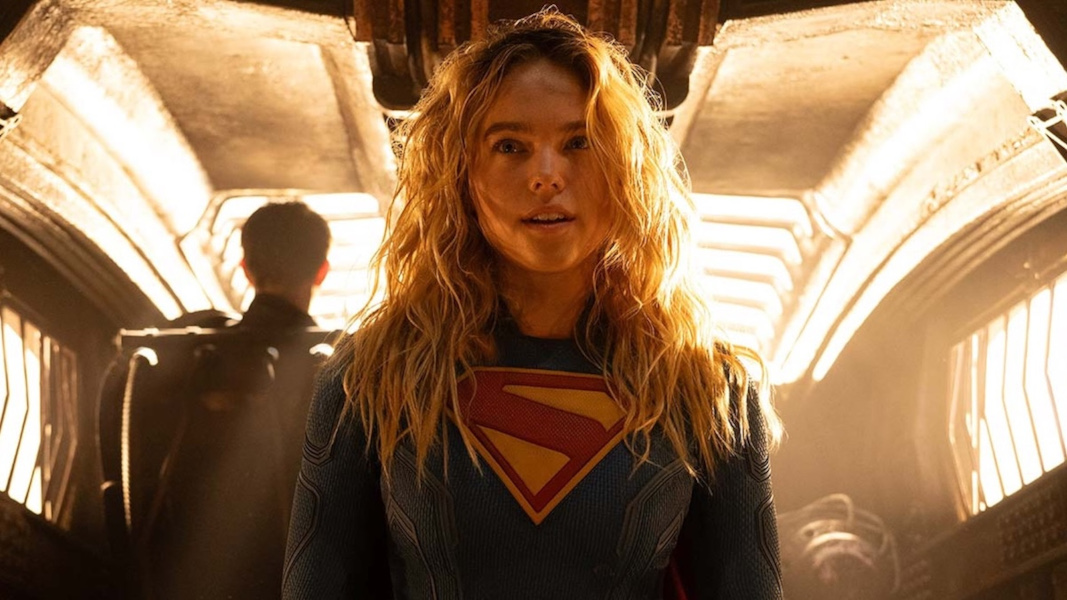
The 2026 Supergirl film has one main objective: get you to love Milly Alcock as Kara Zor-El. In this, it succeeds.
It also has a secondary objective — get audiences to embrace Jason Momoa as Lobo. Here, it also succeeds.
But this also means adapting Tom King and Bilquis Evely‘s Supergirl: Woman of Tomorrow into a film is a tertiary objective at best and while the film mostly succeeds in making the story its own, it may not be the adaptation some had hoped for. Nevertheless, the result is a solid enough summer superhero movie that highlights two key — and wonderfully cast — DC Comics characters. It may not be as good as last year’s Superman, but it is still a fun solo adventure for that character’s famous cousin.
Picking up sometime after the events of Superman, Kara is out in space celebrating another birthday. She constantly leaves Earth because the powers conferred upon her by the yellow sun make it impossible for her to get drunk. As it happens, inebriation is a form a self-medication; this Kara has a huge psychological issue to confront. But, for the most part, she’d rather get soused, listen to music, and play with her dog — the ever-delightful Krypto. Of course, her pub crawl is interrupted when she helps Ruthye Marye Knoll (Eve Ridley) regain her sword from an alien dive bar patron. She soon learns Ruthye is on a quest of revenge: she wants to kill Krem of the Yellow Hills (Matthias Schoenaerts), who butchered her family in cold blood. Kara is, naturally enough, uninterested in aiding the young woman until Krem makes the situation personal.
And while I want to avoid spoilers … if you have any issue with seeing an animal injured in a film, avert your eyes 15 minutes or so into the movie. It does a good job signalling when a certain something is about to occur.
In any event, Kara and Ruthye head out on a multi-planet tour to find Krem, recover a key plot device from him and, maybe, demand satisfaction. Interestingly enough, the conversation between Kara and Ruthye about vengeance — and the ultimate resolution to that thread — is one of the film’s highlights. Despite her own problems, Kara doesn’t want Ruthye to become a jaded twentysomething carrying around the guilt a killing a man. Ruthye, meanwhile, is too consumed with grief to hear what Kara is saying. And Kara herself is also still carrying a lot of grief because of what happened to Krypton and, subsequently, her Kryptonian hometown of Argo City.
This is another highlight: Kara’s origin is revealed in flashbacks that are well-paced and full of emotion. It reframes the character a little bit, but it makes the hopelessness she carries around more effective. Unlike her cousin, Clark (David Corenswet), Kara is a true survivor of Krypton’s explosion and lived enough of a life in its society to mourn its loss. She also has strong memories of her birth parents. Both things truly set her apart from Clark and that delineation makes her emotional journey in the film far more interesting. And, as it happens, it makes her appreciably different from the naivete of Helen Slater‘s Supergirl in the 1984 film, the adorkable Melissa Benoist of the 2010s television show, and even the shellshocked trauma of ‘s one-time appearance as Kara in the otherwise awful Flash feature film. All the while, Alcock’s Kara is recognizably Supergirl.
Also, in those flashbacks, she emotes her heart out while speaking Kryptonian. No easy feet as it only exists as a language in the context of this film and Superman. Additionally, David Krumholtz deserves notice for a similar magic trick as her father, Zor-El. His part is entirely in Krypontian and he does a remarkable job making the character feel real despite the complete fantasy realm he inhabits.
Which is another of the film merits: speaking parts typically feel lived-in. From Kara to a diminutive c0-pilot of a space bus, the characters have lives and interiority. Okay, maybe not Lobo, but he’s not there to feel things or complete some fraggin’ emotional journey.
By now, you’ve noticed this review is very much about the characters and their feelings. That clearly seems to be where director Craig Gillespie‘s heart is at, too, as the action is … odd. While well-choreographed, the camera positions and editing make the fights a little more obscure than they should be. Unlike Superman director James Gunn, who typically moved his camera back to encompass the battles, Gillespie goes in close for a more claustrophobic feel. The result is less impactful as Kara’s powers are as grand as Clark’s. Additionally, the editing makes the violence spring from nowhere and leaves it without key moments of connective tissue. That disconnect within the action sequences and how they relate back to the talky bits is the film’s chief problem. Then again, as someone who seems to be aging out of superhero fights, I didn’t mind the emphasis on character and emotion.
And then there’s Lobo. All things being equal, I wouldn’t be surprised if Gillespie returns to direct the character’s eventual solo outing. From Kara’s introduction to the character to his final look back at her, every scene with him is confident, but seemingly pulled from another film. Momoa breathes this character and his natural charm really fits into the character’s established appeal. He may be the only semi-heroic character to lack any depth, but it’s Lobo. Giving him an arc would be missing the point. He is a cartoon in a universe of thoughtful superheroes and that tension is correct even if some in the audience might be wondering why he’s invading a Supergirl story.
It isn’t the only wonder in the writing as Ana Nogueira‘s script appears to take its cues from the tone Gunn established in Superman. But in his other job as the co-CEO of DC Studios, he wants the directors under him to bring their own sensibilities to their films. In this case, Gillespie also wanted to make the cosmic portion of the new DCU feel grimy and gross. He succeeds here as the full depth of Krem’s depravity becomes clear. Some might find it inappropriate for a broad-appeal superhero movie and that opinion is justified. It is an ill-fit with the jokes Nogueira wrote for a Gunn-style rhythm and even, to an extent, the emotional journeys of Kara and Ruthye. It also serves those journeys as Kara already inhabits a part of the universe that is darker and more like our own than Superman’s bubble of hope and optimism. Nonetheless, it is totally reasonable to recoil at the tonal whiplash when Krem does, um, certain things.
He also lacks for an amount of interiority — an ongoing problem with comic book movie antagonists — but Schoenaerts‘s performance becomes more layered and strange as the film wears on. By the end, you want a specific conclusion to his story. Sure, he could’ve been more developed, the villain writing is a constant problem in superhero movies these days, but he serves his role in the story fairly well.
As it happens, a lot of Supergirl‘s flaws can be summed up in the feeling that there is more there to be explored in terms of the characters, Ruthye’s quest, and Kara’s discontent on Earth. The finished film, though, is a good introduction to Supergirl as she stands in this new cinematic universe. Alcock is extremely watchable as this lovable and damaged mess. The DCU cosmos, while often a somehow grimier version of space Gunn defined for the Marvel Cinematic Universe in the Guardians of the Galaxy films, is well-realized and a setting ripe for Lobo to take a starring role. Although it is not the easy crowdpleaser Superman was, it also tries to establish what different tones in this shared narrative reality can look like. Its success, though, is subjective and, I suspect, based entirely on how much runway a viewer is willing to give the DCU.
Like this version of Kara, the film is messy and flawed, but I’m happy both she and it exist.
Supergirl is in theaters now.