
Fire & Blood Files: Wait … There’s Nine Kingdoms Now?
by Austin Gorton
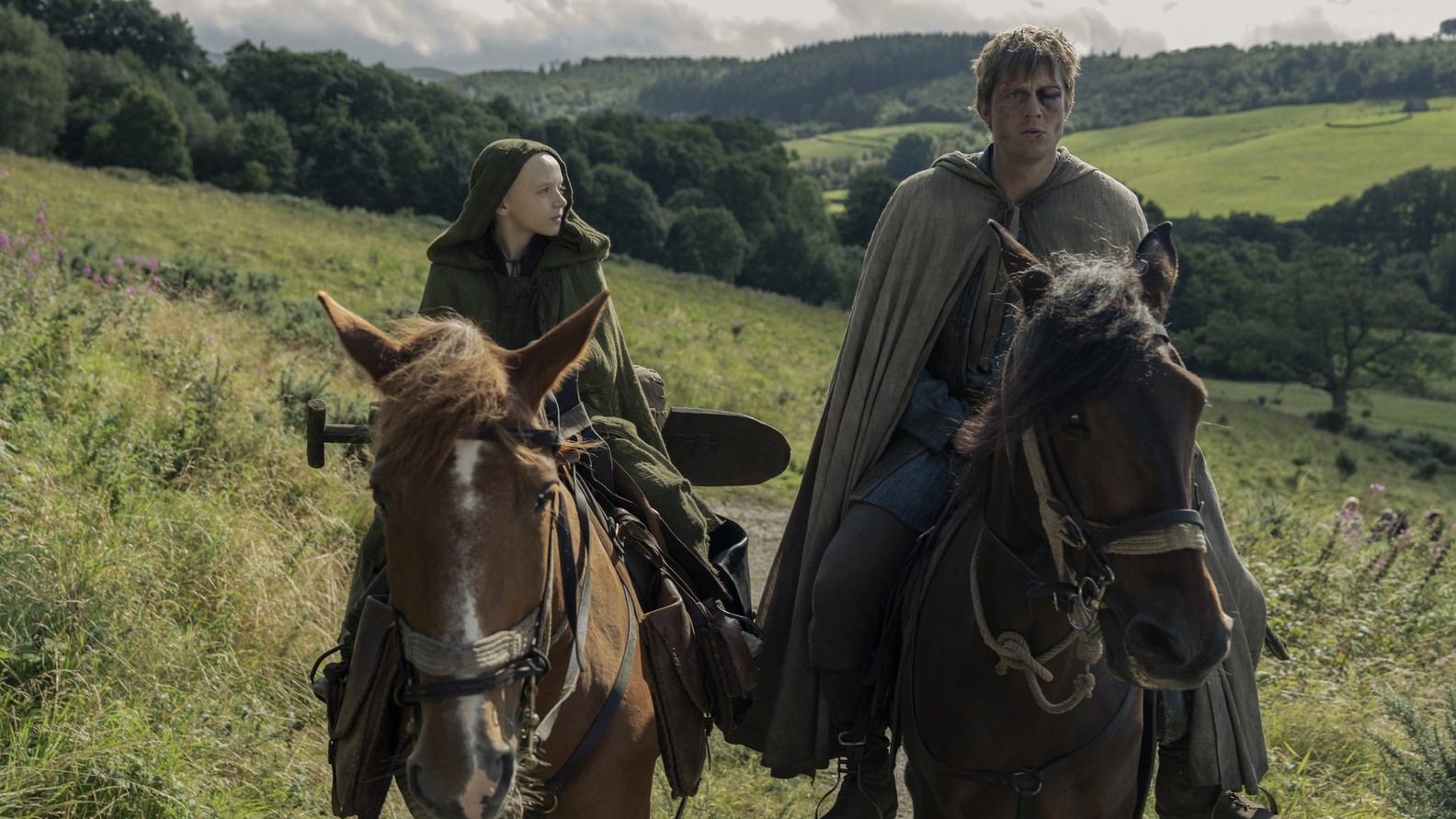
The final episode of A Knight of the Seven Kingdoms‘ first season, “The Morrow,” concludes with the newly re-squired Egg (Dexter Sol Ansell) correcting Dunk (Peter Claffey). He informs his liege that there’s actually nine kingdoms in Westeros, not seven, as suggested by the traditional title of Westeros’ main political body wielded by in-universe monarchs and the title of the show. While Egg is technically correct (aka the best kind of correct) that, at that time, the realm ruled by the Targaryens from their seat of power in King’s Landing comprises nine, not seven, smaller subdivisions, the truth of the matter — and the reason why the title is “Seven Kingdoms” and not “Nine Kingdoms” — is a bit more complicated.

The term “Seven Kingdoms” dates back to the time before the conquest of Aegon Targaryen, slightly more than two hundred years before the events of A Knight of the Seven Kingdoms. Before Aegon’s conquest, the political order in Westeros had coalesced around seven regional kingdoms, each ruled by their own king:
- The King in the North was Torrhen Stark
- Ronnel Arryn was King of Mountain and Vale
- Harren Hoare (who would build the castle Harrenhal) was King of the Isles and the Rivers
- The King of the Rock was Loren Lannister
- The King of the Reach was Mern Gardener
- Argilac Durrandon was the Storm King
- The Princess of Dorne was Meria Martell
Generally speaking, each of those kingdoms maps to one of the established regions in Dunk and Egg’s time: the North, the Vale (aka “the mountains”), the Riverlands, the Westerlands, the Reach, the Stormlands and Dorne. Yet even after Aegon’s conquest of those seven kingdoms, the term “Seven Kingdoms” was a bit of a misnomer. For one, it ignores all the lands north of the Wall (the construction of which predates Aegon), as well as the “kingdom” of Dragonstone, which was the home of the Targaryens from which Aegon launched his conquest.
For another, it also elides the fact that Aegon never actually conquered Dorne, which successfully resisted a formal union with the “Seven” Kingdoms until Daeron II, Egg’s grandfather, peacefully brought them into the realm (to say nothing of the fact that Dorne was ruled by a princess, so not technically a “kingdom” in the first place). To make up for that fact, Aegon created a seventh kingdom by splitting one of the six kingdoms he did conquer into two parts. Harren Hoare’s resistance to the conquest was fierce, and ultimately led to the near obliteration of the family.
After the conquest and the creation of the “Great Houses” (titles given to the defeated kings to help them keep their pride, engender loyalty to Aegon, and help in the administration of the now vast one-of-seven-kingdom), Aegon elevated the Tullys, a vassal of Harren Hoare who openly supported Aegon, to Lords Paramount of the Trident with Riverrun as their seat, effectively supplanting the Hoares as the regional overlords.

At the same time, he broke off “the islands” part of the previous kingdom of “the Isles and Rivers” and named House Greyjoy the Lords of the Iron Islands, giving his new kingdom the titular number of kingdoms even as he continued to try and conquer Dorne (this post-conquest reordering is also when the Tyrells became Lords Paramount of the Mander and Wardens of the South instead of the previous regional rulers, the Gardeners, who were obliterated by dragonfire on the Field of Fire.
This left one of their stewards, Harlan Tyrell, to surrender the seat of Highgarden to Aegon, and when the Baratheons became Lords Paramount of the Stormlands, after Orys Baratheon, a close companion, top general, and rumored bastard half-brother of Aegon, married the daughter of the defeated Argilac Durrandon).
Why was it so important for Aegon to maintain at least the nominal notion that he ruled seven kingdoms, and not six or even just one? Numerology, sort of. As was mentioned briefly this season during the whole “Trial of Seven” setup in episode 4, the number seven is significant to the Andals, as they are polytheists who worship seven specific deities (their religion is called the Faith of the Seven). And while the Andals aren’t the only culture/religion in Westeros, they are the most dominant one, especially in the south, where Aegon launched his invasion.
After his conquest, Aegon adopted the Faith of the Seven in a further effort to smooth over any simmering resentment within the Andal population towards Westeros’ new Targaryen overlords, and in a move a bit like how the Christian celebration of Christmas became intermixed with various pagan traditions and celebrations surrounding the Winter Solstice, by naming the realm he ruled “the Seven Kingdoms” and being able to reasonably identify the regions counting as those seven, Aegon subtly reinforced a connection between his rule and the divine in the eyes of a majority of his subjects every time the name was uttered.

Egg is correct that in his day, the technical number of kingdoms ruled by his grandfather had grown from Aegon’s initial seven to nine (if we’re sticking with the idea that a kingdom in this counting equals a distinctive administrative region/territory). In addition to the “original” seven kingdoms which emerged after the conquest, over time the Crownlands — the areas immediately surrounding King’s Landing, well as Dragonstone and Driftmark (the seat of House Velaryon as seen in House of the Dragon) were added, along with Dorne, bringing the total to nine.
And while the relationship between the crown and the faith strengthened over time (with most post-Aegon Targaryen monarchs paying lip service to if not genuinely following the Faith of the Seven), making the subtle reinforcement of Targaryen right to rule bound up in the name “Seven Kingdoms” less critical, by then the name had stuck – and at any rate, it never hurts to do what you can to stay on the side of the Seven, just in case.
——————————————————————————————————————–
That’s it for this round of the Fire & Blood Files, but they’ll be back in June when the third season of House of the Dragon starts up!